
Which Subjects to Focus on First for CLAT 2028 in Class 11
The short answer
Start with reading. Passages carry most of CLAT, so build a daily reading and argument habit in the first month, then add legal reasoning and logical reasoning. Keep GK as a 20 minute daily habit and Quantitative Techniques in short doses. Your stream changes what you build next, not where you begin.
If you are in Class 11 and wondering which subjects to focus on first for CLAT 2028, you have probably seen five sections, five books and five different opinions. Let me make it simple. I have counselled 4,000 to 5,000 students, and the ones who begin well do not begin with everything. They begin with one habit, add a second, and keep going. This guide gives you a clear order, a split for Science, Commerce and Arts students, and a first 90 days plan. The order is my view from counselling, and I will say so where it is my opinion and not an official rule.
Which Subjects to Focus on First for CLAT 2028 in Class 11: My Answer
My answer is reading first, then legal and logical reasoning, with GK and Quantitative Techniques in small regular doses. Here is why I say it, before we look at the numbers.
First does not mean most important. Legal and logical reasoning are where ranks are decided, and our 15-month roadmap says so clearly. But both of them are passage work, and a student who reads slowly or loses the point of a paragraph finds both sections harder. So you build the reading habit first, and it makes everything after it easier. This guide does not replace the roadmap. It tells you what to do in the first weeks, before the roadmap’s daily legal passage and timed practice take over.
How Many Questions Does Each CLAT Section Have?
CLAT UG has 120 multiple choice questions in 2 hours, with 1 mark for a right answer and 0.25 marks deducted for a wrong one. The section ranges below are from the Consortium’s published format for recent years, and the Consortium has confirmed that CLAT 2027 keeps the current pattern. Please check the official website for the CLAT 2028 notification when it comes.
| Section | Questions (share) | What it asks of you | Your Class 11 order |
|---|---|---|---|
| English Language | 22 to 26 (about 20%) | Reading, inference, meaning in context | Start first |
| Current Affairs including GK | 28 to 32 (about 25%) | Daily news habit | 20 minutes a day from day one |
| Legal Reasoning | 28 to 32 (about 25%) | Applying a given principle to facts | Add from week 3 |
| Logical Reasoning | 22 to 26 (about 20%) | Arguments, inference, and as per reports puzzles | Add from week 5 |
| Quantitative Techniques | 10 to 14 (about 10%) | Elementary maths, up to Class 10 level | Short doses, 3 to 4 days a week |
Add the three biggest passage sections and you get about 70 percent of the paper. That is the simple reason reading comes first.
In What Order Should You Start the Sections?
This is the order I suggest for a normal Class 11 student. It is my recommendation, so change it if your school load or strengths ask for it.
- Reading and English, from day one. One editorial or passage a day, and three lines on its main argument. Our reading comprehension guide shows the method.
- A 20 minute newspaper habit, from day one. This is GK and also reading practice. It matches the roadmap’s advice to keep GK at a reduced but steady level.
- Basic maths, 3 to 4 days a week, from day one. Twenty minutes is enough. The goal is to stay comfortable with numbers, not to finish a book.
- Legal reasoning, from week 3. One passage a day, as the roadmap suggests. Read the principle first and see how it is applied.
- Logical reasoning, from week 5. Start with arguments, assumptions and conclusions. Reports on CLAT 2026 also mentioned puzzles, sequences and blood relations, so add some of these too. See our logical reasoning guide.
Why Is Reading the Best Place to Start?
There are three reasons, and none of them is a trick.
- It feeds three sections at once. English, Legal Reasoning and Current Affairs are all passage based in recent papers, and reading speed and clarity help in each of them.
- It is the slowest skill to build. Our Class 11 guide estimates 6 to 8 months of regular work for English, against 4 to 6 weeks of revision for Quantitative Techniques. The skill that takes longest should start earliest.
- It is cheap. You need a newspaper and a notebook. You do not need a new book, a test series or a long timetable.
Which Subjects Should Science, Commerce and Arts Students Focus on First?
Everybody begins with reading. After that, your stream gives you a different starting point. This is my own reasoning from counselling, not an official rule, and every student is different. A Science student can be a great reader, and an Arts student can be good at maths. Use the table as a starting guess and then check it against your first 90 days.
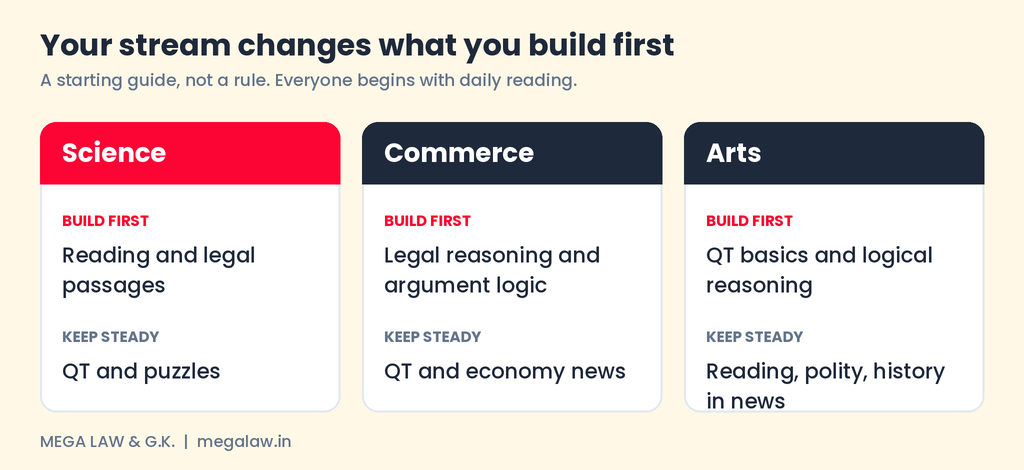
| Stream | Often comfortable with | Build first | Keep steady |
|---|---|---|---|
| Science | Numbers, patterns, puzzles | Reading speed and legal passages, because long formal text is the new skill | QT and puzzles, a little each week so they do not fade |
| Commerce | Numbers, and ideas from Economics and Business | Legal reasoning and argument based logic | QT, and economy items in the news |
| Arts (Humanities) | Reading long text, polity, history | QT basics and logical reasoning, which are often the newer skills | Reading, plus polity and history in the news |
A quick way to find your own gap is to try one short set from each section in week 12, untimed, and see where you struggle most. Our Class 11 guide also explains how subjects like Political Science, History, English and Economics can support your preparation. If you are still choosing a stream, pick it by interest and marks. CLAT should not decide it for you.
What if CLAT 2028 Changes the Pattern?
The Consortium has confirmed that CLAT 2027 keeps the current pattern. For CLAT 2028, the expert committee has put forward proposals, and the Consortium has not confirmed them. As reported, the committee proposed three sections: Logical Reasoning and Legal Aptitude, Language and Comprehension, and Quantitative Techniques, with 10 to 15 questions in each section, and with GK and Current Affairs removed. The proposals also say candidates will not be tested on prior legal knowledge, and the paper stays at 2 hours. Our GK removal post has the full details.
You do not need to guess the outcome to plan your first 90 days. Look at what the proposal asks for:
| Proposed section | Skill behind it | Does your first 90 days build it? |
|---|---|---|
| Language and Comprehension | Reading, argument evaluation | Yes, your reading habit |
| Logical Reasoning and Legal Aptitude | Reasoning, applying principles | Yes, legal passages and logic from week 3 and 5 |
| Quantitative Techniques | Numerical reasoning, moving away from heavy calculation | Yes, your short maths doses |
Whether GK stays or goes, a daily newspaper habit still trains you to read formal text. That is why I keep it small and steady, instead of building the plan around it.
What Does a First 90 Days Plan Look Like?
Here is a week by week shape for your first three months. The first row matches the three daily habits in our roadmap’s first phase, and each later row adds one thing. Keep each day within the 1.5 to 2 hours we suggest in our guide to balancing school and CLAT 2028 preparation, and fall back to your 45 minute minimum day on heavy school days.
| Weeks | What you add | Daily blocks | About how long |
|---|---|---|---|
| 1 and 2 | Reading, newspaper, basic maths | 30 min passage and main argument, 20 min newspaper, 20 min basic maths | About 70 min |
| 3 and 4 | Legal passages | The above, plus one legal reasoning passage a day | About 90 min |
| 5 to 8 | Logical reasoning | The above, plus 20 to 25 min of arguments and puzzles, with maths 3 to 4 days a week | About 1.5 to 2 hours |
| 9 to 12 | Questions on what you have read | Start attempting questions after each passage, and keep a short error log | About 1.5 to 2 hours |
| End of week 12 | A diagnostic | One short untimed set from each section. This is not a mock | One weekend session |
At the end of week 12, look at your error log and decide what to build more. That is also the time to follow the roadmap’s later phases, with timed practice and mocks as it suggests.
What Mistakes Do Students Make When Choosing What to Study First?
| Common mistake | What to do instead |
|---|---|
| Starting with GK only, because it feels easy to study | Keep GK as 20 minutes a day, and build reading beside it. |
| Skipping Quantitative Techniques completely | Give it short doses. It is about 10 percent of the paper and based on Class 10 level maths. |
| Buying five books in week one | Use a newspaper and good passages. Add one source per section when you reach it. |
| Starting full mocks too early | Do a short diagnostic at week 12, and full mocks later. |
| Copying a friend's order from another stream | Use the stream table as a start, then trust your own error log. |
| Waiting for the perfect plan | Start with reading today. You can adjust the plan in week 2. |
What Should You Do This Week?
- Pick a daily reading source. One newspaper editorial or one passage, the same time every day.
- Start the three line habit. After each passage write the main argument, one assumption, and one weak point.
- Set 20 minutes for the newspaper and 20 minutes for basic maths on 3 or 4 days.
- Mark week 3 and week 5 in your calendar for adding legal and logical reasoning.
- Do not buy anything yet. Wait until week 12 and your first diagnostic.
CLASS 11 TO CLAT 2028
NOT SURE WHAT TO START WITH?
The problem: five sections, many opinions, and no clear first step.
The solution: a start plan built around your stream and your school week, with a mentor who checks in. TITAN 2028 is our live online small batch for CLAT 2028, with one-on-one mentor support.
How Does Mentorship Help When You Are Just Starting?
At MEGA LAW & G.K., every batch has mentorship from current NLU students, with one mentor for every 10 students. We also provide one-on-one mentorship to all students, taken by me for strategy and decision guidance. Query? WhatsApp us at +91 7983667303. You can also read our guide to CLAT 2028 mentoring for Class 11 and whether you need a CLAT mentor.
“Do not ask which section is biggest. Ask which habit makes every section easier. In Class 11, that habit is reading.”
Manav Lawania, Founder, MEGA LAW & G.K.
Read next on MEGA LAW
Frequently asked questions
Which subject should I start first for CLAT 2028 in Class 11?
Start with reading. English, Current Affairs and Legal Reasoning together are about 70 percent of the paper and they all come as passages. Build a daily habit of reading and noting the main argument, then add legal and logical reasoning from the third week.
Should I start with GK because it has so many questions?
Not as your first big task. GK and Current Affairs has 28 to 32 questions in the official format, but the expert committee has proposed removing it from CLAT 2028 and nothing is confirmed. A 20 minute daily newspaper habit is the safe middle path.
Is maths compulsory for CLAT?
Quantitative Techniques is part of the paper with 10 to 14 questions, which is about 10 percent. It is based on elementary maths, up to Class 10 level. Arts students should not fear it, but they should not skip it either.
Which stream is best for CLAT, Science, Commerce or Arts?
As far as I know, CLAT does not restrict you by stream, so please check the official notification for eligibility. Choose your stream by interest and marks, not by CLAT. Each stream just gives you a different starting point, as the table above shows.
Can I study all five sections together in Class 11?
You can, in small doses, and many students do. The risk is trying five new things in week one. Start with two, add one every two weeks and you will carry the load for months.
What if CLAT 2028 changes its pattern?
The expert committee has proposed three sections, with GK removed, but these are proposals and the Consortium has said CLAT 2027 will keep the current pattern. Reading, reasoning and number sense appear in every version, so building them first is safe.
When should I take my first mock test?
Our roadmap says no full mocks in the first four months. In your first 90 days take only a short untimed set from each section to see where you stand. Full mocks can come after you have a base.
Should I buy a separate book for each section now?
No. In the first 90 days you need good passages and a newspaper, not a shelf of books. Pick one main source for each section only when you reach it.

About the Founder
Manav Lawania, India's Teens & Twenties Mentor. Founder of MEGA LAW & G.K. and UsefullBooks, Agra, Uttar Pradesh. Former Intelligence Officer, Cabinet Secretariat, Government of India. 15+ years of teaching experience and 4,000 to 5,000 students counselled for CLAT and AILET. Manav scored 13 out of 100 in Class 12 before rebuilding his own path, and that comeback is the lens he brings to every student he now mentors. He writes and teaches under the belief that CLAT preparation is as much about having the right data as it is about having the right mindset.