
Is GK Being Removed from CLAT 2028? What the Expert Committee Report Actually Says
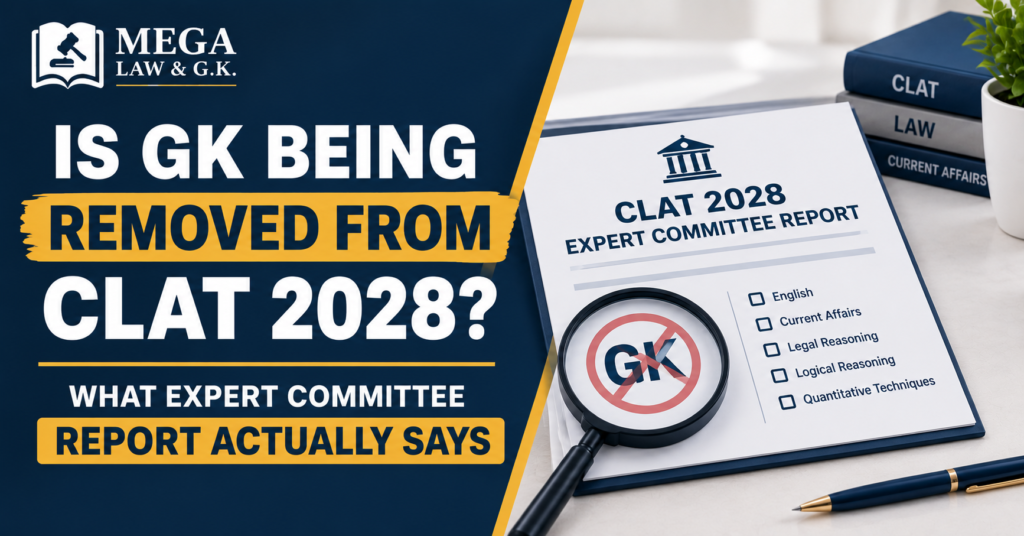
The short answer is: recommended, yes. Confirmed, no. And that distinction matters enormously for how you should be preparing right now.
The CLAT Expert Committee Report, published by the Consortium of National Law Universities on July 22, 2026, recommends removing the General Knowledge and Current Affairs section from the undergraduate examination entirely. It also recommends replacing the current five-section format with a leaner three-section model. These recommendations are real, they are detailed, and they are well-argued.
But the Consortium of NLUs has not confirmed these changes for CLAT 2028. A committee constituted under the Office of the Chief Justice of India will review the recommendations before any implementation. That review has not concluded. Until it does, GK removal for CLAT 2028 is a strong probability, not a settled fact.
I run a GK coaching product. MEGA LAW & G.K.’s GK Booster batch, which I have been teaching for years, is built around current affairs and legal GK. I am aware that I have a commercial interest in telling you GK is safe. I am writing this post anyway — because the honest picture serves you better than the comfortable one.
“Every coaching institute in India is now being asked the same question: is GK going? The ones telling you it is definitely going are wrong. The ones telling you to ignore the report are wrong. The truth is in the middle — and it requires you to read the actual document, not the headlines about it.”
— Manav Lawania, Founder, MEGA LAW & G.K.
Who Wrote the Report and Why It Carries Weight
This was not a routine internal review. The Expert Committee consisted of four internationally based legal academics:
- Dev Saif Gangjee, University of Oxford — Co-Chair
- Tarunabh Khaitan, London School of Economics — Co-Chair
- Shyamkrishna Balganesh, Columbia Law School — Member
- Surabhi Ranganathan, University of Cambridge — Member
Timeline: Committee constituted September 15, 2025 → Public feedback October 15 to November 4, 2025 → Report submitted February 2, 2026 → Report published July 22, 2026.
The composition — all four members from globally ranked institutions specialising in law — signals that the Consortium wanted a rigorous external review. This is why the recommendations deserve serious attention and why the Consortium’s response deserves equally careful reading.
What the Report Actually Recommends — Full Picture
On removing GK — the exact rationale: The committee recommends completely removing the General Knowledge and Current Affairs section from the UG examination, observing that such questions often reward memorisation and coaching rather than aptitude and legal reasoning — testing news-cycle trivia and obscure factual recall instead of real aptitude.
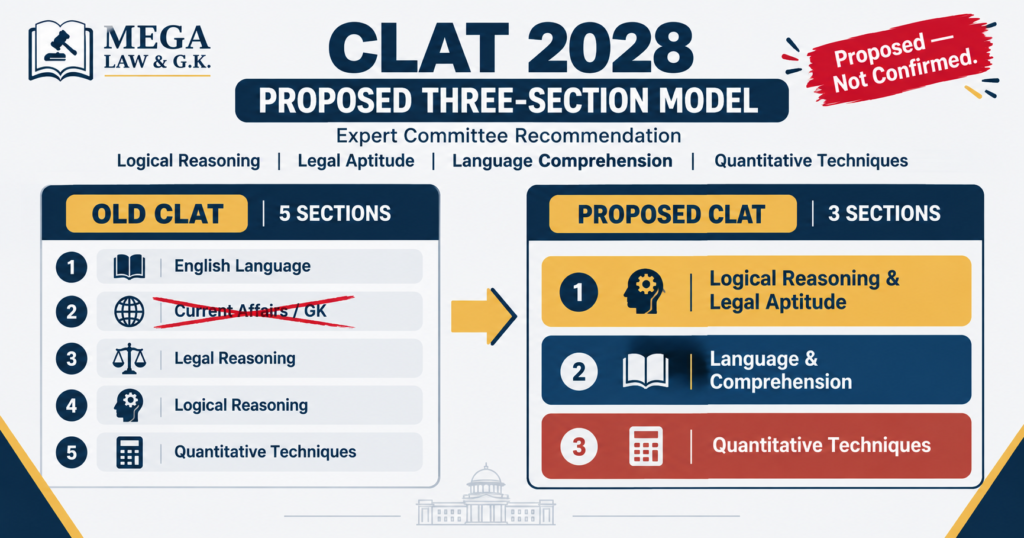
The proposed three-section UG model:
| Proposed Section | What It Replaces | What It Tests |
|---|---|---|
| Logical Reasoning and Legal Aptitude | Current Legal Reasoning + Logical Reasoning (merged) | Application of given rules to facts using purely hypothetical scenarios. No prior legal knowledge needed or rewarded. |
| Language and Comprehension | Current English Language section (evolved) | Reading for tone, inference, implication and argument strength — not grammar drills or vocabulary lists. |
| Quantitative Techniques | Current Quantitative Techniques (retained) | Interpreting data, spotting patterns and reasoning with numbers — not advanced maths. |
On essay writing: Considered but NOT recommended at this stage — concerns about fair, objective and scalable evaluation. The committee recommended revisiting after 3 years.
On NTA as paper setter: Committee recommended removing NTA as CLAT’s paper setter, citing concerns about question quality, drafting accuracy and evaluation transparency.
What the Consortium of NLUs Actually Decided — Word for Word
Exact language from the Consortium press release (July 22, 2026): “There will be no changes to the syllabus and pattern/sections of the UG and PG papers in CLAT 2027.” The Governing Body resolved to retain the existing examination format and consider the committee’s recommendations for implementation from CLAT 2028 after further consultation. The Consortium will “engage with the recommendations of the Report and public feedback in preparation for CLAT 2028.” A committee constituted under the Office of the Chief Justice of India will review the recommendations first.
Three things to note: First, CLAT 2027 is confirmed unchanged. Second, CLAT 2028 is a possibility, not a commitment — “engage with” and “consider” are not “implement.” Third, a separate review committee under the CJI’s office stands between the Expert Committee’s recommendation and any CLAT 2028 change. That review has not reported yet.
Recommended vs Confirmed — The Honest Table
| Question | Answer | Source |
|---|---|---|
| Has GK removal been recommended? | ✅ Yes — clearly and explicitly | Expert Committee Report, July 2026 |
| Is GK removed from CLAT 2027? | ❌ No — confirmed unchanged | Consortium press release, July 2026 |
| Is GK removed from CLAT 2028? | ⚠️ Not confirmed — under review | Consortium press release, July 2026 |
| Is the 3-section model confirmed for CLAT 2028? | ⚠️ Not confirmed — same review process | Consortium press release, July 2026 |
| Is the direction clear? | ✅ Yes — the committee rationale is strong, the Consortium did not push back on it | Combined reading of both documents |
| Is NTA removal confirmed? | ⚠️ Recommended but not yet confirmed | Expert Committee Report, July 2026 |
| Who reviews this before CLAT 2028? | A new committee under the Office of the Chief Justice of India | Consortium press release, July 2026 |
Why the Committee Wants to Remove GK — The Full Argument
The aptitude argument. CLAT was designed to test aptitude for legal education — the ability to reason, read closely, and apply principles to new situations. The committee argues that GK as currently structured does not test any of these things. A student who has read the newspaper obsessively for 12 months has an advantage over a student with stronger reasoning abilities but less current affairs exposure. That is not a test of legal aptitude.
The coaching dependency argument. The report explicitly connects the current GK section to coaching industry advantage. Students who have access to good GK coaching — structured current affairs compilations, weekly sessions, filtered monthly material — have a measurable advantage over equally capable students who are self-studying or in less resourced environments. The committee argues this is an exam design problem, not a student preparation problem.
This second argument is the harder one for coaching institutes to respond to honestly. As someone who runs GK coaching, I think the committee is largely right about this — which is exactly what the committee would expect coaching institutes to resist saying. The GK section in its current form does reward organised coaching more than self-study. That is a genuine equity concern for a national law entrance exam.
What This Means for CLAT 2027 Students
Nothing changes. The Consortium has confirmed this explicitly. CLAT 2027 retains all five sections — English Language, Current Affairs and GK, Legal Reasoning, Logical Reasoning and Quantitative Techniques — at their existing weightages and with the existing passage-based format.
CLAT 2027 students: GK is confirmed. Legal Reasoning is confirmed. All five sections remain. The Expert Committee report changes nothing about your CLAT 2027 preparation. Do not let the noise around CLAT 2028 distract you from the exam in December 2026. |
The report also directed CLAT 2027 paper setters to take into account the committee’s observations on question quality, drafting and accuracy. This means CLAT 2027 may have better-quality GK passages with cleaner questions — but the section will exist and carry its existing weightage.v
What This Means for CLAT 2028 Students
The probability of GK removal for CLAT 2028 is high. The committee’s argument is well-reasoned, the Consortium did not push back on it, and the direction of travel is clear. Students planning 16 months of preparation for CLAT 2028 should not build their preparation strategy around GK as the anchor section.
The certainty is not there yet. A committee under the CJI’s office must still review the recommendations. That review could result in full adoption, partial adoption or modification. It is not impossible that CLAT 2028 retains GK in a reformed version that addresses the committee’s concerns rather than removing it entirely.
The safest preparation strategy for CLAT 2028 is reasoning-first. Prioritise depth of reasoning — legal aptitude, critical thinking, inference from passages, argument analysis. These skills are tested in every version of CLAT that has existed and in every version the Expert Committee is proposing. If GK is removed, they lose nothing. If GK is retained, the parallel GK preparation still holds value.
A reasoning-first approach also builds better lawyers. Whether or not the new pattern is adopted, the shift in CLAT’s philosophy is clear: the exam wants to select students who can think, not students who can recall. The students who develop genuine reasoning depth will be better prepared for whatever pattern CLAT 2028 takes — and better prepared for law school itself.
5 Things Everyone Is Getting Wrong About This Report
- “GK is definitely gone from CLAT 2028.”It is not confirmed. The Expert Committee recommended it. The Consortium has not adopted it. A review committee has not reported. Treating a recommendation as a confirmed fact could result in CLAT 2028 aspirants abandoning GK and then discovering in 2027 that GK is still in the paper.
- “CLAT 2027 students should relax on GK.” CLAT 2027 is confirmed unchanged. Any CLAT 2027 student reducing GK preparation based on a report about CLAT 2028 is making a direct mistake with marks on the line in December 2026.
- “The new CLAT will be easier because there is no GK to memorise.”The proposed Logical Reasoning and Legal Aptitude section is explicitly designed to be harder in reasoning depth. The committee’s goal is not a less demanding exam. It is a differently demanding exam — one that rewards reasoning over recall.
- “This is good news for self-studiers.”Partly, but not entirely. The removal of GK reduces one advantage of organised coaching. But the proposed format places higher demands on passage-reading depth and argument analysis — skills that also benefit from structured practice and feedback.
- “Legal Reasoning is also being removed.”This is a misreading of the three-section model. Legal Reasoning is not removed — it is merged with Logical Reasoning into the new “Logical Reasoning and Legal Aptitude” section. The section name changes. The core skill being tested does not disappear.
The Honest Advice From Someone Whose GK Product Is Directly Affected
MEGA LAW & G.K. runs a GK Booster batch. Our name has “G.K.” in it. I have been teaching current affairs to CLAT aspirants for 15+ years. If GK is removed from CLAT 2028, that is a direct commercial impact on one of our core products. I am telling you this because you deserve to know that when I tell you the following, I am telling you despite my commercial interest, not because of it.
The committee’s critique of GK-heavy coaching is largely valid. The current GK section does reward organised coaching input in ways that create advantage for students with access to those resources. That is an equity problem for a national entrance exam. I can see that clearly even as someone who benefits from it commercially.
For CLAT 2027, nothing changes — GK is confirmed and you should prepare it fully. For CLAT 2028, the direction is toward reasoning depth, not GK breadth. The TITAN 2028 batch we have built reflects this. The core of TITAN 2028 is reasoning-first preparation — deep legal aptitude, passage analysis, argument evaluation — with current affairs as a supporting discipline rather than the anchor. That is the right design regardless of whether the new pattern is confirmed.
What to Watch For — The Timeline That Matters
The next milestone: the report from the committee under the Office of the Chief Justice of India. Until that committee reports and the Consortium issues a formal CLAT 2028 notification, the current Expert Committee recommendations remain proposals under review.
When the Consortium publishes the official CLAT 2028 notification — expected sometime in 2027 — it will contain the confirmed syllabus, pattern and section structure. That notification is the document that settles this question.
If someone tells you GK is definitely removed from CLAT 2028: Ask them to show you the official Consortium notification. If they cannot — because it does not exist yet — the statement is an extrapolation, not a fact. Prepare accordingly. |
Read Next
- CLAT 2028 Preparation: Why Class 11 Students Should Start Now
- CLAT Current Affairs September 2026 — SC Judgments, Bills and Legal GK
- CLAT Revision Strategy: How to Revise Without Starting From Scratch
- Your CLAT Rank vs NLU Reality — Honest Cutoff Data
- How to Analyse CLAT Mocks Like a Topper
- CLAT Exam 2027 — Complete Guide, Syllabus & Pattern
Frequently Asked Questions
Is GK removed from CLAT 2028?
Not confirmed. The CLAT Expert Committee Report (published July 22, 2026) recommends removing the General Knowledge and Current Affairs section from the UG examination. However, the Consortium of NLUs has not confirmed this change for CLAT 2028. A separate committee under the Office of the Chief Justice of India will review the recommendations first. Until that review committee reports, GK removal is a strong probability, not a confirmed fact.
Is GK removed from CLAT 2027?
No. The Consortium has confirmed clearly that there will be no changes to the syllabus and pattern of the UG and PG papers in CLAT 2027. All five sections — English Language, Current Affairs including GK, Legal Reasoning, Logical Reasoning and Quantitative Techniques — remain unchanged for CLAT 2027. Any student reducing GK preparation for CLAT 2027 based on the Expert Committee report is making a direct preparation error.
What does the CLAT Expert Committee report say about GK removal?
The Expert Committee recommends completely removing the General Knowledge and Current Affairs section from the UG CLAT examination. The committee's reason: GK questions often reward memorisation and coaching rather than aptitude and legal reasoning. The committee proposed replacing the five-section format with a three-section model: Logical Reasoning and Legal Aptitude, Language and Comprehension, and Quantitative Techniques.
What is the new CLAT 2028 pattern if GK is removed?
The Expert Committee proposes a three-section model: Logical Reasoning and Legal Aptitude (merging current Legal Reasoning and Logical Reasoning), Language and Comprehension (evolved from the English section), and Quantitative Techniques (retained). This is a recommendation under review. The Consortium has not confirmed this will be the CLAT 2028 pattern.
Should CLAT 2028 students prepare for GK even if it might be removed?
The safest approach: prioritise reasoning depth and legal aptitude as the primary focus, and treat GK as secondary. If GK is removed, the reasoning-first approach is exactly right. If GK is retained — which remains possible — the parallel GK preparation still holds value. Do not abandon GK entirely, but do not let it dominate a preparation schedule that should now be weighted toward reasoning skills regardless of the final pattern.
Who wrote the CLAT Expert Committee report?
The report was written by a 4-member international academic committee: Prof. Dev Saif Gangjee (Oxford) and Prof. Tarunabh Khaitan (LSE) as Co-Chairs, and Prof. Shyamkrishna Balganesh (Columbia) and Prof. Surabhi Ranganathan (Cambridge) as members. The committee was constituted September 15, 2025, and submitted its recommendations February 2, 2026. The Consortium published the report publicly July 22, 2026.

About the Author
Manav Lawania, India's Teens & Twenties Mentor. Founder of MEGA LAW & G.K. and UsefullBooks, Agra, Uttar Pradesh. Former Intelligence Officer, Cabinet Secretariat, Government of India. 15+ years of teaching experience and 4,000 to 5,000 students counselled for CLAT and AILET. Manav scored 13 out of 100 in Class 12 before rebuilding his own path, and that comeback is the lens he brings to every student he now mentors. He writes and teaches under the belief that CLAT preparation is as much about having the right data as it is about having the right mindset.