
CLAT Revision Strategy: How to Revise the Entire Syllabus Without Starting From Scratch
QUICK ANSWER
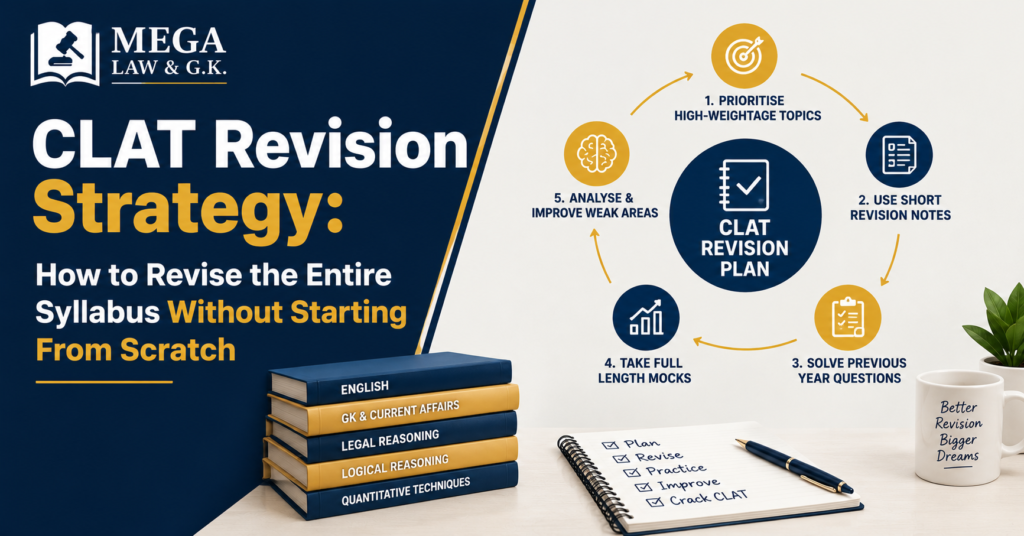
Do not revise the syllabus in order. Revise in priority order — and priority comes from your mock error log, not the official syllabus document. Open your error log, find your top 3 recurring error types per section, and build your entire revision schedule around fixing those. Sections you are already strong in need only a maintenance mock every 4 to 5 days. Sections with persistent errors need daily targeted drilling. A 4-week revision sprint built on this triage approach will do more than 3 months of re-reading notes from the beginning.
The week before CLAT, I see the same scene play out every year. Students who have covered the entire syllabus are back at chapter one of their legal reasoning notes, re-reading principles they understood months ago, while their actual weak spots sit unaddressed. They feel busy. They are not getting better.
Revision done wrong is preparation theater. It feels like progress because pages are being covered. It produces almost no improvement because the wrong pages are being covered.
I have taught CLAT and AILET for 17 years and worked with over 4,000 to 5,000 students. The revision strategies that work — and the ones that feel productive but waste critical pre-exam time — are very different. This post gives you the framework that actually moves scores in the weeks before CLAT.
“The students who improve their CLAT score the most in the final 4 weeks are never the ones who read the most. They are the ones who drilled the right things the most — and they knew what the right things were because their error log told them.”
— Manav Lawania, Founder, MEGA LAW & G.K.
Why 'Starting From Scratch' Is the Revision Trap Most CLAT Students Fall Into
There is a specific anxiety that kicks in approximately 6 to 8 weeks before CLAT. You have covered the syllabus. You have done some mocks. And suddenly everything feels uncertain. The instinct is to go back to the beginning. This instinct is understandable and almost always wrong.
The problem with starting from scratch: You are using the time you need for targeted drilling to repeat content you already know at 70 to 80 percent retention. Every hour spent re-reading a legal reasoning principle you understand is an hour not spent drilling the one inference-based RC question type that keeps costing you 3 marks per mock.
What revision should actually look like: Triage first, then drill, then test, then fix. The sequence is non-negotiable. Skipping the triage step — the audit of your mock error log — means you are revising blind, making preparation decisions based on how uncertain you feel rather than on actual evidence of where your marks are leaking.
If you do not yet have a running error log, see our mock analysis guide at megalaw.in/how-to-analyse-clat-mocks-like-a-topper-the-complete/ — the error log format is explained there in full. Build it now, even if the exam is 4 weeks away.
The CLAT Revision Audit — Do This Before You Revise a Single Page
The revision audit is a 45-minute exercise you do once, before any other revision activity begins. It is the most valuable 45 minutes of your entire revision phase.
Step 1: Pull your last 5 to 10 mocks. If you have fewer, use what you have. If you have none, take one now before doing anything else.
Step 2: Section by section, count your wrong answers across all mocks reviewed. Do not look at scores yet. Only wrong answers.
Step 3: Categorise every wrong answer as one of four types: Silly (knew the answer, made a careless error), Conceptual (genuinely did not understand the principle), Guesswork (no basis for the answer), or Time-Pressure (rushed because running out of time).
Step 4: Build your triage table. Identify your top 2 error types per section. This is your revision syllabus — not the official CLAT syllabus document.
| Section | Primary Error Type | Secondary Error Type | Revision Priority |
|---|---|---|---|
| English Language | Fill from your log | Fill from your log | High / Medium / Low |
| Current Affairs & GK | Fill from your log | Fill from your log | High / Medium / Low |
| Legal Reasoning | Fill from your log | Fill from your log | High / Medium / Low |
| Logical Reasoning | Fill from your log | Fill from your log | High / Medium / Low |
| Quantitative Techniques | Fill from your log | Fill from your log | High / Medium / Low |
Once this table is filled, your revision schedule for the next 4 weeks writes itself. High priority sections get daily targeted drilling. Medium priority get 3 sessions per week. Low priority need only one maintenance mock per week — do not waste revision time polishing what is already working.
Section-wise CLAT Revision — What Revision Actually Means for Each Section
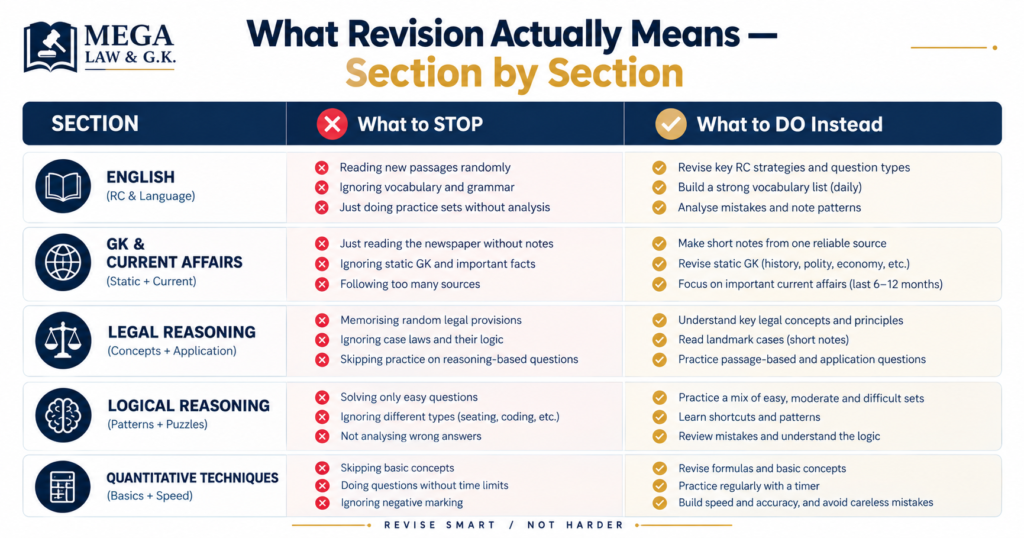
Revision does not mean the same thing in every section of CLAT. The biggest mistake students make is applying a one-size approach — usually “re-read notes” — across all five sections.
English Language — Revision means timed passage practice, not vocabulary lists. Do two timed CLAT passages every morning — one passage with questions in 7 minutes, then immediately move to the next. After both, check answers and categorise every error. Re-reading English notes does almost nothing. Timed passage repetition does a great deal.
Current Affairs & GK — Revision means topic-wise consolidation sheets, not re-reading news. Build a one-page topic-wise consolidation sheet for each major CLAT GK category: national politics and governance, international affairs, economy, legal and constitutional developments, science and technology, environment, sports and awards. Each page holds the 10 to 15 most CLAT-relevant facts. Revise these sheets — not raw notes.
Legal Reasoning — Revision means principle-application drills, not re-reading textbooks. Take 8 to 10 unseen application questions on each principle category per day, timed, and categorise the errors. Build a one-page principle summary per legal domain as a quick reference only — not as primary revision material.
Logical Reasoning — Revision means drilling your specific recurring error type. If your audit shows assumption-based questions are your primary error type, spend daily time exclusively on assumption and inference questions for the first 2 weeks. Do not do a broad mix. Focused repetition of a specific question type is what closes a persistent error gap.
Quantitative Techniques — Revision means one formula sheet and three timed drills per week. Build a single formula sheet covering percentage, ratio, profit-loss, speed-time-distance, averages, and basic statistics. Revise this sheet twice a week. Do one timed QT section drill per week. Beyond this, QT needs accuracy habits from disciplined calculation practice — not additional reading.
The 4-Week CLAT Revision Sprint — Week by Week
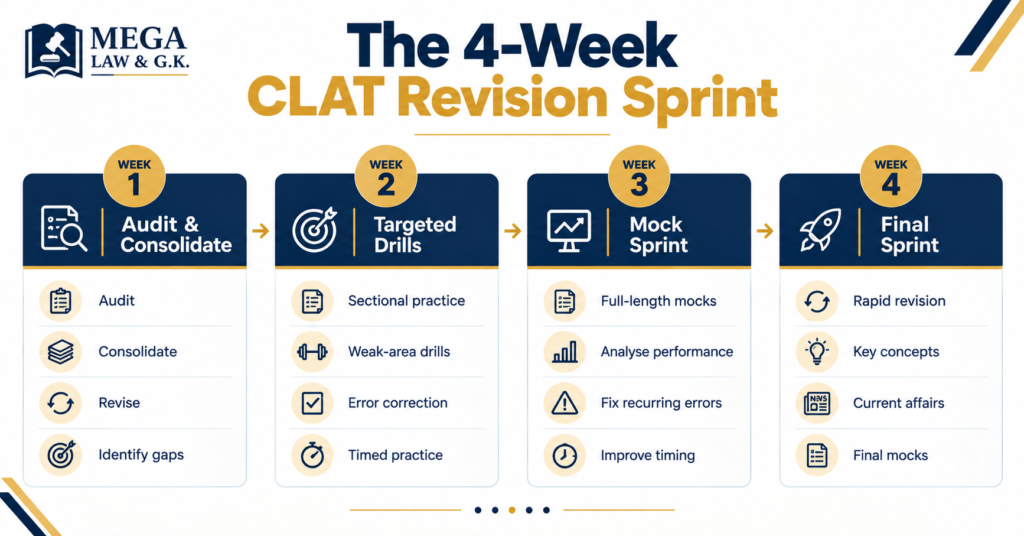
Here is the complete 4-week revision framework, assuming you have completed at least one full round of the CLAT syllabus and have taken a minimum of 5 to 8 mocks.
| Week | Primary Focus | Daily Tasks | Mocks |
|---|---|---|---|
| Week 1 — Audit & Consolidate | GK consolidation sheets, revision audit, identify top error types | 45-min audit (once). Build GK topic sheets. 2 timed RC passages. 10 LR questions (priority type). Formula sheet for QT. | 1 full mock mid-week. Full 5-step analysis only — no score-chasing. |
| Week 2 — Targeted Drilling | Legal Reasoning application drills, English RC timed practice, LR error type drilling | 8 to 10 LR principle-application questions. 2 timed RC passages. 15 LR questions (priority type). Revise GK topic sheets once. | 2 full mocks. Update error log after each. Pick top 3 errors for next day's drilling. |
| Week 3 — Mock Sprint | Full mock series + targeted section drilling between mocks | Morning: targeted drilling on top error type. Afternoon: full mock OR section mock. Evening: analysis + error log update. | 3 full mocks. Full analysis every time. Track whether error log entries are reducing. |
| Week 4 — Final Sprint | One mock per day, consolidation sheet revision, pre-exam routine | Morning: GK + LR principle sheets. Afternoon: 1 full mock. Evening: analysis + fix-forward drill on top 2 errors only. | 5 to 6 mocks in the week. Final 2 days: no mocks. Only consolidation sheets. |
On the mock analysis loop: Taking mocks without the full 5-step analysis is not revision — it is repeated exposure to the same mistakes. Every mock in this 4-week plan must be followed by the complete analysis protocol: score split, time audit, error categorisation, error log update, fix-forward drill. See megalaw.in/how-to-analyse-clat-mocks-like-a-topper-the-complete/ for the full guide. |
How to Revise GK and Current Affairs Without Re-Reading 12 Months of News
The consolidation sheet method. Create one A4 page per major GK category: National Politics & Governance, International Affairs, Economy & Business, Legal & Constitutional Developments, Science & Technology, Environment & Ecology, Sports & Awards. On each page, list only the 10 to 15 most CLAT-relevant facts — not everything you know, only the things that are specific, testable, and have appeared or are likely to appear in CLAT passages.
The CLAT lens filter. CLAT consistently favours: Supreme Court judgments and constitutional developments, major economic policy changes, India’s bilateral and multilateral diplomacy, science and technology milestones with legal or governance implications, and major national awards. Filter your consolidation sheets through this lens.
The revision routine. Once your consolidation sheets are built, read each sheet once per day for 15 minutes. Do not re-read raw notes. Do not watch news videos. Take a GK-specific mock section once per week to test whether the consolidation is sticking.
How to Revise Legal Reasoning Without Reading Another Textbook
Legal Reasoning revision done right: take 10 unseen fact situations involving a principle and apply it to each under a 90-second timer. Categorise which errors came from misreading the fact pattern vs genuinely misapplying the principle. Update the error log. Next day: do the same with the next priority principle.
The principle priority list for revision should come from your error log. A starting framework based on CLAT’s consistent question patterns:
- Tort law: Negligence (most tested), trespass to person and property, nuisance, strict liability under Rylands v Fletcher.
- Contract law: Offer and acceptance, consideration, void and voidable contracts, misrepresentation and fraud.
- Criminal law: Mens rea and actus reus, sections 299 and 300 of the IPC (culpable homicide vs murder), self-defence.
- Constitutional law: Fundamental Rights under Part III, Article 21 expansions, separation of powers.
- Property and family law: Basic succession rules, property transfer concepts, Hindu Undivided Family structures.
For each principle category on your priority list, do 10 application questions per day for 3 consecutive days. Then move to the next priority. Concentration on one at a time produces faster retention than spreading thin across all.
5 Mistakes Students Make During CLAT Revision
These five mistakes are responsible for most of the preparation time that does not translate into score improvement in the final weeks before CLAT.
- Revising in syllabus order instead of error-log order. The official CLAT syllabus is organised for teaching, not for revision. Your error log is organised by actual performance gaps. If your log shows assumption-based logical reasoning and inference-based RC are your two biggest loss points, those two things should occupy the first two hours of every revision day.
- Treating re-reading as revision. Re-reading notes produces a feeling of familiarity, not genuine retention or application ability. The test in CLAT is not “have you seen this principle before?” It is “can you apply it correctly to this specific fact situation in 90 seconds?” Re-reading prepares you for the first test. Timed application drilling prepares you for the second.
- Taking mocks without the analysis loop. A mock you take without running the full 5-step analysis is almost useless as a revision tool. The analysis loop — error categorisation, log update, fix-forward drill — is what makes a mock into actual revision.
- Abandoning GK because it feels unmanageable. GK feels unmanageable when the approach is wrong. With topic-wise consolidation sheets and a daily 15-minute review routine, GK becomes one of the most revision-efficient sections in CLAT. Students who give up on GK revision in the final 4 weeks leave 8 to 10 marks on the table.
- Adding new content in the final 2 weeks. The final 2 weeks are not for learning new things. Any new topic introduced in the final 2 weeks will be in a low-retention state on exam day — not yet consolidated, easily confused under pressure.
The 72-Hour Pre-CLAT Revision Protocol
The final 72 hours before CLAT are the most mismanaged preparation period in the entire exam cycle. Most students either panic and try to cram everything, or do nothing and lose the benefit of a structured final review.
72 hours before CLAT (Day 3): Take one full mock — your last one. Run complete 5-step analysis. Update your error log one final time. Do a fix-forward drill on your top 2 recurring errors from the last 3 mocks. Then close your mock papers. You are done with mocks.
48 hours before CLAT (Day 2): No mocks. No new content. Open your consolidation sheets: GK topic sheets, Legal Reasoning principle summaries, QT formula sheet. Read each one once. 2 hours maximum. Then rest.
24 hours before CLAT (Day 1): No mocks. No new content. No re-reading of anything you are uncertain about — this only raises anxiety without adding retention. Read your cheat sheets once in the morning. Verify exam centre location, admit card, stationery. Eat normally. Sleep by 10pm.
How This Changes for CLAT Droppers vs First-Time Aspirants
First-time aspirants in the revision phase often have an incomplete or shallow error log. The single most valuable thing you can do before entering the 4-week sprint is to take 3 mocks in 5 days, run full analysis on each, and build a rapid error log. Even a 5-mock error log gives you enough data to triage.
CLAT droppers typically have a deeper error log and a more accurate sense of their weak points. The risk for droppers is over-preparation anxiety. Usually you do not need a radically different approach — you need the same approach as before, but with the error log driving the revision rather than the syllabus. See megalaw.in/clat-dropper-batch-vs-fresher-batch/ for the specific preparation differences between the two groups.
Frequently Asked Questions
How long does it take to revise the entire CLAT syllabus?
A structured 4-week revision sprint is sufficient for most CLAT aspirants who have already completed one full round of the syllabus. Week 1 covers the audit and GK consolidation. Week 2 covers Legal Reasoning and English RC timed drills. Week 3 is mock-heavy with targeted section drilling. Week 4 is the final sprint — one mock per day, error log review, and pre-exam routine building. This assumes 3 to 4 hours of focused daily revision.
Should I start CLAT revision from the beginning of the syllabus?
No. Starting from the beginning of the syllabus is the most common and most costly revision mistake. Revision should be triage-driven, not syllabus-order driven. Start with your mock error log — identify your top 3 recurring error types per section — and build your revision schedule around fixing those first. Revising content you already know well at 70 to 80 percent retention is preparation time wasted.
How should I revise GK and Current Affairs for CLAT?
Do not re-read 12 months of news. Create a topic-wise consolidation sheet — one page per major GK category (national politics, international affairs, economy, legal and constitutional, science and technology, sports). Each page holds the 10 to 15 most CLAT-relevant facts from that category. Revise the sheets, not the raw notes. This is the revision method used by CLAT toppers — not chronological re-reading.
How many mocks should I take during CLAT revision?
During a 4-week revision phase, aim for 2 to 3 full mocks per week in weeks 1 to 3, and 1 mock per day in the final week. Each mock must be followed by the full 5-step analysis. Taking mocks without this analysis loop does not constitute revision — it is repeated exposure to your existing mistakes without correction.
What is the best CLAT revision strategy for Legal Reasoning?
Legal Reasoning revision is principle-application drills, not textbook re-reading. Make a one-page principle summary per legal domain — tort, contract, criminal, constitutional, property — and do 8 to 10 timed application questions per category per day. The goal is not to recall the principle from memory but to apply it correctly to an unfamiliar fact situation under time pressure. That is exactly what CLAT tests.
What should I do in the last 72 hours before CLAT?
Day 3 before: one final mock, full analysis, error log review, fix-forward drill on top 2 errors. Day 2 before: consolidation sheets only, no new content, 2 hours maximum. Day 1 before: no mock, no new content, read cheat sheets once in the morning, sleep by 10pm. The exam is a performance of your preparation — and performances improve with rest, not last-minute cramming.

About the Author
Manav Lawania, India's Teens & Twenties Mentor. Founder of MEGA LAW & G.K. and UsefullBooks, Agra, Uttar Pradesh. Former Intelligence Officer, Cabinet Secretariat, Government of India. 17 years of teaching experience and 4,000 to 5,000 students counselled for CLAT and AILET. Manav scored 13 out of 100 in Class 12 before rebuilding his own path, and that comeback is the lens he brings to every student he now mentors. He writes and teaches under the belief that CLAT preparation is as much about having the right data as it is about having the right mindset.