
CLAT Reading Comprehension Strategy: How to Solve Passages Faster
QUICK ANSWER
To solve CLAT Reading Comprehension passages faster, preview the questions before reading the passage, read for structure rather than every detail, answer direct questions immediately while flagging inference-based ones, and time-box every passage instead of reading at your own pace. Speed comes from fewer re-reads, not from reading faster.
If you have ever stared at the clock during a CLAT mock test and realised you still have three Reading Comprehension passages left with twelve minutes on the timer, you already know why this section decides ranks more than any other. CLAT Reading Comprehension is not a test of how much you have read in your life. It is a test of how fast and how accurately you can read right now, under pressure, on a topic you have never seen before.
This blog breaks down a practical, testable CLAT Reading Comprehension strategy that helps you solve passages faster without losing accuracy. No vague tips like “read more books.” Just a system you can apply from your very next mock test.
Why CLAT Reading Comprehension Decides Your Rank
Reading Comprehension makes up close to 50 percent of the English Language section and indirectly affects your speed across the entire CLAT paper, since RC-heavy passages also appear in the Legal Reasoning and Current Affairs sections in a comprehension-based format. This weightage is confirmed in the official CLAT exam pattern published by the Consortium of National Law Universities, the body that conducts the exam each year. A student who is slow at CLAT Reading Comprehension does not just lose marks in English. They lose time that should have gone to Logical Reasoning or Quantitative Techniques.
This is exactly why, at MEGA LAW & G.K. in Agra, Uttar Pradesh, we treat Reading Comprehension as a skill to be trained daily, not a topic to be revised once before the exam.
The 3 Biggest Mistakes Students Make in CLAT RC
Before the strategy, it helps to know what is slowing you down in the first place.
- Reading the passage word by word, like a novel. CLAT passages are 450 to 600 words of dense, often argumentative writing. Reading every word at the same speed wastes precious minutes on sentences that do not carry a question.
- Not knowing why they are reading. Most students read the passage first and the questions second, with no sense of what they are looking for. This forces a second full re-read later.
- Treating every passage the same way. A legal editorial, a scientific extract, and a narrative passage each need a slightly different reading approach. Using one method for all three slows you down.
Fixing these three habits alone can cut your per-passage time by 2 to 3 minutes.
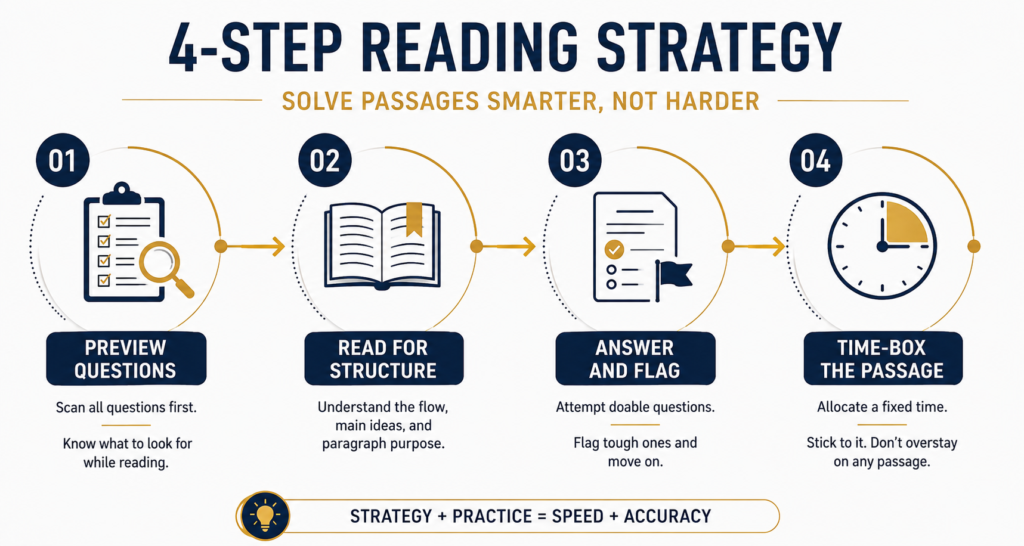
A 4-Step CLAT Reading Comprehension Strategy to Solve Passages Faster
Step 1: Preview the Questions Before You Read
Spend 20 to 30 seconds scanning the questions (not the options) before you touch the passage. This tells you whether the questions are fact-based, inference-based, tone-based, or about the author’s central argument. Your brain now reads with a purpose, which is the single biggest speed multiplier in any CLAT Reading Comprehension strategy.
Step 2: Read for Structure, Not for Detail
On your first read, your only goal is to identify:
- The central argument or claim of the passage
- The author’s tone (critical, neutral, persuasive, descriptive)
- Where each paragraph is going (you do not need to remember facts, just their location)
This is called structural reading, and it typically takes 60 to 90 seconds for a standard CLAT passage. You are building a mental map, not memorising content.
Step 3: Answer Direct Questions Immediately, Flag the Rest
Once you have the structure, attempt fact-based and vocabulary questions straight away since the answer location is usually easy to trace back to. For inference and tone-based questions, go back to the specific paragraph rather than trying to recall the whole passage from memory. This targeted re-reading is faster and more accurate than a full second read.
Step 4: Time-Box Every Passage
This is where most students lose marks, not on ability but on pacing. Use this benchmark while practising:
| Passage Type | Reading Time | Questions Time | Total Target |
|---|---|---|---|
| Straightforward / factual | 60-75 sec | 3-4 min | 4-5 min |
| Argumentative / editorial | 90 sec | 4-5 min | 5-6.5 min |
| Dense / legal-philosophical | 90-120 sec | 5 min | 6.5-7 min |
If you are consistently going over these numbers in mocks, that is your signal to slow down on accuracy drills and speed up on timed passage practice, not the other way around.
Passage Types You Will See in CLAT Reading Comprehension
CLAT draws its Reading Comprehension passages from contemporary fiction, non-fiction, journals, editorials, and academic writing on themes like law, politics, economics, history, and current affairs, a scope you can cross-check against the CLAT exam overview on Wikipedia for a quick outside reference point. Recognising the passage type in the first two lines helps you pick the right reading speed instantly. A narrative passage rewards a slightly slower, detail-tracking read. An opinion-editorial rewards fast structural reading followed by targeted question-solving, since most questions there test the author’s stance rather than isolated facts.
Daily Practice Habits That Actually Move Your Speed
- Read one editorial a day and summarise it in three lines. This trains structural reading without you realising it.
- Practise with a timer from day one. Untimed RC practice builds false confidence.
- Review your wrong answers by category, not just by score. Are you losing marks on inference, tone, or vocabulary-in-context questions? Fix the category, not just the passage.
- Attempt Level 5 difficulty passages at least twice a week once your basics are solid, since actual CLAT passages have gotten noticeably denser in recent years.
If you want a structured, print-ready set of graded passages built specifically for this kind of daily practice, the CLAT Advanced Passages Mastery Workbook from UsefullBooks is built around exactly this anti-drift, progressive difficulty approach.
How MEGA LAW & G.K. Trains This Skill
At our CLAT and AILET coaching institute in Agra, Uttar Pradesh, Reading Comprehension is drilled as a daily timed exercise inside both our SPARTA Batch and Shaurya Elite+ programs, alongside dedicated current affairs coverage in the GK-CA Booster. Students track their per-passage time every single week so that speed improvement is visible, not assumed.
Every batch follows a set weekly rhythm rather than random passage practice. Students attempt timed passages in class, get their per-question error pattern reviewed by a mentor the same week, and repeat weak categories until the fix actually sticks. This close, week-on-week tracking is what turns the 4-step framework above from a one-time tip into a habit the student carries into the actual CLAT exam hall.
Frequently Asked Questions
How many Reading Comprehension passages come in CLAT?
CLAT typically includes around 4 to 5 passages in the English Language section, each followed by 4 to 5 questions, so roughly 20 to 22 questions come directly from RC.
How much time should I give to each CLAT RC passage?
Aim for 4 to 7 minutes per passage depending on its difficulty, including both reading and answering. Use the time-box table above as a working benchmark and adjust based on your own mock test data.
Does reading newspapers actually help with CLAT Reading Comprehension?
Yes, but only if you read actively. Reading an editorial and immediately summarising the author's argument in your own words builds the exact skill CLAT tests. Passive reading without summarising builds vocabulary but not speed.
Should I read the passage first or the questions first in CLAT RC?
Preview the questions first (not the options) so you know what to look for, then read the passage for structure. This is faster than reading the passage cold and then re-reading it after seeing the questions.
What is a good CLAT Reading Comprehension score to aim for?
Since CLAT is a relative ranking exam, aim for accuracy above 80 percent on RC in your mocks while staying within the time-box targets. Speed without accuracy will still cost you rank.
About the author: Manav Lawania is the founder of MEGA LAW & G.K., a CLAT and AILET entrance coaching institute based in Agra, Uttar Pradesh, and of UsefullBooks. An ex-Intelligence Officer with the Cabinet Secretariat, he has 15+ years of teaching experience and has personally counselled 4,000 to 5,000 students. He is recognised as India’s Teens & Twenties Mentor.
Final Word
CLAT Reading Comprehension speed is not a talent some students are born with. It is a trained response built through purposeful reading, disciplined timing, and consistent review of mistakes. Start with the 4-step framework above in your very next mock, track your per-passage time honestly, and adjust weekly. That single habit change is often the difference between a good CLAT score and a rank that actually gets you into your target law school.