
CLAT Logical Reasoning Preparation Tips 2027: Topper's Secrets and Shortcuts You Must Know
Quick Answer
CLAT 2027 Logical Reasoning is a passage-based section worth roughly 22 to 24 marks. Toppers do not chase reasoning “tricks.” They master three habits: reading each short passage once with full attention, separating the author’s stated facts from their own outside opinion, and eliminating wrong options using the passage’s own logic. The syllabus, the shortcuts, the common mistakes, and a week-by-week plan are all below.
Why Logical Reasoning Can Make or Break Your CLAT 2027 Rank
Most CLAT 2027 aspirants pour their energy into GK and Legal Reasoning because those sections feel more “learnable.” Logical Reasoning gets treated like an afterthought, and that is exactly why it becomes the section that separates a rank of 800 from a rank of 80.
Here is the part students underestimate: Logical Reasoning is one of the few CLAT sections where accuracy is almost fully in your control. There is no vast syllabus to memorise, no current affairs cutoff date to track. It rewards a trained way of thinking, and a trained way of thinking can be built in a fixed number of weeks with the right practice.
In my 17 years of teaching and after counselling 4,000+ CLAT and AILET aspirants at MEGA LAW & G.K. in Agra, Uttar Pradesh, I have watched the same pattern play out every single year: students who treat logical reasoning as a skill to drill, not a topic to read, are the ones who walk out of the exam hall calm about this section.
CLAT 2027 Logical Reasoning Syllabus: What Actually Comes in the Paper
Since the passage-based CLAT UG pattern was introduced, Logical Reasoning has moved away from standalone puzzle-style questions and into short argumentative passages of around 300 to 450 words, each followed by 4 to 5 questions. Inside these passages, the paper typically tests:
- Identifying the premise, conclusion, and central argument of a passage
- Spotting unstated assumptions the author is relying on
- Strengthening or weakening a given argument
- Drawing valid inferences without adding outside information
- Applying a stated principle or rule to a new factual situation
- Identifying logical flaws, contradictions, or inconsistencies in an argument
Note for CLAT 2027 aspirants: the Expert Committee’s ongoing review of the CLAT pattern means small structural tweaks are possible before your exam year. Always cross-check the exact weightage and format against the current official CLAT information brochure closer to your exam date.
| Question Type | What It Actually Tests | One-Line Strategy |
|---|---|---|
| Conclusion identification | Can you find what the author is actually claiming | Underline the sentence that everything else is supporting |
| Assumption | Can you spot the unstated logical gap | Use the negation test on every option |
| Strengthen or weaken | Can you judge new evidence against the existing argument | Ask: does this option touch the conclusion, or something else |
| Inference | Can you avoid adding outside knowledge | If it is not in the passage, it is not the answer |
| Principle application | Can you apply a rule mechanically, without bias | Match facts to the rule word for word first |
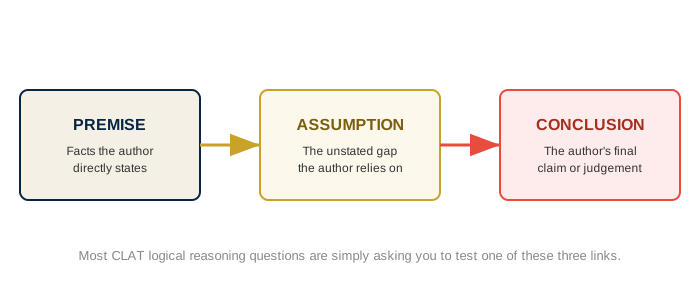
The Anatomy of Every Reasoning Passage: A Topper's Mental Model
Every CLAT reasoning passage, no matter how it is dressed up, is built from three moving parts. Once you can separate these three in seconds, most question types become mechanical rather than confusing.
FROM MY EXPERIENCE COUNSELLING 4,000+ STUDENTS
The single biggest reason bright students lose marks in logical reasoning is not weak logic, it is contaminated logic. They bring in outside opinions, current affairs knowledge, or personal beliefs into a passage that has already told them everything they need. The moment you catch yourself thinking “but I know that in real life…”, stop. CLAT wants the author’s world, not yours.
7 Shortcuts and Techniques Every CLAT 2027 Aspirant Must Know
1. The Author’s Voice Only Rule
Before you touch a single option, ask: what does the author believe, not what do I believe. This one habit alone eliminates a large share of wrong answers.
2. Premise-Conclusion Underlining
On your rough sheet, mark P for every premise and C for the conclusion as you read. It takes ten extra seconds and saves a full re-read later.
3. The Assumption Negation Test
To check if an option is truly the author’s assumption, mentally reverse it. If reversing it breaks the conclusion, it is the correct assumption. If the conclusion still stands, that option is a distractor.
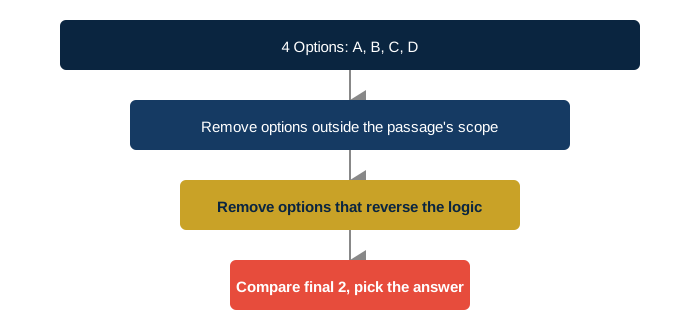
4. The Elimination Funnel
Do not hunt for the “right” answer first. Eliminate the two options that are clearly out of scope or reverse the argument’s direction, then compare only the remaining two.
5. Qualifier Word Flagging
Words like all, only, never, always, and some completely change what an option is claiming. Circle them. A large share of “close but wrong” options fail on exactly one qualifier word.
6. The Two-Pass Timing Method
Give every passage a strict 45 to 60 second read on the first pass, purely to locate the conclusion. Attempt the questions on the second pass. Students who read slowly and carefully in one long pass consistently run out of time before the paper ends.
7. The Post-Mock Error Log
After every mock, write down not just which question you got wrong, but why: outside knowledge, missed qualifier word, timing pressure, or a genuine concept gap. Patterns show up within three to four mocks, and that pattern is your real revision list.
Common Mistakes CLAT Aspirants Make in Logical Reasoning
- Overthinking with outside knowledge: Bringing in real-world facts the passage never mentioned.
- Ignoring qualifier words: Missing the difference between “some” and “all,” or “always” and “usually.”
- No passage-level timing: Spending six minutes on one passage and then rushing the last three.
- Skipping error analysis: Attempting mock after mock without ever asking why a wrong option felt right.
- Random practice without a plan: Solving whatever question set is available instead of targeting a known weak area.
In my years of counselling both first-time aspirants and droppers, one gap stands out. First-timers usually struggle with reading speed. Droppers usually struggle with overconfidence, they “know” reasoning already and stop maintaining an error log. Both problems are fixable, but only if you notice which one is yours.
8-Week Study Plan for Logical Reasoning
| Weeks | Focus | Daily Target |
|---|---|---|
| Week 1 to 2 | Build the Premise, Assumption, Conclusion habit on easy passages | 5 passages, review every wrong answer |
| Week 3 to 4 | Introduce timing: two-pass method on medium passages | 8 passages within a fixed 40 minute block |
| Week 5 to 6 | Full-length sectional tests, start the error log | 1 sectional test, 30 minute review after |
| Week 7 to 8 | Full mocks, revise only from your error log patterns | 1 full mock every 3 days |
Best Resources to Practice for CLAT 2027
Logical reasoning and reading comprehension share the same underlying muscle: careful, honest reading of unfamiliar passages under time pressure. If your reading speed on unfamiliar topics is shaky, that will show up in your reasoning score too. The CLAT Advanced Passages Mastery Workbook from UsefullBooks was built for exactly this overlap, with anti-repetition passage sets so you are never practising on questions you have half-memorised.
For a broader shortlist of books across every CLAT section, see our guide on the best CLAT books for 2027. To build overall exam temperament, our post on
how to prepare for CLAT 2027 covers a full-syllabus timeline for Class 11, Class 12, and dropper students. And once your reasoning accuracy is solid, revisit our
CLAT previous year papers (2008 to 2026) post to test it against real exam-level passages.
Frequently Asked Questions
Is logical reasoning hard in CLAT?
Not conceptually hard, but time-hard. The logic itself is usually straightforward once you separate the author's stated facts from your own outside opinion. Most marks are lost to speed and overthinking, not to genuine difficulty.
How many questions come from logical reasoning in CLAT?
Typically around 22 to 24 questions in the CLAT UG paper. This can shift slightly year to year, so confirm the exact weightage in the current year's official CLAT brochure.
Can logical reasoning be improved in one month before CLAT?
Yes. Logical reasoning responds faster to focused practice than a knowledge-heavy section like GK. A disciplined month of daily passage practice, error logging, and timed mocks can meaningfully lift both accuracy and speed.
Is coaching necessary for CLAT logical reasoning?
Not mandatory, but structured guidance helps most students avoid practising randomly without reviewing their mistakes. A mentor who tracks your error pattern across mocks usually saves months of trial and error.
What is the difference between logical reasoning and critical reasoning in CLAT?
In the CLAT context, these describe the same passage-based section. It tests your ability to find the premise, assumption, and conclusion inside a short passage and to judge arguments strictly using the passage's own logic.

About the Author
Manav Lawania, India's Teens & Twenties Mentor Founder of MEGA LAW & G.K. and UsefullBooks, Agra, Uttar Pradesh. Ex-Intelligence Officer, Cabinet Secretariat. 17 years of teaching experience and 4,000 to 5,000 students counselled for CLAT and AILET. Manav scored 13 out of 100 in Class 12 before rebuilding his own path, and that comeback is the lens he now brings to every student he mentors. He writes and teaches under the belief that CLAT preparation is as much about mindset and discipline as it is about the syllabus itself.