
CLAT Negative Marking Strategy 2027: The Attempt vs Accuracy Maths
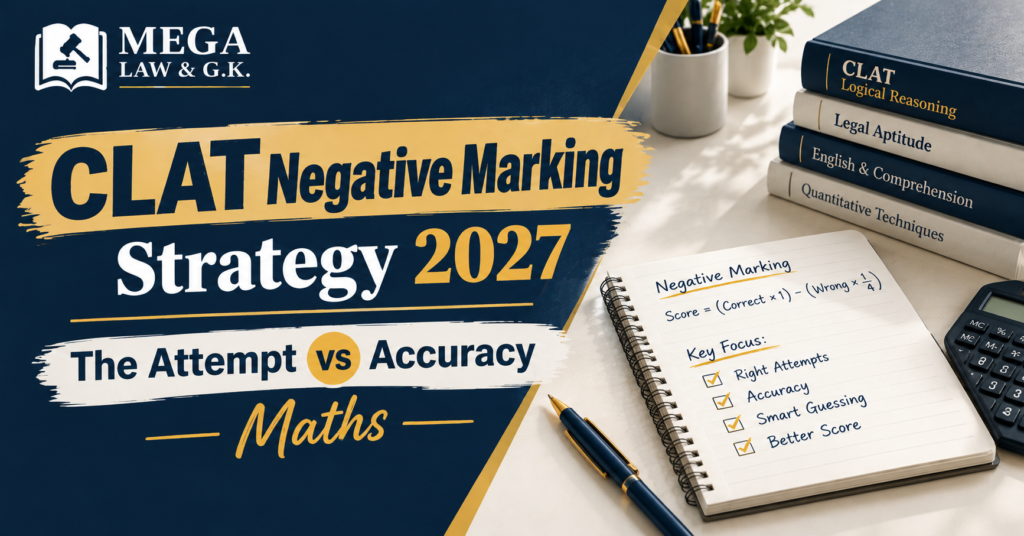
The breakeven accuracy for CLAT negative marking is 20% — not 25%. If you get just 1 question right for every 5 you attempt, you break even. If you can eliminate even one wrong option, your expected score from attempting is positive.
→ CLAT marking: +1 correct, −0.25 wrong, 0 for unattempted
→ Breakeven: 20% accuracy (1 correct per 5 attempts)
→ Random guess on 4-option MCQ: 25% accuracy — already above breakeven
→ Eliminate 1 wrong option: 33% accuracy — clearly worth attempting
→ Skip only when: zero knowledge of a GK topic AND cannot eliminate a single option
→ Most students leave 8 to 12 marks on the table by over-skipping
Every CLAT student knows negative marking exists. Almost every student uses it wrong. The most common mistake is not reckless guessing — it is the opposite: skipping too many questions out of fear, and losing marks that should have been gained.
“The students who do worst with negative marking are not the ones who guess too much. They are the ones who skip too much. Fear of negative marks costs more marks in CLAT than negative marks do — because skipping a question you had a 40% chance of getting right is a guaranteed −0.4 marks in expected value, while attempting it is +0.3.”
— Manav Lawania, Founder, MEGA LAW & G.K.
The Core Maths: What Is the Breakeven Accuracy?
For CLAT 2027 (+1 correct, −0.25 wrong), the breakeven accuracy is calculated as:
Breakeven = 0.25 ÷ (1 + 0.25) = 0.25 ÷ 1.25 = 20%
You need just 1 correct answer in every 5 attempts to break even
Now compare that to what your actual accuracy options look like:

The critical insight: even pure random guessing on a 4-option CLAT question gives 25% accuracy — which is above the 20% breakeven. This means that in pure mathematical terms, you should always attempt CLAT questions — even with no basis at all.
This does not mean you should guess randomly on every question. What it means is that the threshold for “worth attempting” is much lower than most students believe. You do not need to be confident. You need to have a better-than-random basis — which virtually any engaged student does on any question they have read carefully.
What Happens When You Eliminate Wrong Options
The elimination method — ruling out options that are obviously wrong — dramatically changes your expected score even when you cannot identify the correct answer.
| Situation | Options Left | Accuracy If You Guess | Expected Score Per Attempt | Decision |
|---|---|---|---|---|
| No basis at all — pure guess | 4 of 4 | 25% | +0.063 per attempt | ✓ Attempt (marginally positive) |
| Eliminated 1 wrong option | 3 of 4 | 33% | +0.167 per attempt | ✓ Attempt |
| Eliminated 2 wrong options | 2 of 4 | 50% | +0.375 per attempt | ✓ Strongly attempt |
| Eliminated 3 wrong options | 1 of 4 | 100% | +1.00 per attempt | ✓ Certain — attempt |
| Zero knowledge, cannot eliminate any | 4 of 4 | 25% (pure random) | +0.063 per attempt | ⚠ Marginal — GK only, consider skipping |
Notice that eliminating even one wrong option raises the expected score from +0.063 to +0.167 per attempt — nearly a 3× improvement. And eliminating two options (which is often possible in Legal Reasoning and Logical Reasoning with passage-based questions) raises it to +0.375, making it one of the most efficient marks available in the paper.
The practised reader’s advantage: In Legal Reasoning, Logical Reasoning and English RC, careful passage reading usually makes 2 of the 4 options obviously eliminable. This means even on questions where you are unsure of the correct answer, your expected accuracy is around 50% — well above the 20% breakeven. Skipping these questions is a guaranteed loss of expected marks.
Section-Wise Attempt Strategy for CLAT 2027
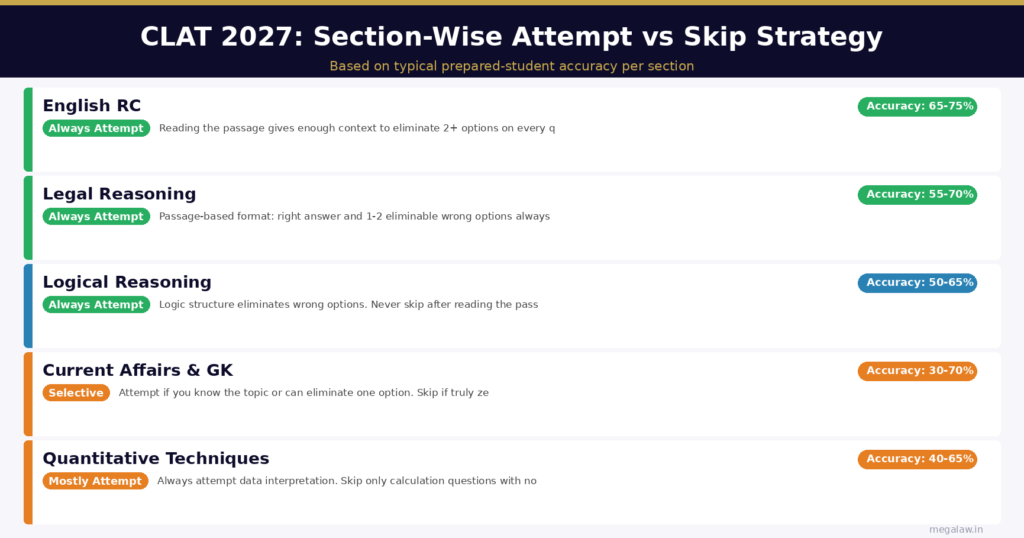
| Section | Typical Accuracy (prepared student) | Strategy | When to Skip |
|---|---|---|---|
| English Language (RC) | 60 to 75% | Attempt all — accuracy is far above breakeven | Almost never. If you have read the passage, you can eliminate at least 2 options on any question |
| Legal Reasoning | 55 to 70% | Attempt all — passage-based format means 2 options are usually eliminable | Almost never. Skipping Legal Reasoning questions you have read is one of the most common mark-loss mistakes |
| Logical Reasoning | 50 to 65% | Attempt all — logic structure eliminates wrong options systematically | Only if you genuinely did not understand the passage at all after re-reading once |
| Current Affairs and GK | 30 to 70% (varies by topic) | Selective — attempt if you know the topic or can eliminate an option; skip if completely blind | When you have zero knowledge of the specific topic and cannot rule out even one option. This is the one section where skipping a subset makes sense |
| Quantitative Techniques | 40 to 65% | Attempt data interpretation questions always — elimination is easy. Skip pure calculation questions only if you have no approach | Specific calculation questions where you have no method and the answer options are not helpful for elimination |
The 4 Mistakes Students Make With Negative Marking
Mistake 1: Skipping questions they have already read. This is the single most expensive negative marking mistake. A student who reads a Legal Reasoning passage, narrows it to two options, and then skips because they are not 100% sure is throwing away an expected +0.375 marks per question. Reading a question and skipping it is not caution — it is a guaranteed loss of expected value.
Mistake 2: Treating all GK questions the same. GK is the only section where some selective skipping makes sense — but only for questions where you have literally zero association with the topic. Most students skip entire GK topic clusters unnecessarily when they could eliminate 1 to 2 options based on legal reasoning context.
Mistake 3: Adjusting their attempt strategy mid-paper. Many students hit a difficult passage and shift into defensive mode — skipping everything they are unsure about for the rest of the exam. The strategy should be set before the exam, not adjusted mid-paper. Mid-exam strategy changes are driven by emotion, not maths.
Mistake 4: Not tracking their section-wise accuracy across mocks. The ideal attempt strategy depends on your actual accuracy — which you can only know if you track it systematically. A student who knows their Legal Reasoning accuracy is 64% will never skip a Legal Reasoning question. A student who “feels” their accuracy is low will skip questions even when the data says not to.
Your Actual Decision Rule — Simplified
Attempt if: You have read the question fully AND can eliminate at least one option OR have any knowledge of the topic. This covers more than 95% of questions for a prepared student.
Skip if: It is a GK question AND you have zero association with the topic AND you genuinely cannot rule out even one option. This is the only defensible skip scenario.
Never skip: Legal Reasoning, Logical Reasoning or English RC questions you have fully read. The passage-based format always gives you enough information to eliminate at least one option.
How to Build Your Attempt Strategy Using Mock Data
Step 1: After your next mock, calculate accuracy per section — correct answers divided by questions attempted (not total questions). Write this down for each section.
Step 2: Compare each section accuracy to the 20% breakeven. If your Logical Reasoning accuracy is 58%, you should be attempting every LR question you read. If your GK accuracy is 38%, even partial knowledge clears the bar.
Step 3: Identify your skip zone — the specific sub-type of question where your accuracy genuinely falls below 20%. For most students, this is a very narrow category: specific GK topic clusters where they have no preparation.
Step 4: Set your attempt target before each mock — for example, “I will attempt at least 110 of 120 questions.” Track whether you hit this target and whether your net score improves.
The over-skipping trap: Most students who “play it safe” in CLAT by skipping uncertain questions score 8 to 12 marks below what their preparation justifies. A student with 58% average accuracy who skips 20 questions loses 11.6 expected marks — far more than any plausible negative marking damage on those same 20 questions.
Read Next
- How to Analyse CLAT Mocks Like a Topper: The Complete Framework
- CLAT Revision Strategy: How to Revise Without Starting From Scratch
- 3 Out of 4 CLAT Droppers at MEGA LAW & G.K. Improved Their Rank: What Changed
- CLAT 2027 Self Study Plan: 4-Month Framework
- Is CLAT Coaching Necessary or Can I Self-Study? Honest Answer
- CLAT 2027: Complete Guide to Syllabus, Pattern and Important Dates
Frequently Asked Questions
What is the negative marking in CLAT 2027?
CLAT 2027 has a negative marking of 0.25 marks for every wrong answer. Correct answers carry +1 mark. Unattempted questions carry 0 marks. The total paper is 120 marks (120 questions, 2 hours). The negative marking scheme makes accuracy important but does not mean you should skip questions — the breakeven accuracy at which attempting is worthwhile is just 20%.
Should I attempt or skip in CLAT if I am unsure?
Attempt, in most cases. The mathematical breakeven for CLAT negative marking is 20% accuracy — meaning you need to get just 1 in 5 attempts correct to break even. Since CLAT has 4 options per question, pure random guessing gives 25% accuracy, which is already above the breakeven. If you can eliminate even one wrong option (raising your effective accuracy), the expected value of attempting is clearly positive. The only situation where skipping makes sense is when you have genuine zero knowledge of a GK question and cannot eliminate a single option.
What is the breakeven accuracy for CLAT negative marking?
The breakeven accuracy for CLAT 2027 negative marking is exactly 20%. This is calculated as: breakeven = negative marks per wrong answer divided by (positive marks per correct answer + negative marks per wrong answer) = 0.25 divided by (1 + 0.25) = 0.25/1.25 = 0.20 = 20%. This means if your accuracy on a group of questions is above 20% (more than 1 correct in every 5 attempts), you gain net positive marks from attempting them. If your accuracy is below 20%, you lose marks. Since most students have accuracy well above 20% in all sections after preparation, skipping aggressively loses more marks than negative marking costs.
How does elimination help with CLAT negative marking?
Eliminating wrong options raises your effective accuracy significantly. With 4 options: pure guess = 25% accuracy. Eliminate 1 wrong option (3 remaining) = 33% accuracy. Eliminate 2 wrong options (2 remaining) = 50% accuracy. All three of these are well above the 20% breakeven. So if you can identify even one option that is definitely wrong, attempting the question is mathematically correct regardless of whether you know the right answer.
Which CLAT section should I skip questions in?
The only section where systematic skipping is sometimes justified is Current Affairs and GK — specifically questions where you have zero knowledge of the topic and cannot eliminate even one option. In Legal Reasoning, Logical Reasoning and English RC, well-prepared students should have accuracy well above 20% on every question, making skipping a losing strategy. In Quantitative Techniques, students who have drilled data interpretation should attempt all questions; those who have not should skip only pure arithmetic questions where they have no approach at all.

About the Author
Manav Lawania, India's Teens & Twenties Mentor. Founder of MEGA LAW & G.K. and UsefullBooks, Agra, Uttar Pradesh. Former Intelligence Officer, Cabinet Secretariat, Government of India. 15+ years of teaching experience and 4,000 to 5,000 students counselled for CLAT and AILET. Manav scored 13 out of 100 in Class 12 before rebuilding his own path, and that comeback is the lens he brings to every student he now mentors. He writes and teaches under the belief that CLAT preparation is as much about having the right data as it is about having the right mindset.