
Is CLAT Coaching Necessary or Can I Self-Study? Honest Answer

You can crack CLAT through self-study — but the success rate is significantly lower than with structured coaching and regular mock analysis. Among students who approach MEGA LAW & G.K. after one or more self-study attempts, the most common gaps are mock test analysis, GK coverage, and absence of someone to flag when preparation is going off track. Coaching is not essential — but accountability, structured mocks, and expert feedback are.
I am aware of what it looks like when a coaching institute says this. So let me be direct: I run MEGA LAW & G.K. I have a commercial interest in you joining coaching. I am telling you coaching is not essential because that is the accurate answer.
I have watched this decision from both sides for 15+ years and across 4,000 to 5,000 students. The pattern is clear and consistent. This post gives you the honest picture.
“The question is not whether you join coaching. The question is whether you will do — every single day — the three things that determine CLAT outcomes: structured mock analysis, consistent GK, and drilling your specific error type. Coaching is one way to make those happen. It is not the only way.”
— Manav Lawania, Founder, MEGA LAW & G.K.
What Coaching Actually Provides — vs What It Claims To
Most coaching institutes market themselves on content — comprehensive coverage, daily classes, study material. The content claim is real but largely irrelevant. All CLAT preparation content is available without a coaching institute. The content is not the gap.
What coaching actually provides — when it is working — is four things that content access alone does not:
- External accountability. Someone checking whether you ran mock analysis yesterday, whether your error log is updated, whether your GK consolidation sheets are current. Most students follow their schedule 4 to 5 days a week when no one is watching. Most follow it 6 to 7 days a week when someone is. That gap compounds over 12 months.
- Curated GK. A coaching institute compiles monthly current affairs filtered for CLAT relevance — you revise 30% of the news actually likely to appear, not 100% of everything you read. Self-studiers who read daily but lack this filtration end up with 12 months of reading they cannot retrieve under exam pressure. This is the single most common self-study failure mode.
- Expert feedback on reasoning errors. A mentor watching your Legal Reasoning work can tell you whether you are misreading the fact pattern or misapplying the principle — a distinction that changes the fix entirely. Self-studiers who miss questions often cannot make this diagnosis themselves, so they drill the wrong thing and the error rate does not drop.
- Structured mock series with analysis support. A coaching institute provides a calibrated sequence of mocks at increasing difficulty, with section-specific analysis and benchmark data across a cohort. A self-studier can access mock papers, but calibration and cohort benchmarking are harder to replicate.
Of these four, external accountability and GK curation are the ones most consistently missing from self-study attempts that do not produce the expected result.
The Three Things You Actually Need — Coaching or Not
| What You Actually Need | How Coaching Delivers It | How to Replicate in Self-Study |
|---|---|---|
| Mock analysis with error logging | Mentor-led analysis sessions after each mock; cohort error benchmarking | 5-step protocol after every mock — score split, time audit, error categorisation, error log update, fix-forward drill. Non-negotiable after every mock, not selective. |
| Consistent GK with filtration | Monthly compiled current affairs filtered for CLAT relevance; weekly GK sessions | Daily newspaper + weekly topic-wise consolidation sheet (one page per major GK category). The sheet — not the newspaper — is what you revise. Build it every week without exception. |
| Feedback on specific error type | Mentor identifies whether error is fact-pattern misread or principle misapplication; adjusts drilling accordingly | Track every Legal Reasoning wrong answer in error log. After 8 to 10 mocks, identify your top error type. Run application-only drills on that specific type — not all LR, just that one. If the error rate does not drop after 3 weeks of targeted drilling, your diagnosis may be wrong; get a second opinion. |
When Self-Study Is Genuinely Enough
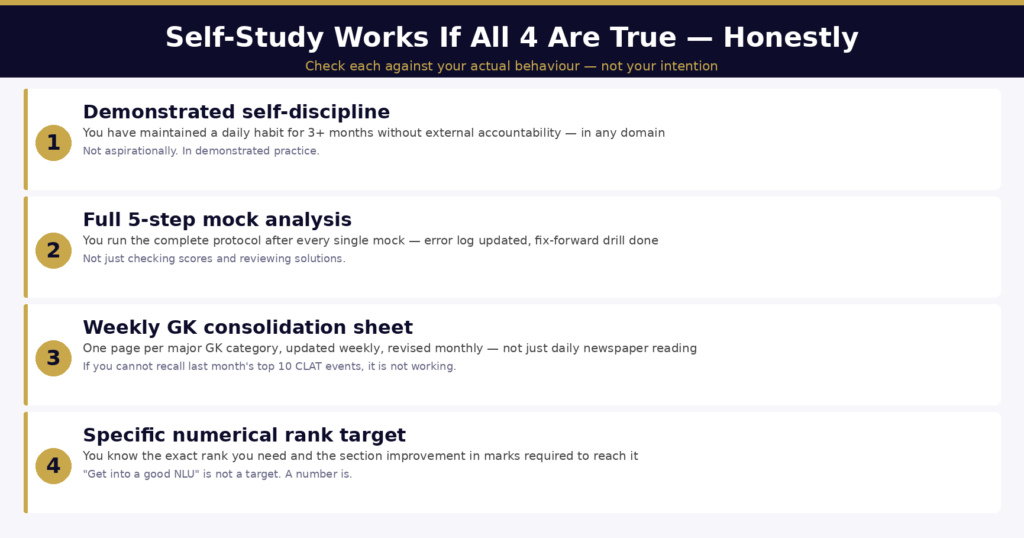
- You have demonstrated self-discipline in another high-stakes context. Not “I am good at studying when motivated” but “I have maintained a daily habit for 3+ months without external accountability before.” If you have never done this, self-study for a 12-month CLAT cycle is a harder starting point than most students recognise.
- You are willing to run the full 5-step mock analysis protocol after every mock without exception. Not just reviewing solutions. The full protocol — score split, time audit, categorising every wrong answer, updating the error log, drilling the top error type before the next mock. If you have taken more than 5 mocks and have not been doing this, why not — and will that reason still apply?
- You can build and maintain a GK consolidation system independently. Daily newspaper reading is not enough. You need the weekly consolidation sheet. If you have been reading the newspaper for 2+ months and cannot right now recall the 8-10 most CLAT-relevant events from last month across each major category, your GK consolidation is not working.
- You have a specific rank target, not a general aspiration. “I want to get into a top NLU” is not a preparation target. “I need rank 150 or below, which means improving Legal Reasoning by 7 marks and English RC by 4 marks over my best mock performance” is a preparation target.
When Coaching Makes the Difference
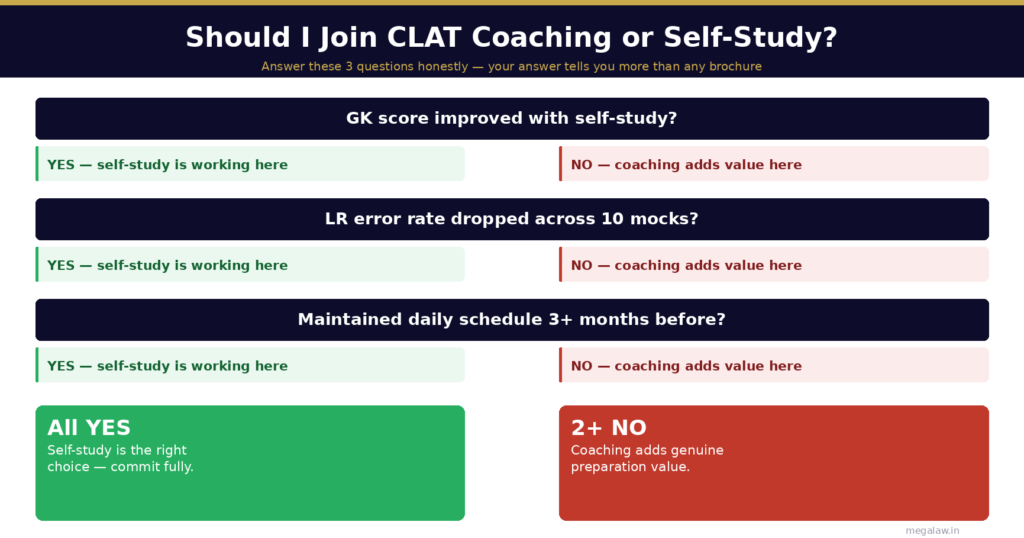
- Your GK score has not improved across multiple self-study attempts. If you have prepared GK independently for one or more CLAT cycles and the GK section consistently underperforms relative to preparation time, the issue is consolidation and filtration — not reading. A GK coaching resource will produce faster improvement than more independent newspaper reading.
- Your Legal Reasoning error rate has not dropped despite regular drilling. This is the clearest signal that you are misdiagnosing your own errors. You think it is a conceptual gap — you drill the concept — but the errors keep appearing because the actual problem is fact-pattern misreading or timing. A mentor can identify this in one session.
- You cannot maintain a daily schedule without external accountability. If you have tried to prepare independently before and the schedule consistently broke down after 2-4 weeks, self-study for a 12-month CLAT cycle is likely to produce the same result. This is not a character flaw — it is information about the preparation structure you need.
- You are a dropper and your first attempt did not produce the improvement you expected despite genuine effort. This is the strongest signal that the preparation process — not the preparation volume — needs to change. See our data on 3 out of 4 CLAT droppers improving rank at megalaw.in/clat-dropper-rank-improvement/
What Students Who Came to Us After Self-Study Were Missing
Gap 1 — Mock analysis depth. In almost every case, the student had taken plenty of mocks. In almost no case had they run the full error log protocol. They checked scores and reviewed solutions. But they had never built a running log of top recurring error types by section, and never done a targeted fix-forward drill before the next mock.
Gap 2 — GK consolidation. Almost all had been reading the newspaper. Almost none had a systematic consolidation sheet they could revise. When asked to recall the 10 most CLAT-relevant events from the last month across major categories, most could name 3 or 4. The reading was happening. The consolidation was not.
Gap 3 — Legal Reasoning error diagnosis. Most knew their LR score was low and attributed it to “not knowing enough legal principles” — so they re-read principles. In most cases the actual error was fact-pattern misreading, time pressure, or option-elimination instead of pre-formed reasoning. More principle revision was not going to fix a fact-pattern misreading habit.
None of these three gaps require full coaching to fix. All three can be fixed with the right method applied independently. But all three are hard to diagnose yourself, because you cannot see what you cannot see.
Making the Decision — A 5-Question Diagnostic
- Have you maintained a daily study habit for 3+ months without external accountability before? If yes: your self-regulation track record is evidence self-study is viable. If no: factor this in — not as a disqualifier but as information.
- After your last 5 mocks, can you name your top 3 recurring error types in LR and English RC? If yes: your mock analysis is working. If no: fix this first, regardless of whether you choose coaching or self-study.
- Can you right now recall the 10 most CLAT-relevant events from the last month across each major GK category? If yes: your GK consolidation is working. If no: either build the consolidation sheet process or find a GK resource that does it for you.
- Has your CLAT score or mock score improved meaningfully in the last 3 months? If yes: your current approach is working — do not disrupt it. If no: the approach needs to change. Coaching is one vehicle; a more disciplined independent process is another.
- Do you have a specific rank target with the section improvement required to reach it identified? If yes: your preparation has direction. If no: set this before doing anything else — every other decision depends on it.
The honest verdict: If you answered yes to all five, self-study is the right choice — and doing it well will produce a better result than joining coaching as an anxious hedge. If you answered no to two or more, coaching adds genuine value to your specific preparation. If you answered no to only one, fix that one thing first — with or without coaching — and reassess.
The Middle Path Most Students Miss
The framing of “coaching vs self-study” creates a false binary. Most students do not need full coaching or pure self-study — they need one or two targeted resources that address their specific gaps.
A student whose GK consolidation is failing does not need 5 sections of daily coaching. They need a weekly GK resource that compiles and filters current affairs for CLAT relevance. A student whose Legal Reasoning error rate is not dropping does not need full coaching — they need one expert session per month to look at the error log. A student whose mock analysis is not working does not need a coaching institute — they need the 5-step analysis framework applied every single time.
The most important point: the decision is not about coaching vs no coaching. The decision is about which of the three things — accountability, GK curation, expert error feedback — you genuinely have, and which you genuinely do not.
For the complete 4-month self-study framework: megalaw.in/clat-self-study-plan-2027/. For full CLAT exam pattern and syllabus: megalaw.in/clat-exam/
Read Next
- CLAT 2027 Self Study Plan: Crack CLAT Without Coaching in 4 Months
- 3 Out of 4 CLAT Droppers at MEGA LAW & G.K. Improved Their Rank — What Changed
- How to Analyse CLAT Mocks Like a Topper
- CLAT Revision Strategy: How to Revise Without Starting From Scratch
- Your CLAT Rank vs NLU Reality — Honest Cutoff Data
- CLAT Exam 2027 — Complete Guide, Syllabus & Pattern
Frequently Asked Questions
Can I crack CLAT without coaching?
Yes. CLAT can be cracked without classroom coaching. The exam tests reading comprehension, logical reasoning, legal aptitude, quantitative techniques and current affairs — none of which require exclusive access to a coaching institute. What matters is whether you can replicate the four things coaching provides: structured daily schedule, mock analysis with error logging, consistent GK coverage, and feedback on reasoning errors. If you can build all four independently, coaching is not a requirement. The success rate for self-studiers is lower — not because the material is unavailable, but because most self-studiers underestimate the GK and mock analysis requirements.
Is self-study enough for CLAT 2027?
Self-study is enough for CLAT 2027 if you meet four conditions: (1) you have a structured daily schedule you follow consistently, not aspirationally; (2) you maintain a running error log after every mock and run the full 5-step analysis protocol; (3) you read a newspaper daily and consolidate what you read into topic-wise sheets every week; (4) you have a specific target rank with the section improvement identified. If you are missing any of these, self-study will feel productive but may not improve your result. Most self-studiers are missing condition 2 or 3.
What is the success rate for CLAT self-study students?
Precise industry-wide data does not exist, but the pattern from students who approach MEGA LAW & G.K. after self-study attempts is consistent: the most common gaps are mock analysis depth, GK coverage and consolidation, and absence of external feedback on reasoning errors. Students who cover all five sections through self-study but skip systematic mock analysis consistently underperform relative to their preparation time. The self-study students who do well share one pattern: they treat preparation like a structured job with daily deliverables, not a flexible study schedule.
What does CLAT coaching give you that self-study cannot?
CLAT coaching provides four things that self-study struggles to replicate: (1) external accountability — someone checking whether you are following your schedule and running mock analysis correctly; (2) curated GK — monthly current affairs compilations filtered for CLAT relevance, so you are revising the right 30% of news rather than all of it; (3) expert feedback on reasoning errors — a mentor who can tell you whether you are misreading fact patterns or misapplying principles, a distinction self-studiers often cannot make alone; (4) structured mock series with full analysis support. Of these four, external GK curation and reasoning error feedback are the hardest to replicate alone.
Is CLAT coaching worth the money?
CLAT coaching is worth the money if you lack the self-discipline to maintain a daily schedule independently, if your GK consolidation process is not working (you read the news but cannot retrieve it under exam pressure), or if your Legal Reasoning error rate has not improved across 10 or more mocks despite regular practice. It is not worth the money if you are paying for content access alone — all CLAT preparation content is available without a coaching institute. You are paying for structure, accountability and expert analysis. If you already have those, coaching adds limited value at additional cost.

About the Author
Manav Lawania, India's Teens & Twenties Mentor. Founder of MEGA LAW & G.K. and UsefullBooks, Agra, Uttar Pradesh. Former Intelligence Officer, Cabinet Secretariat, Government of India. 15+ years of teaching experience and 4,000 to 5,000 students counselled for CLAT and AILET. Manav scored 13 out of 100 in Class 12 before rebuilding his own path, and that comeback is the lens he brings to every student he now mentors. He writes and teaches under the belief that CLAT preparation is as much about having the right data as it is about having the right mindset.