
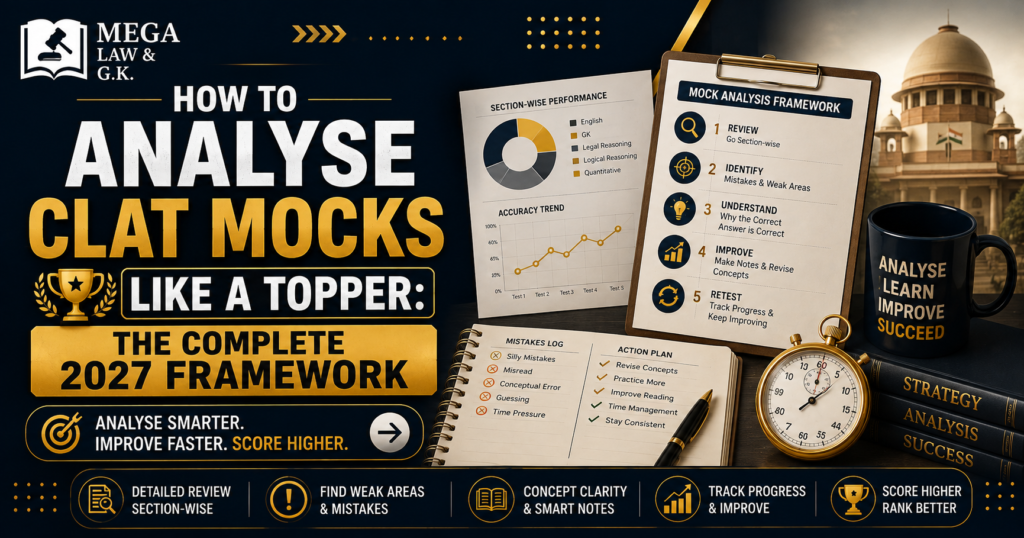
How to Analyse CLAT Mocks Like a Topper: The Complete 2027 Framework
QUICK ANSWER
To analyse a CLAT mock like a topper, don’t stop at your score. Run five steps every single time: split your score into attempted, correct, wrong, and skipped; audit the time you spent per section; categorise every wrong answer as silly, conceptual, guesswork, or time-pressure; log it in a running error log; and drill your top 3 recurring errors before the next mock. Toppers repeat this loop after every mock, not just the bad ones.
Most CLAT 2027 aspirants will take 40 to 60 mocks before December. Most of them will properly analyse maybe five of those mocks. The rest follow the same routine: open the mock, check the score, feel a spike of relief or dread, close the tab, and move to the next mock.
That is not analysis. That is just consuming a number. This guide walks you through exactly how to analyse CLAT mocks like a topper, step by step.
I have sat with 4,000+ students over 15+ years and reviewed their mock-taking habits, or the lack of them. The students who eventually cracked an NLU were rarely the ones with the highest score in October. They were the ones whose error log from mock 5 was empty of the mistakes that were still showing up in mock 25 for everyone else.
This is the exact 5-step framework I ask every War Room and SPARTA batch student to run after every mock, no exceptions, and no skipping it just because the score looked good.
Why Mock Analysis Matters More Than the Mock Itself
A mock test alone only tells you where you stand today. Analysis is what tells you why, and “why” is the only part of this you can actually act on before your next attempt. Learning how to analyse a CLAT mock like a topper actually would is what separates a number from a plan.
Picture two students who both score 78 out of 120 on the same mock. One re-reads the solutions for ten minutes and closes the laptop. The other spends 45 minutes categorising every single wrong answer. Eight weeks later, only one of them is scoring 95+.
The gap between your first mock and CLAT day is not more mocks. It is more analysis per mock, done in a way that actually changes what you do differently the next time.
“In 15+ years of teaching CLAT and AILET aspirants, I have never seen a student with a genuinely sharp, honest error log score outside the top percentile band. Not once. The mock is just data. The log is the actual preparation.”
— Manav Lawania, Founder, MEGA LAW & G.K.
The Topper's 5-Step Mock Analysis Framework
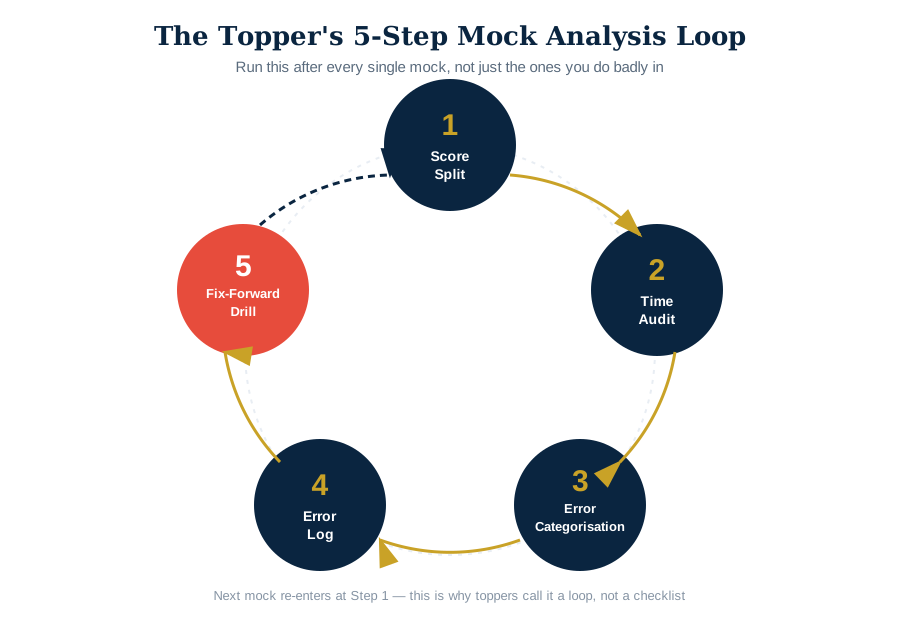
Step 1 — The Score Split
Before you touch a single question, break your total score into four numbers: attempted, correct, wrong, and skipped. Do this section-wise, not just for the overall paper.
This one split tells you whether your real problem is accuracy or speed. A student who attempted 100 questions and got 60 right has a completely different problem from a student who attempted only 70 and also got 60 right. The fix for each is not the same.
Step 2 — The Time Audit
Most mock platforms show section-wise time. If yours does not, note your start and end time per section by hand while attempting the mock.
Compare the time you actually spent against a sensible split for CLAT’s format, weighted toward the higher-weightage sections rather than split equally across all five. The Consortium of NLUs publishes the official exam pattern each year, so cross-check your section weightage against the latest notification rather than an old one.
If you are consistently running out of time in one section and finishing another with ten minutes to spare, that imbalance alone could be costing you 8 to 10 marks.
Step 3 — Error Categorisation
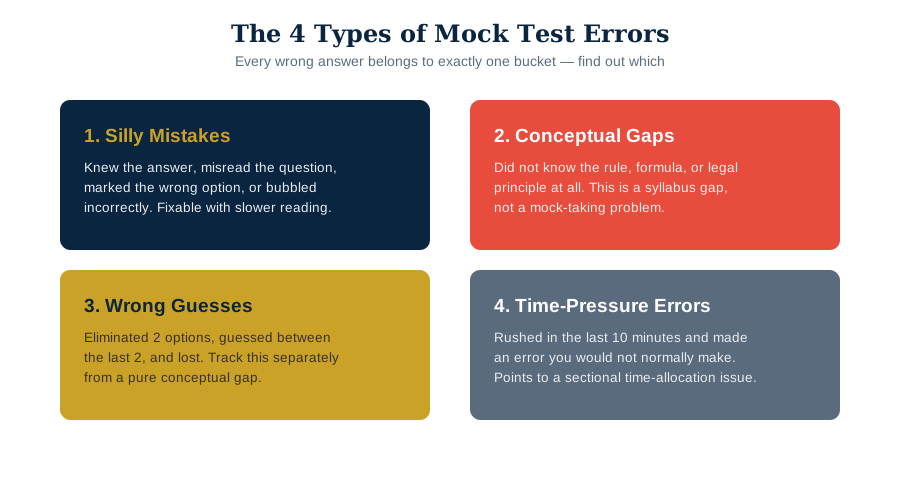
Go through every wrong answer and tag it with exactly one label: Silly, Conceptual, Guesswork, or Time-Pressure. Do not re-solve the question yet. Categorise first, fix later. This single habit is where most students learn how to analyse CLAT mocks like a topper instead of just reviewing answers.
Step 4 — Build the Error Log
An error log is a single running sheet, in Excel, Google Sheets, or even a notebook, with one row per wrong question: mock number, section, topic, error type, and a one-line note on the correct approach.
The point of the log is not record-keeping for its own sake. It is pattern-spotting. After four or five mocks, sort the log by error type or topic and look at what keeps repeating. That repeat pattern is your actual syllabus, not the official one.
Step 5 — The Fix-Forward Drill
Pick your top 3 recurring errors from the log, not all fifteen you might find. Trying to fix everything before the next mock fixes nothing. This is the step most guides on how to analyse CLAT mocks like a topper skip entirely.
Running this loop alone, mock after mock, is hard to sustain without a second pair of eyes. Our War Room and SPARTA batches include structured, mentor-led error-log reviews every week.
Section-Wise Mock Analysis: What to Check in Each Section
Knowing how to analyse CLAT Mocks like a topper also means going section by section , since each one breaks down differently.
English Language: Check whether your errors cluster in inference-based questions versus direct-recall questions. If you are slow here, the fix is usually reading speed, not vocabulary. Our reading comprehension strategy guide breaks this down further.
GK & Current Affairs: Separate static GK errors from current affairs errors. Static GK gaps mean you need a revision sheet. Current affairs gaps usually mean your daily reading habit has a blind spot in a specific area, like sports or international relations.
Legal Reasoning: Check if you are missing the principle-fact match or genuinely misapplying the principle. The first is a reading-speed issue. The second is a comprehension issue and needs targeted principle-based practice.
Logical Reasoning: This section rewards a clean process more than raw intelligence. If your errors are mostly in assumption or conclusion-based questions, revisit the core elimination method in our logical reasoning preparation guide.
Quantitative Techniques: With fewer questions in this section, even two or three silly calculation errors can swing your percentile noticeably. Track whether your Maths errors are calculation slips or actual concept gaps separately from every other section.
How Many Mocks Should You Actually Analyse This Deeply
Volume without analysis plateaus fast. Taking 30 mocks with no error log is not meaningfully different from taking 10.
A realistic cadence: run the full 5-step analysis on every single mock for your first 8 to 10 weeks of mock-taking. Once your error log shows that conceptual gaps have mostly disappeared and your errors are mostly silly or time-pressure related, you can shift to a lighter-touch analysis on regular mocks and reserve the deep 45-minute analysis for full-length mocks closer to CLAT.
5 Mistakes Students Make While "Analysing" Mocks
Even students who genuinely try to figure out how to analyse CLAT mocks like a topper fall into a handful of the same traps. Watch out for these five:
- Only reviewing wrong answers. Skip the ones you guessed right and you never catch the guesswork pattern that will fail you on a harder paper.
- Analysing once and never revisiting the log. An error log you do not reopen before the next mock is just a diary, not a tool.
- Treating every wrong answer the same. Skipping categorisation means you cannot tell a content gap from a speed problem.
- Comparing your raw score to friends. Compare your own error-type trend across mocks instead. That is the number that actually predicts CLAT day.
- Taking mock after mock with zero log entries. More attempts without analysis is just more exposure to the same mistakes.
Sample Error Log Template
Here is a simplified version of the error log format we use with our batches. Recreate this in a spreadsheet and add a row after every mock. This is the exact template we hand out to students learning how to analyse CLAT mocks like a topper for the first time.
| Mock # | Section | Topic | Error Type | Correct Approach (1 line) |
|---|---|---|---|---|
| Mock 14 | Logical Reasoning | Assumption-based | Conceptual | Assumption must bridge the gap, not just support the conclusion |
| Mock 14 | Legal Reasoning | Tort – principle application | Silly | Misread "defendant" as "plaintiff" in the fact pattern |
| Mock 15 | Quantitative Techniques | Percentage & Profit-Loss | Time-Pressure | Rushed calculation in the last 5 minutes, redo under a timer |
| Mock 15 | English | Inference-based RC | Guesswork | Eliminated to 2 options, guessed wrong; re-check keyword mapping |
Want help putting this into practice? Our mentors show you how to analyse CLAT mocks like a topper every week, with the full editable error-log template built into our batch structure.
Frequently Asked Questions
Should I analyse every CLAT mock or only the ones I score badly in?
Analyse every mock, not just the bad ones. A high score can still hide silly mistakes, lucky guesses, and time-pressure errors that will hurt you on a tougher paper. Toppers run the same 5-step analysis after a 95-percentile mock as after a 60-percentile one.
How long should CLAT mock analysis take?
Budget 45 to 60 minutes per mock: around 10 minutes for the score split and time audit, 25 to 30 minutes to categorise and log every wrong answer, and 10 minutes to pick your top 3 fix-forward targets. Rushing this defeats the point of doing it at all.
Should I re-attempt wrong questions immediately after the mock?
Categorise first, re-attempt later. Re-solving a question right after seeing the answer tests your memory, not your understanding. Log the error type, then re-attempt similar (not identical) questions two to three days later to check if the concept actually stuck.
My mock scores are not improving even though I analyse them. What am I missing?
Usually one of two things: you are logging errors but not actually drilling the top 3 patterns before the next mock, or you are miscategorising errors, treating conceptual gaps as silly mistakes. Re-check your log for the same topic repeating across three or more mocks.
What is the real difference between a topper's mock analysis and an average student's?
An average student checks the score and re-reads the solutions once. A topper runs a structured loop every time: score split, time audit, error categorisation, a written error log, and a fix-forward drill on the top 3 recurring mistakes before the next mock. The framework compounds. The mock itself does not. That loop is, in short, how to analyse CLAT mocks like a topper. If you are still in the early stage of building your overall preparation calendar before mocks even begin, our CLAT 2027 month-wise preparation strategy is a good place to start. For more on the exam itself, the CLAT overview on Wikipedia covers the exam's history and structure.

About the Author
Manav Lawania, India's Teens & Twenties Mentor. Founder of MEGA LAW & G.K. and UsefullBooks, Agra, Uttar Pradesh. Former Intelligence Officer, Cabinet Secretariat, Government of India. 15+ years of teaching experience and 4,000 to 5,000 students counselled for CLAT and AILET. Manav scored 13 out of 100 in Class 12 before rebuilding his own path, and that comeback is the lens he brings to every student he now mentors. He writes and teaches under the belief that CLAT preparation is as much about having the right data as it is about having the right mindset.