
3 Out of Every 4 CLAT Droppers Who Joined MEGA LAW & G.K. Improved Their Rank

QUICK ANSWER
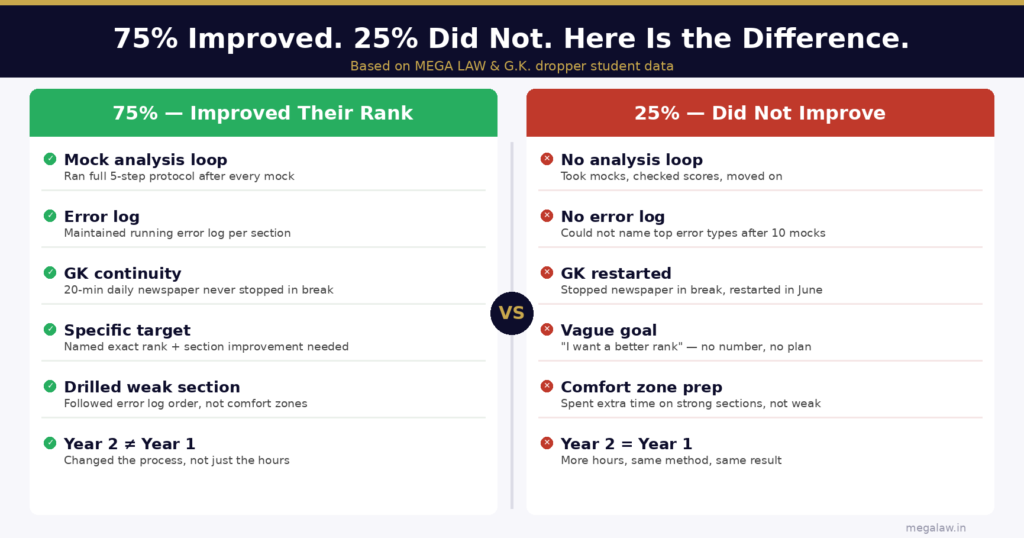
3 out of every 4 CLAT droppers who joined MEGA LAW & G.K. improved their rank on their second attempt — a 75% improvement rate across our dropper students.
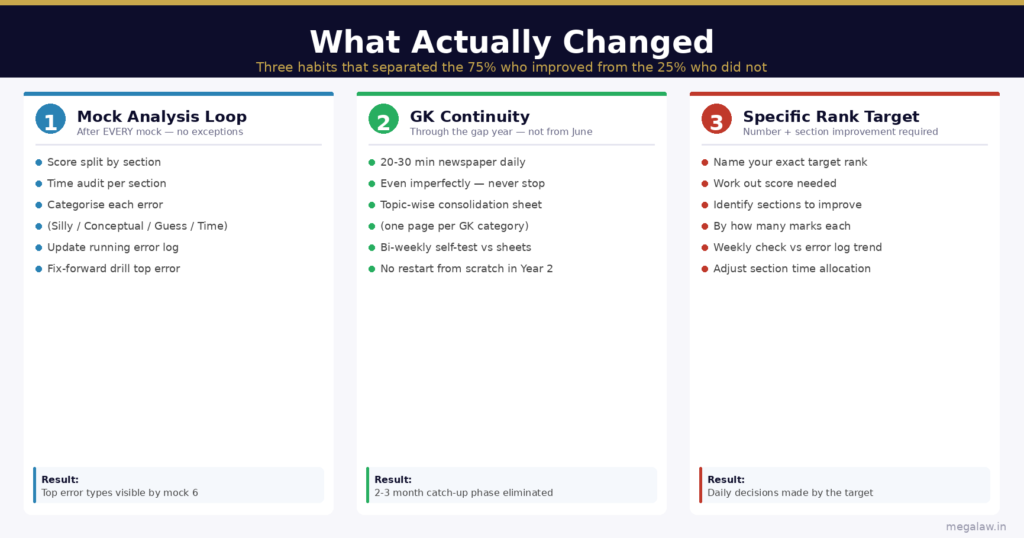
Three things changed:
- Mock analysis loop— full 5-step protocol after every mock (score split, time audit, error categorisation, error log update, fix-forward drill), not just checking scores
- GK continuity— daily newspaper habit maintained through the gap year instead of restarting from scratch in June
- Specific rank target— an exact numerical rank with section improvement required to reach it, not a vague aspiration
Example: Janvi Joshi moved from CLAT rank 1500 to AIR 8 after implementing all three changes in her second attempt.
Among CLAT droppers who joined MEGA LAW & G.K., 3 out of every 4 improved their rank on their second attempt. Not because they worked more hours. Not because the syllabus got easier. Because something specific changed in how they prepared — and it is the same thing in almost every case.
This post is not a sales pitch. If you read it and decide to prepare differently on your own, that is a good outcome. The point is to show you what the data from our own students tells us about why second attempts succeed or fail.
I have been teaching CLAT and AILET for 15+ years and have counselled over 4,000 to 5,000 students. The dropper students are the ones I watch most carefully — because their trajectory teaches me the most about what preparation actually does and does not do.
“A dropper who changes nothing except the number of hours they put in will almost certainly get approximately the same result. A dropper who identifies their specific error type and drills it systematically will almost certainly improve. The difference is not effort. It is direction.”
— Manav Lawania, Founder, MEGA LAW & G.K.
The Dropper's Trap: Why More Hours Does Not Mean a Better Rank
You already know the syllabus. You have read the legal reasoning principles. You have done enough mocks to understand the time pressure. You are not starting from zero — you are starting from around 60 to 70 percent of what the exam requires, and the question is how to close the remaining gap.
The instinct of most droppers is to go back to the beginning. Re-read the legal reasoning notes. Revise English from fundamentals. Cover the entire GK calendar again. This is understandable. It is also, in most cases, the wrong approach.
What you almost always find when you audit a dropper’s first attempt honestly is not a knowledge gap. It is a process gap. The legal reasoning errors were not because you did not know what negligence means — they were because you consistently misread the fact pattern. The GK errors were not because you had not read the news — they were because you had not consolidated what you read into something retrievable under pressure.
More hours studying the same material in the same way produces the same result, delivered with more confidence. The preparation process needs to change. The hours are almost always already enough.
What Actually Changed for the 75% Who Improved
Change 1: They started running the full mock analysis loop after every single mock.
In Year 1, most of these students took mocks and checked their scores. Almost none maintained a running error log that categorised every wrong answer into a type — silly, conceptual, guesswork, or time-pressure — and then used that categorisation to drive the next day’s drilling. In Year 2, that changed. Within 6 to 8 mocks, every student could name their top 3 recurring error types per section. Within 12 mocks, those error types were demonstrably reducing.
This is the single most reliable predictor of rank improvement across our dropper students. Students who ran the full analysis loop after every mock improved. Students who did not — even those who took more mocks — did not improve reliably.
Change 2: They maintained the GK habit through the gap year instead of restarting it.
After the first exam, most students stop reading the newspaper. The break is fine. But when the break extends to 3 or 4 months, the GK base erodes significantly and the student spends the first half of their gap year trying to recover ground rather than building on it.
The droppers who improved fastest had maintained a 20 to 30 minute daily newspaper habit through the gap period — even imperfectly. The ones who restarted from scratch spent 2 to 3 months just catching up to where they had been in Year 1.
Change 3: They set a specific rank target and worked backward.
“I want to improve my rank” is not a preparation goal. “I need to move from rank 1500 to rank under 100, which requires improving my Legal Reasoning score by 8 marks and my English RC score by 5 marks” is a preparation goal. It tells you exactly which sections to prioritise and whether your preparation is on track.
STUDENT STORY — REAL RESULT
Janvi Joshi — From Rank 1500 to AIR 8
CLAT 2025: Rank 1500 → CLAT 2026: AIR 8
After joining MEGA LAW & G.K. for the second attempt
Janvi came to us after her first CLAT attempt with a rank of 1500. Her Legal Reasoning error rate was high not because of conceptual gaps but because she was consistently misreading the fact pattern before applying the principle. Her GK coverage had strong breadth but poor consolidation. And her mock analysis had been limited to checking scores and briefly reviewing solutions, with no running error log. In the second attempt, she ran the full 5-step analysis after every mock, built and maintained a topic-wise GK consolidation sheet, and did targeted Legal Reasoning application drills daily on her specific error type. The result was AIR 8 — a move from rank 1500 to rank 8 nationally. The full story is at megalaw.in/janvi-joshi-rank-1500-to-air-8/
Year 1 vs Year 2 — What the Preparation Actually Looks Like
| Preparation Element | Typical Year 1 Approach | Year 2 Approach (for those who improved) |
|---|---|---|
| Mock analysis | Check score, briefly review solutions, move on | Full 5-step protocol after every mock — error log updated each time |
| GK preparation | Daily newspaper reading + weekly sessions | Daily newspaper + topic-wise consolidation sheets + bi-weekly self-tests against the sheets |
| Legal Reasoning | Re-read principles, then attempt questions broadly | Error-log identifies top error type → daily application drills on that specific type only |
| English RC | Practice passages, check answers | Timed passage practice (7 min per passage) with specific error-type categorisation after each |
| Preparation goal | "Improve my rank / get into a good NLU" | Specific rank target → section improvement required → weekly check against error log trajectory |
| Gap year GK habit | Stop completely after exam, restart in June/July | 20-minute daily newspaper maintained through gap, even imperfectly |
| Revision approach | Re-read syllabus in order from the beginning | Error-log order — revise by frequency of error, not by syllabus position |
The 5-Step Mock Analysis Loop That Drove Almost Every Improvement
Here is the exact 5-step protocol our dropper students ran after every mock in Year 2:
- Step 1 — Score split by section.Not overall score. Per-section: attempted, correct, wrong, skipped in each section. This tells you where marks are coming from and where they are leaking.
- Step 2 — Time audit.How many minutes in each section? Compare against an ideal distribution weighted toward stronger sections. Most droppers discover they have been spending too long on their weakest section — the opposite of the right strategy.
- Step 3 — Error categorisation.For every wrong answer, assign it to one of four types: Silly (knew it, made a careless error), Conceptual (genuinely did not understand), Guesswork (had no basis), or Time-Pressure (rushed). The fix for a silly error is completely different from the fix for a conceptual error.
- Step 4 — Error log update.Add every categorised wrong answer to your running error log. After 5 mocks, patterns emerge. After 10 mocks, you know your top 3 recurring error types per section. That is your preparation syllabus.
- Step 5 — Fix-forward drill.Before the next mock, spend 30 to 45 minutes drilling the top error type from the updated log. One thing at a time, driven by the log.
This loop took 45 to 60 minutes after each mock. Students who ran it improved. Students who skipped it — even those taking more mocks — did not improve at the same rate.
What the 25% Who Did Not Improve Had in Common
- They repeated Year 1’s preparation approach. Almost universally, they brought Year 1 habits into Year 2 — including not running a detailed error log. They worked the hours. They took the mocks. But they did not change the process, and the process was the problem.
- They treated GK as a catch-up exercise starting in July or August. Students who did not maintain any GK continuity through the gap year and tried to rebuild from scratch in the final 4 to 5 months consistently underperformed on GK relative to their first attempt.
- They studied in comfort zones. A dropper who scored 15 out of 30 in Legal Reasoning in Year 1 tends to spend disproportionate time on English RC in Year 2 — because English RC is a strength. Students who followed their instinct rather than the log did not close the gap that had cost them marks in Year 1.
- They took the drop under external pressure rather than genuine self-assessment. Preparation without a specific plan for change is just more of the same preparation repeated. The starting question for any dropper must be: what specifically will I do differently this year?
Should You Take a Drop Year for CLAT?
A drop year is worth it if: you know your Legal Reasoning error rate was high because of a specific, fixable pattern (not generic “I need to improve LR”). You have a specific rank target. You are genuinely willing to run the mock analysis loop after every mock. And you understand that the gap year GK habit must start immediately, not in June.
A drop year is likely to produce a similar result if: your plan is to study more of the same content with more hours. You do not have a specific rank target. You are dropping because you want to avoid a difficult decision about your current options. And your Year 1 mock analysis was limited to checking scores.
The decision to drop is not about time. It is about honesty — specifically, the ability to identify what preparation error cost you marks in Year 1 and commit to correcting it in Year 2. If you can do that, a drop year is one of the highest-return decisions a CLAT aspirant can make.
If you are deciding whether to drop: Before choosing a batch or coaching institute, spend 2 hours doing an honest error audit of your first attempt. Pull your last 5 mocks. Categorise every wrong answer. Identify your top 3 error types per section. If you can name specifically what you will drill to fix each one — you are ready to make a second attempt count. See the mock analysis framework at megalaw.in/how-to-analyse-clat-mocks-like-a-topper-the-complete/
Read Next
- Janvi Joshi: From CLAT Rank 1500 to AIR 8 — The Full Story
- How to Analyse CLAT Mocks Like a Topper
- CLAT Revision Strategy: How to Revise Without Starting From Scratch
- Your CLAT Rank vs NLU Reality — Honest Cutoff Data
- CLAT 2027 Self Study Plan — Crack CLAT Without Coaching in 4 Months
- CLAT Exam 2027 — Complete Guide, Syllabus & Pattern
Frequently Asked Questions
What percentage of CLAT droppers improve their rank on the second attempt?
Among CLAT droppers who joined MEGA LAW & G.K., 3 out of every 4 — approximately 75% — improved their CLAT rank on their second attempt. The improvement was not the result of working more hours. It was the result of changing the preparation method: replacing passive re-reading with active error-log-driven drilling, replacing mock-taking without analysis with the full 5-step mock analysis protocol, and correcting a persistent GK gap from the gap year. Droppers who maintained the same preparation approach from Year 1 into Year 2 rarely improved significantly, regardless of hours invested.
Why do most CLAT droppers fail to improve their rank?
The most common reason CLAT droppers do not improve their rank is that they bring the same preparation habits into their second attempt. A student who took 40 mocks in Year 1 without running proper analysis will take 40 mocks in Year 2 the same way and get broadly similar results. The preparation habit — not the preparation volume — is what determines whether the second attempt produces a different outcome. Droppers who fail to improve almost always have one of three patterns: mock-taking without analysis, GK discontinuity during the gap year, or over-reliance on familiar content rather than targeted error drilling.
What changes between a CLAT dropper's first and second attempt?
For droppers who improve, three things change: first, the mock analysis process — instead of checking the score, they run a full 5-step analysis (score split, time audit, error categorisation, error log update, fix-forward drill) after every mock. Second, the GK approach — instead of starting current affairs fresh in the gap year, they maintain a daily newspaper reading habit and topic-wise consolidation sheets throughout. Third, the target specificity — instead of 'I want to improve my rank,' they set a specific numerical target rank and identify the section improvement required to reach it, then drill that section systematically until the error rate drops.
Should I take a drop year for CLAT?
Taking a drop year for CLAT is worth it only if you can identify specifically what went wrong in the first attempt and change it in the second. If you know your Legal Reasoning error rate was high because you were misreading fact patterns, and you have a plan to drill application questions daily, a drop year is very likely to produce a significantly better outcome. If your plan is simply to study more of the same content you studied before, a drop year is unlikely to produce a meaningfully different result. The question to ask is not 'should I drop?' but 'what specifically will I do differently — and can I commit to that every day?'
How is CLAT preparation different for droppers vs first-time aspirants?
CLAT droppers enter the second attempt with a full conceptual base — they have covered the syllabus once, taken multiple mocks, and developed section-specific strengths. The preparation difference is in starting point: droppers do not need to build from scratch. They need to triage their existing performance data, identify their persistent error types, and spend the gap year fixing those specifically. First-time aspirants need to build foundation habits simultaneously with content coverage. Droppers need error-log-driven drilling and psychological reset — not re-reading of material they already know.

About the Author
Manav Lawania, India's Teens & Twenties Mentor. Founder of MEGA LAW & G.K. and UsefullBooks, Agra, Uttar Pradesh. Former Intelligence Officer, Cabinet Secretariat, Government of India. 15+ years of teaching experience and 4,000 to 5,000 students counselled for CLAT and AILET. Manav scored 13 out of 100 in Class 12 before rebuilding his own path, and that comeback is the lens he brings to every student he now mentors. He writes and teaches under the belief that CLAT preparation is as much about having the right data as it is about having the right mindset.