
Why Your CLAT Mock Score Is Not Improving, and How to Fix It
Quick answer
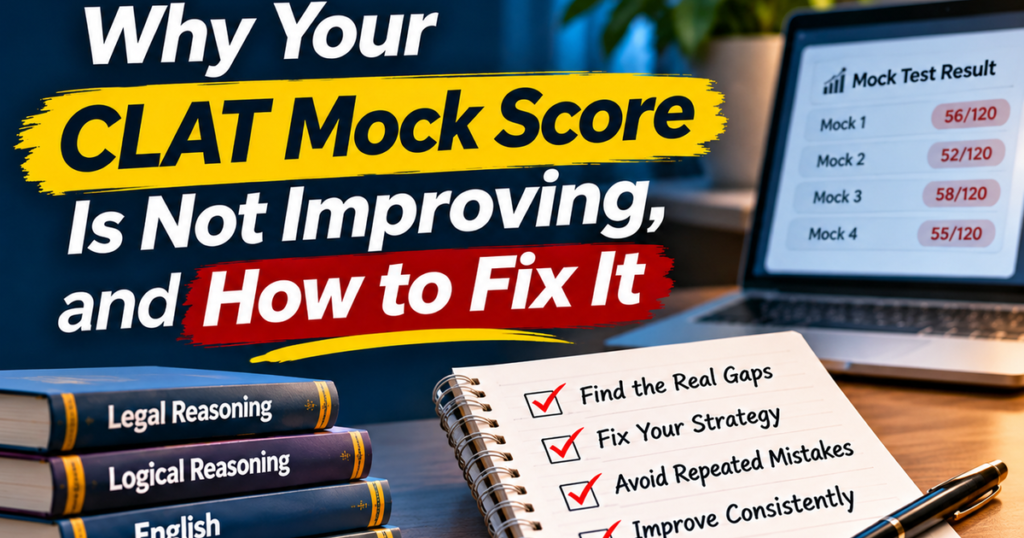
If your CLAT mock score is not improving, the problem is usually not effort. It is how you review. Most students attempt mock after mock and never find out why they lost marks. Fix three things: sort every wrong answer by cause, stop risky attempts, and work only on the section that leaks the most marks.
You are giving the mocks, you are checking the answers, and still the score sits at the same number. I have counselled 4,000 to 5,000 students, and this is one of the most common worries I hear in November. A CLAT mock score not improving for two or three weeks feels like proof that you are not good enough. It is not. It is a signal that something specific is stuck, and that something can be found.
CLAT 2027 is on Sunday, 6 December 2026, so the time to fix this is now. Here is how to find the real cause and fix it step by step.
Is It Normal for a CLAT Mock Score to Stop Improving?
Yes, up to a point. In the first few mocks you gain easily because you learn the paper pattern, the time pressure and the style of passages. After that, those easy gains are used up, and a plateau is normal.
But if your score has stayed flat for four or more mocks, it is no longer a plateau. It means the same mistakes are repeating, and taking another mock will not break the pattern. You need to change what you do after the mock, not how many you take.
How Do You Find the Real Reason Your Score Is Stuck?
Match what you see in your mocks with the table below. It takes five minutes and tells you where to look first.
| What you see | Likely cause | First fix |
|---|---|---|
| Score jumps up and down by 10 or more marks | Guessing, unstable accuracy | Use the 2-option rule (Reason 3) |
| Many wrong answers, very few skipped | Over-attempting under negative marking | Attempt only when you can defend the answer |
| Last 10 to 15 questions left blank | Slow passage reading, too long on one section | Timed passages and a fixed section order |
| One section is always weak | A knowledge gap, not a mock problem | Stop full mocks for 3 days, do targeted practice |
| You knew the answer but marked wrong | Silly mistakes, missed words like 'not' or 'except' | Error log and underline the qualifier |
| Score drops in later mocks | Panic, tiredness, or a new strategy every time | Pick one plan and keep it for 3 mocks |
Why Is Your CLAT Mock Score Not Improving? 7 Reasons
. You check the score but not the mistakes
The score tells you what happened. It does not tell you why. If you read the solutions, nod, and move to the next mock, you have only seen the answers, not your own thinking. Give the review at least 90 minutes for a full 2-hour mock, and spend most of it on the wrong and guessed questions.
2. You only look at the total score
Two mocks with the same total can have very different stories. In one, English is strong and Legal Reasoning is weak. In the other, it is the opposite. Always note marks, attempts, accuracy and time for each section. The official CLAT UG paper has 120 questions in 2 hours: English Language (22 to 26 questions), Current Affairs including GK (28 to 32), Legal Reasoning (28 to 32), Logical Reasoning (22 to 26) and Quantitative Techniques (10 to 14). Your section-wise table should follow that pattern.
3. Negative marking is quietly eating your score
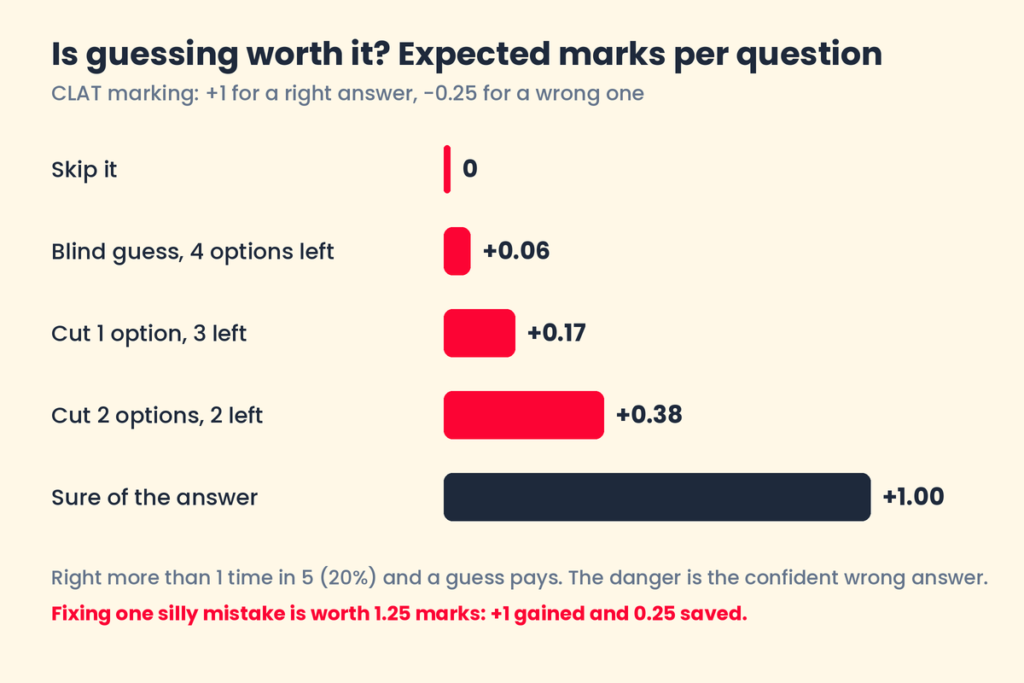
Every right answer gives you 1 mark and every wrong answer takes away 0.25. That sounds small, but it adds up. If you attempt 100 questions with 80 right and 20 wrong, your score is 80 minus 5, which is 75.
The useful rule is simple. A guess pays off only if you are right more than 1 time in 5. A blind guess among 4 options is barely positive (about +0.06 marks per question), but once you remove 2 options, the expected gain jumps to +0.38. So guess only after you cut options, never on a question you have not read properly. Our post on negative marking in passages goes deeper.
4. Passages are slow, so everything after them gets rushed
English, Current Affairs, Legal Reasoning and Logical Reasoning all give you a passage first and questions after it. If you read slowly, you lose time on the first sections and rush the rest. That is why many students see blank questions at the end of a mock. Practise passages with a timer, and read with a purpose: find the main idea, the author’s tone, and any word that changes the meaning. Read more in our guide to improving reading speed for CLAT passages.
5. You have no fixed section order or time plan
If you choose a new order every mock, you cannot learn what works. Decide your order and rough time per section before the mock starts, and keep it for at least three mocks. Then change one thing at a time. Our CLAT 2027 time management guide helps you build the plan.
6. You avoid the sections you are weak in
Current Affairs and Legal Reasoning carry 28 to 32 questions each, the biggest chunks of the paper. Quantitative Techniques is the smallest at 10 to 14 questions, which is exactly why many students skip it and leave marks on the table. A section you avoid stays weak. If GK is your weak point, start with the 30-day GK backlog plan.
7. You change your strategy after every mock
One bad mock and you drop your plan. Another bad mock and you switch again. With no fixed plan, you never know what worked. Change one thing, such as your guess rule or your section order, and test it for two or three mocks before judging it.
How Do You Review a CLAT Mock the Right Way?
This is the part that actually moves your score. Use the error log method after every mock.
- Ignore the rank first. Open your section-wise numbers: marks, attempts, accuracy and time.
- Redo every wrong question and every lucky guess without looking at the key. Note what you thought at that moment.
- Tag each one with a single cause from the table below.
- Count the tags. The cause that appears most is your real problem. Fix only that one before the next mock.
- Test it again in 48 hours. Solve 10 to 15 fresh questions on the same weak topic and see if the tag count drops.
| Error type | What it looks like | Fix |
|---|---|---|
| Knowledge gap | You did not know the concept, fact or rule | Study the topic, then solve 10 questions on it |
| Reading error | You misread the passage or missed a word like 'not' | Underline the qualifier before choosing an option |
| Silly mistake | Calculation slip, wrong bubble, wrong option copied | Slow down on easy questions, check the last step |
| Time pressure | You rushed or left the question blank | Practise timed sets, skip and return |
| Guess | You were unsure and marked anyway | Apply the 2-option rule, otherwise skip |
You can do this in a notebook or a spreadsheet. You can also use our CLAT Mock Analyser to look at your mock result section by section
What Does a Good Week of Mocks Look Like Before CLAT?
This is a simple pattern you can follow. It gives you about two full mocks a week and enough time to learn from each.
| Day | What to do |
|---|---|
| Day 1 | Full mock at 2 PM for 2 hours, the same time as the real paper |
| Day 2 | Review for 90 minutes and fill your error log |
| Day 3 | Fix the biggest error bucket with targeted practice |
| Day 4 | Full mock, with the same section order as Day 1 |
| Day 5 | Review and update the error log. Compare it with Day 2 |
| Day 6 | Timed passages or sectionals on your weakest section |
| Day 7 | Light revision of the error log. Rest your mind |
If you are in the last stretch, read our CLAT 2027 last 30 days strategy to fit this into a full plan.
How Many Marks Can You Win Back From Mistakes?
More than you think. Take the earlier example: 100 attempted, 80 right, 20 wrong, score 75. Say 6 of those 20 wrong answers were silly mistakes or reading errors. If you fix them, you now have 86 right and 14 wrong, and the score is 86 minus 3.5, which is 82.5. That is 7.5 more marks without learning anything new.
Each silly mistake you remove is worth 1.25 marks: 1 mark gained and 0.25 saved. This is why fixing errors beats adding more study hours.
Not sure what a score means for your target NLU? Try our college predictor and read the CLAT 2026 closing ranks to set a realistic target.
Still stuck on the same score?
Get guidance from a current NLU mentor
The problem: You know something is wrong, but you cannot see what.
The fix: At MEGA LAW & G.K., every batch has mentor groups of 10 students, and your mentor is a current NLU student who guides your preparation.
Read Next
- CLAT Mock Analyser
- CLAT College Predictor
- CLAT 2026 Closing Ranks: NLSIU, NALSAR, NLU Delhi
- CLAT 2027 Last 30 Days Strategy
- CLAT 2027 Time Management
CLAT Mock Score Not Improving: Your Questions Answered
Why is my CLAT mock score not improving even after many mocks?
Most often because the mocks are not being reviewed. If you only check the score and read the solutions, you repeat the same mistakes in the next paper. Sort every wrong answer by cause, fix the biggest cause first, and the score starts moving.
How many CLAT mocks should I take before the exam?
There is no official number. With a few weeks left, one full mock every 2 to 3 days, with a full review in between, helps more than one mock every day. A mock you do not review teaches you very little.
Is it normal to score low in CLAT mocks?
Yes. Mocks differ in difficulty from one provider to another, so compare your own trend across mocks and not your score with a friend's. CLAT 2027 is on 6 December 2026 from 2 to 4 PM, so what matters is that your accuracy and time use are getting better.
How do I analyse a CLAT mock test?
Start with section-wise numbers, not the total score. Redo every wrong or guessed question without the key, tag each one with a cause such as knowledge gap, reading error, silly mistake, time pressure or guess, and then fix the cause that shows up most.
Should I guess in CLAT with negative marking?
A right answer gives 1 mark and a wrong one costs 0.25, so a guess pays off if you are right more than 1 time in 5. A blind guess among 4 options is only slightly positive, but once you cut 2 options the expected gain is much better. Guess when you can remove options, not on questions you have not read.
How much time should I spend reviewing a mock?
Give the review at least 90 minutes for a full 2-hour mock. Most of that time should go on wrong and guessed questions, because those are where your marks are leaking.
What if my score drops close to the exam?
Do not change your whole strategy in the last few days. Look at your error log, find what repeated, and fix only that. A drop of a few marks in one mock is usually a time or attention issue, not a sign that you cannot do it.

About the Author
Manav Lawania, India's Teens & Twenties Mentor. Founder of MEGA LAW & G.K. and UsefullBooks, Agra, Uttar Pradesh. Former Intelligence Officer, Cabinet Secretariat, Government of India. 15+ years of teaching experience and 4,000 to 5,000 students counselled for CLAT and AILET. Manav scored 13 out of 100 in Class 12 before rebuilding his own path, and that comeback is the lens he brings to every student he now mentors. He writes and teaches under the belief that CLAT preparation is as much about having the right data as it is about having the right mindset.