
CLAT 2027 Paper Analysis: Difficulty Level, Good Attempts and Section Review
The short answer
Our CLAT 2027 paper analysis goes live on this page on the evening of 6 December 2026, right after the paper. Until then, use it for CLAT 2026 section by section, the last three years compared, good attempts maths and a method to estimate your score. Reports put good attempts near 105 last year.
- Exam: 6 December 2026, 2 to 4 PM, 120 questions, +1 and minus 0.25.
- Status: the CLAT 2027 analysis is added on 6 December, after the paper.
CLAT 2027 is on 6 December 2026, from 2 to 4 PM. This page will carry our team’s CLAT 2027 paper analysis the same evening. Until then, I have put here what you can use right now: last year’s paper section by section, how the last three papers compare, and a simple way to estimate your own score the moment you step out of the hall. Please come back after the paper for our view of the 2027 paper.
What Is a Good Attempt in CLAT?
A good attempt is not the number of questions you attempt. It is the number you attempt with high accuracy. Our own estimate for the CLAT 2027 paper will be added after the exam. For reference, reports after the last three papers put a good attempt at around 105.
The reason is simple. Each wrong answer costs 0.25, and you break even on a guess only when you are right one time in five. Here is an invented example, only to show the idea. A student who attempts 100 questions and gets 90 right and 10 wrong scores 90 minus 2.5, which is 87.5. A student who attempts 110, with 92 right and 18 wrong, scores 92 minus 4.5, which is 87.5. Same score, but the first student was calmer and took less risk. Our negative marking guide shows how to decide when to attempt.
How Does CLAT 2027 Compare With the Last Three Years?
It helps to see the paper next to the last three. This table is based on news and coaching analyses published after each exam, so please treat it as a reported picture and not an official record.
| Year | Overall difficulty (as reported) | Toughest section | Good attempts (as reported) |
|---|---|---|---|
| CLAT 2024 (3 Dec 2023) | Easy to moderate | Not clear in the reports | Around 105 or more |
| CLAT 2025 (1 Dec 2024) | Reports varied: easy to moderate, moderate, and moderate to tough | Reports differed. Some called Quantitative Techniques lengthy | Around 105 in most reports, 110 or more in a few |
| CLAT 2026 (7 Dec 2025) | Moderate | Logical Reasoning | Around 105 or more |
Two things stand out. The pattern has stayed at 120 questions in 2 hours for these years, and the “good attempts” figure in most reports has stayed close to 105. That is a reference, not a target. Your own accuracy decides how many you should attempt.
What Happened in CLAT 2026, Section by Section?
CLAT 2026 is the most recent paper, so it is the best reference for the 2027 paper. These are the section-wise details reported after the exam. The question counts come from one detailed question-wise analysis, and difficulty ratings differ between reports, so please read the table as a reported picture and not an official record.
| Section | Questions (reported) | Difficulty (reported) | Topics students mentioned |
|---|---|---|---|
| English Language | About 24 | Easy to moderate | Vocabulary heavy questions, with some literature based passages, as per one expert analysis |
| Current Affairs including GK | About 28 | Easy, and the highest scoring section | American taxation, the SCO, Air India, Pahalgam and other national and international events |
| Legal Reasoning | About 32 | Easy to moderate | Same-sex marriage, governance and basic legal principles |
| Logical Reasoning | About 24 | Moderate and tricky | Blood relations, ordering and sequences, coding and decoding, deductive puzzles and table based arrangement |
| Quantitative Techniques | About 12 | Easy in expert analyses, but some students found it tricky and long | Percentages, ratio and proportion |
Reports also said Logical Reasoning was time consuming, with one table based set easy to misread, while the GK questions were quick and direct. One analysis that compared the two years rated Logical Reasoning, Legal Reasoning and English a little harder in CLAT 2026 than in CLAT 2025, and Quantitative Techniques a little easier. Student feedback on Quantitative Techniques was not the same, which is why the table says so.
How Can You Estimate Your CLAT 2027 Score Right After the Paper?
You do not have to wait with a blank mind. Use your memory while it is fresh, but treat the result as a range.
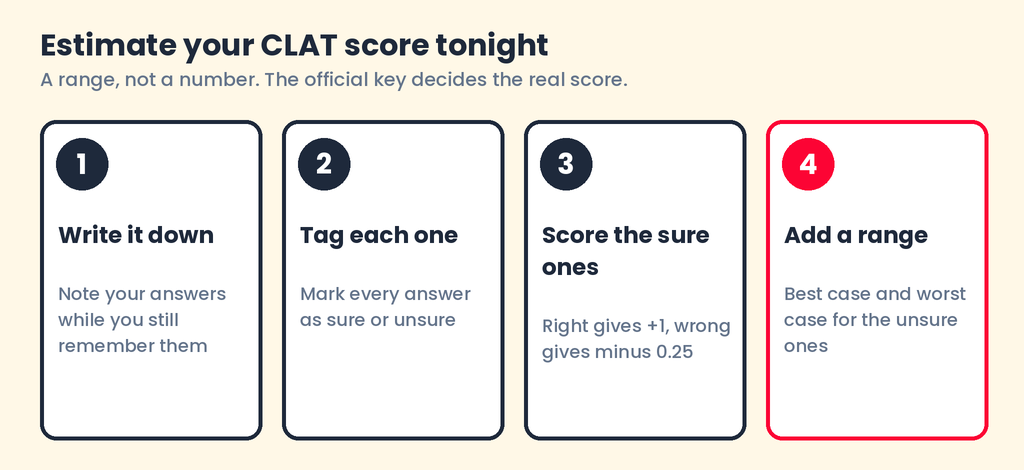
- Write down your answers for as many questions as you remember, section by section.
- Tag each answer as sure or unsure.
- Score the sure ones. Add 1 for each right and subtract 0.25 for each wrong.
- Give the unsure ones a range. Best case, if they are all right. Worst case, if they are all wrong.
This gives you a low and a high number, and your real score will most likely sit between them. Our mock analysis method works the same way, and so does the mock test guide.
Why Should You Not Trust the First Analysis Completely?
Analyses written on exam evening are quick views, and they often disagree. The CLAT 2025 paper is a good example. One news analysis called it easy to moderate, another called it moderate, a third called it moderate to tough, and an expert analysis later described CLAT 2025 as unusually easy compared with CLAT 2026. Even for CLAT 2026, expert analyses called Quantitative Techniques easy, while students quoted in a news report called it the toughest and longest section. Students also remember a hard section more than an easy one, which can make a paper feel tougher than it was. So please use any analysis, including ours, only as a rough picture.
What Should You Do After the Paper?
- Rest. Eat properly and sleep. Once the paper is over, nothing you worry about that night will change it.
- Avoid comparing answers in groups. Different memories lead to different answers, and it only creates stress.
- Do not guess your rank yet. It depends on how everyone else did too.
- Do not take big decisions. No drop year, no giving up, nothing, until you see the answer key and your result.
- Talk to someone. If you feel low, speak to a parent, a teacher or a counsellor. Our guide on handling exam stress may also help.
What Happens After the Paper: Answer Key, Result and Counselling?
Watch the official Consortium website for the answer key and the result date. For a rough idea of the timeline, in CLAT 2026 the result came on 16 December 2025, nine days after the paper, and counselling registration ran from 16 to 27 December, with the first allotment list on 7 January 2026, as per reports. The CLAT 2027 dates will be announced by the Consortium, so please do not rely on any date until then.
While you wait, you can read our CLAT 2027 expected cutoff guide, the rank to NLU guide, the marks vs rank guide and what to do after CLAT 2027. Our college predictor gives a rough range once you have your score.
AFTER THE PAPER
WAITING FOR YOUR RESULT?
The problem: you do not know what your score means for your colleges, and the waiting feels long.
The solution: talk to me one on one. We will read your score, plan your preference list and your backup options together.
How Does Mentorship Help After the Paper?
At MEGA LAW & G.K., every batch has mentorship from current NLU students, with one mentor for every 10 students. We also provide one-on-one mentorship to all students, taken by me for strategy and decision guidance. Query? WhatsApp us at +91 7983667303. If you are planning for CLAT 2028 instead, see our CLAT 2028 page and whether you need a CLAT mentor.
“The paper is over. What you do in the next few days is not studying. It is staying calm, so that you can make good decisions when the numbers come.”
Manav Lawania, Founder, MEGA LAW & G.K.
Read next on MEGA LAW
Frequently asked questions
When will the CLAT 2027 paper analysis be published?
We will add our team's analysis to this page on the evening of 6 December 2026, after the paper. It will cover overall difficulty, a section-wise review and good attempts. Until then, the page gives you last year's analysis and a method to estimate your score.
What is a good attempt in CLAT?
A good attempt is the number of questions you can answer with high accuracy, because each wrong answer costs 0.25. Reports after the last three papers put it at around 105. It changes with the paper's difficulty, so our own estimate for CLAT 2027 will be added after the exam.
Can I calculate my CLAT 2027 score before the answer key?
Only as a rough range. Write down your answers while you remember them, tag each as sure or unsure, score the sure ones and add a best case and a worst case for the unsure ones. The official answer key gives your real score.
Where will the CLAT 2027 answer key be released?
On the official Consortium website, consortiumofnlus.ac.in. In earlier years a provisional key came first and a final key came before the result, as reported, so keep checking the site and ignore keys from unofficial pages.
Is this paper analysis official?
No. It is our team's analysis based on student feedback and our own reading of the paper. Only the Consortium's answer key, result and allotment lists are official.
Will my rank depend on how hard the paper was?
Your rank depends on how you did compared with everyone else, not only on your marks. In a harder paper, marks go down for everyone, so a lower score can still give a good rank. That is why a rank is a better guide than marks alone.
What if I made many mistakes in the paper?
Do not decide anything tonight. Wait for the answer key, since some students do better than they felt. If the result is lower than you hoped, you still have options, and our guide on law colleges other than NLU explains them.
Should I plan for a drop year after CLAT 2027?
Not before you see your score and rank. A good decision needs real numbers and a clear reason for what will change in your preparation. Talk to a parent, a teacher or a mentor first.

About the Founder
Manav Lawania, India's Teens & Twenties Mentor. Founder of MEGA LAW & G.K. and UsefullBooks, Agra, Uttar Pradesh. Former Intelligence Officer, Cabinet Secretariat, Government of India. 15+ years of teaching experience and 4,000 to 5,000 students counselled for CLAT and AILET. Manav scored 13 out of 100 in Class 12 before rebuilding his own path, and that comeback is the lens he brings to every student he now mentors. He writes and teaches under the belief that CLAT preparation is as much about having the right data as it is about having the right mindset.