
CLAT 2027 Marks vs Rank: How Your Score Translates to an NLU

In CLAT 2027, the difference between NLSIU and RMLNLU is roughly 7 to 8 marks out of 120. Here’s the exact score-to-rank translation based on CLAT 2026 verified data.
- 105 to 107 marks: approximately rank 70 to 150 NLSIU Bangalore range
- 103 to 105 marks: approximately rank 150 to 320 NALSAR Hyderabad range
- 100 to 103 marks: approximately rank 320 to 600 NUJS Kolkata and NLUJ/GNLU range
- 97 to 100 marks: approximately rank 600 to 1,350 RMLNLU Lucknow and HNLU Raipur range
- In the 93 to 107 marks band, one mark moves your rank by 200 to 500 positions
- Category students (SC/ST/OBC/EWS) have lower score requirements at every NLU
Every CLAT student knows their target score. But there’s a number they actually need to know first: what rank does that score produce? And then, what NLU does that rank get?
Most students get the score right. They understand the syllabus, they know their weak sections, they’ve taken mocks. But they have a blurry idea of what their score actually means in terms of rank and a completely unclear picture of how rank translates to a specific college.
I want to fix that with this piece. I’ve been teaching CLAT for 15+ years, and the score-to-rank gap is one of the most consistent sources of confusion I see in October and November every year, when students are in their final preparation stretch.
Here’s everything you need to know, based on CLAT 2026 data the most recent verified figures available before CLAT 2027 results.
How CLAT 2027 scoring actually works
Before we get to the translation table, let’s be precise about how your score is calculated. CLAT 2027 has 120 questions, each worth 1 mark. There’s a negative marking of 0.25 marks for every wrong answer. Questions you leave unattempted carry no penalty.
So your raw score = correct answers minus (0.25 x wrong answers). If you attempt 108 questions, get 101 right and 7 wrong: 101 minus 1.75 = 99.25 marks. That’s your score.
The attempt strategy matters more than people realise. A student who skips 12 questions and gets 98 right out of 108 attempted scores 98 minus 2.5 = 95.5. A student who attempts all 120 and gets 98 right but 22 wrong scores 98 minus 5.5 = 92.5. Same number of correct answers, very different scores. In CLAT 2027, knowing when to skip is part of the exam.
The critical band: where one mark changes your NLU
Here’s the thing most students don’t realise until they’ve seen rank data from a properly calibrated mock.
In CLAT 2026, roughly 75,000 students appeared. The total seats across all 27 NLUs are around 2,500 for the general category. That means roughly the top 3.3% of students get into an NLU. And most of those admissions are concentrated in a narrow score band.
This is the critical band. It’s where every CLAT student who wants an NLU is competing. And it’s why score consistency not just studying more is what determines your rank in this exam.
“I’ve seen students score 101 in one mock and 96 in the next, same week. That 5-mark swing is the difference between NUJS Kolkata and not making it to any NLU. Score consistency in the critical band is the most underrated skill in CLAT preparation.”
Manav Lawania, Founder, MEGA LAW & G.K.
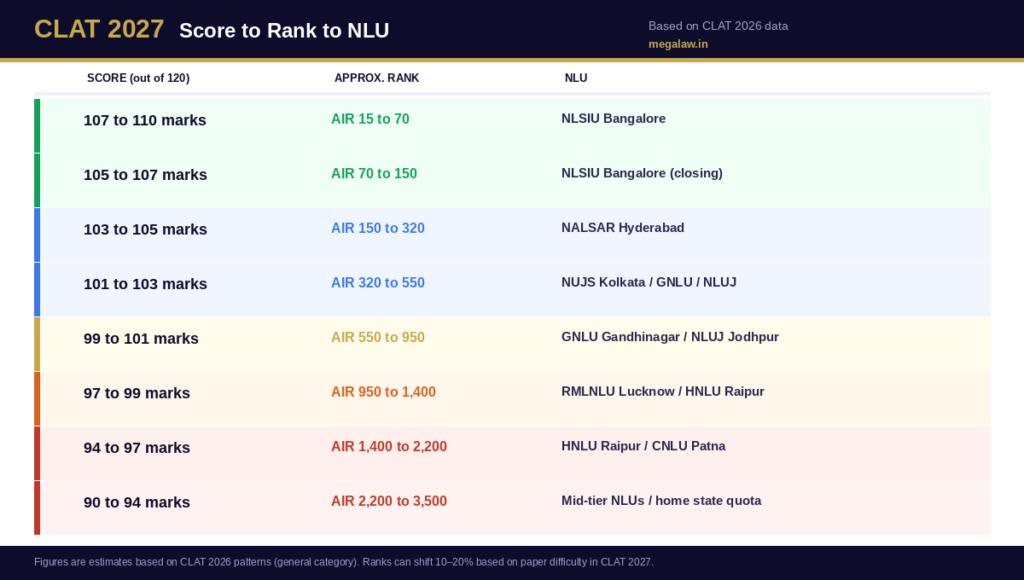
CLAT 2027 marks to rank: the translation table
These are estimated rank ranges based on CLAT 2026 score distribution patterns. Actual 2027 ranks will depend on paper difficulty and total candidates. Treat this as a working guide, not a guarantee. Figures are for the general category.
| Score out of 120 | Approximate Rank (General) | NLU within reach | Based on |
|---|---|---|---|
| 110 and above | AIR 1 to 15 | NLSIU Bangalore (top seats) | CLAT 2026 pattern |
| 107 to 110 | AIR 15 to 70 | NLSIU Bangalore | CLAT 2026 pattern |
| 105 to 107 | AIR 70 to 150 | NLSIU (closing), NALSAR Hyderabad | CLAT 2026 pattern |
| 103 to 105 | AIR 150 to 320 | NALSAR Hyderabad, NUJS Kolkata (entering) | CLAT 2026 pattern |
| 101 to 103 | AIR 320 to 550 | NUJS Kolkata, GNLU Gandhinagar, NLUJ Jodhpur | CLAT 2026 pattern |
| 99 to 101 | AIR 550 to 950 | GNLU/NLUJ, RMLNLU Lucknow (entering) | CLAT 2026 pattern |
| 97 to 99 | AIR 950 to 1,400 | RMLNLU Lucknow, HNLU Raipur | CLAT 2026 pattern |
| 94 to 97 | AIR 1,400 to 2,200 | HNLU Raipur, CNLU Patna, NLUs ranked 8 to 12 | CLAT 2026 pattern |
| 90 to 94 | AIR 2,200 to 3,500 | Mid-tier NLUs (varies by home state) | CLAT 2026 pattern |
| 85 to 90 | AIR 3,500 to 6,000 | Lower NLUs with home state quota | CLAT 2026 pattern |
| Below 85 | AIR 6,000 and beyond | AILET, SLAT, private law colleges | CLAT 2026 pattern |
What score does each NLU actually require?
Now let’s reverse the question. Instead of “what rank does my score give?” let’s ask “what score do I need for the NLU I want?” Here are the realistic score targets based on CLAT 2026 verified closing data.
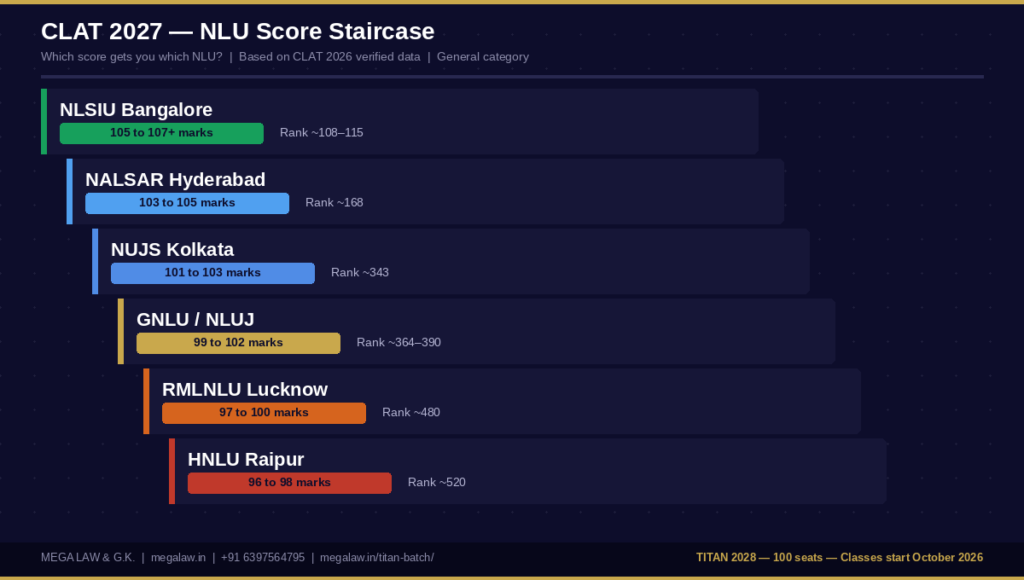
NLSIU Bangalore Score target: 105 to 107+ marks
NLSIU closed at approximately rank 108 to 115 in CLAT 2026 general category. That’s roughly 105 to 107 marks. It’s the toughest target in CLAT you’re competing with the top 0.15% of all students who appear. One wrong question in Legal Reasoning can take you out of the range.
NALSAR Hyderabad Score target: 103 to 105 marks
NALSAR closed at approximately rank 168 in CLAT 2026. That corresponds to roughly 103 to 105 marks. It’s one of the most consistently competitive NLUs in India. The difference between getting NALSAR and missing it is often a single question in English or Current Affairs.
NUJS Kolkata Score target: 101 to 103 marks
NUJS closed at approximately rank 343 in CLAT 2026. You’re looking at roughly 101 to 103 marks. NUJS has consistently strong placement records, and this is a realistic target for students who’ve been preparing since Class 11 with a good system in place.
GNLU Gandhinagar and NLUJ Jodhpur Score target: 99 to 102 marks
Both GNLU and NLUJ closed in the 360 to 390 range in CLAT 2026. That’s roughly 99 to 102 marks. These are genuinely excellent NLUs with strong placement outcomes. If your score is around 100, this is your core target range.
RMLNLU Lucknow Score target: 97 to 100 marks
RMLNLU closed at approximately rank 480 in CLAT 2026. You need roughly 97 to 100 marks. It’s a Tier 1 NLU with strong campus placement. Being in UP gives home state students an additional advantage here, though the general category seats are competitive.
HNLU Raipur Score target: 96 to 98 marks
HNLU closed at approximately rank 520 in CLAT 2026 general category. Roughly 96 to 98 marks. A consistent, well-regarded NLU. Students aiming here should also be preparing their Round 2 and 3 strategy for potential upgrades to GNLU or NLUJ.
Category cutoffs: SC, ST, OBC and EWS
Everything above is for the general category. If you’re a reserved category student, your score requirements are significantly lower at every NLU. Here’s an approximate picture based on CLAT 2026 data.
| NLU | General Cutoff (approx. rank) | OBC Cutoff (approx. rank) | SC Cutoff (approx. rank) | ST Cutoff (approx. rank) |
|---|---|---|---|---|
| NLSIU Bangalore | 108 to 115 | 300 to 400 | 700 to 900 | 1,200 to 1,600 |
| NALSAR Hyderabad | 168 | 450 to 550 | 900 to 1,200 | 1,800 to 2,400 |
| NUJS Kolkata | 343 | 750 to 900 | 1,500 to 1,900 | 2,800 to 3,500 |
| GNLU Gandhinagar | 370 | 800 to 1,000 | 1,800 to 2,200 | 3,200 to 4,000 |
| NLUJ Jodhpur | 364 | 820 to 1,000 | 1,700 to 2,100 | 3,000 to 3,800 |
| RMLNLU Lucknow | 480 | 950 to 1,200 | 2,000 to 2,600 | 3,800 to 4,800 |
| HNLU Raipur | 520 | 1,100 to 1,400 | 2,200 to 2,800 | 4,200 to 5,200 |
These category figures are approximate estimates based on CLAT 2026 patterns. OBC/SC/ST cutoffs are not always officially published and vary significantly by counselling round. If you’re a reserved category student, the range above is for directional planning. Always check official NLU seat matrices once they’re released.
Why 3 marks is the real gap between NLUs
Here’s the number that should change how you think about CLAT preparation from this point on.
From NLSIU to HNLU, the score difference is roughly 7 to 9 marks. That’s 7 questions, in an exam of 120. Less than 6% of the total paper separates the top NLU from the seventh. And the gap between any two consecutive NLUs in the top 7 is usually 1 to 3 marks.
So if you’re scoring 96 right now in your mocks and targeting NLUJ Jodhpur, you don’t need a transformation. You need 4 to 5 more marks. That’s 4 questions where you’re currently wrong and can be right. That’s a specific, solvable problem. Not a vague “study harder” instruction.
“Every student I’ve taught who got into a top-5 NLU could point to the specific error type they fixed in the last 60 days of preparation. It was always something specific. A comprehension habit. A principle identification mistake. A negative marking decision they changed. Not a general improvement. A specific one.”
Manav Lawania, Founder, MEGA LAW & G.K.
How to use this data to set your score target
Don’t just pick a score number that sounds good. Work backwards from the NLU you want to the rank you need to the score you have to hit. Then compare that to what you’re actually scoring in mocks right now.
The gap between your current mock average and your target score is your actual preparation problem. Everything else the number of hours, the material you’re using, the sections you’re studying should be in service of closing that specific gap.
If your current mock average is 93 and you want NUJS (needs about 102), you’re 9 marks short. That’s a big gap with 2 months left before CLAT 2027. Possible to close, but it requires specific diagnosis: which 9 marks are you leaving on the table, and why?
If your mock average is 98 and you want GNLU (needs about 100 to 102), you’re 2 to 4 marks short. That’s very closeable. You need to find the 2 to 4 questions per paper where you’re consistently making a recoverable error.
What this means for CLAT 2028 students in Class 11
If you’re in Class 11 reading this, you have a genuine advantage. You can see exactly what score you need for the NLU you want. You have 15 months before CLAT 2028. And you can build your entire preparation around hitting that specific number with consistency.
The students who get to NLSIU in 2028 aren’t going to be the ones who studied the most. They’re going to be the ones who started in October 2026, built their approach correctly from Week 1, and had someone checking their error patterns every month.
That’s what TITAN 2028 is built for. If you want to talk about where you stand right now and what score is realistic for you given your current preparation, WhatsApp me at +91 6397564795. That conversation is free and takes 10 minutes.
Read Next

About the Author
Manav Lawania, India's Teens & Twenties Mentor. Founder of MEGA LAW & G.K. and UsefullBooks, Agra, Uttar Pradesh. Former Intelligence Officer, Cabinet Secretariat, Government of India. 15+ years of teaching experience and 4,000 to 5,000 students counselled for CLAT and AILET. Manav scored 13 out of 100 in Class 12 before rebuilding his own path, and that comeback is the lens he brings to every student he now mentors. He writes and teaches under the belief that CLAT preparation is as much about having the right data as it is about having the right mindset.