
CLAT Mock Tests: How to Take, Analyse and Improve

The short answer
To use CLAT mock tests well, take each mock under real exam conditions, analyse every wrong and skipped question, find your top two leaks and fix them before the next mock. A mock is a practice tool, not a verdict. One mock with a full review beats two mocks without one.
- CLAT 2027: 120 questions, 120 minutes, +1 and minus 0.25.
- Take the loop: take, analyse, fix, retest.
Every year I see two kinds of students. One takes a mock, looks at the score, feels good or bad, and moves on. The other takes a mock, sits with it for two hours and finds exactly where the marks went. The second student improves. This guide is everything I know about CLAT mock tests: how many to take, how to take them, how to analyse them and how to raise your score. I have counselled 4,000 to 5,000 students, and this is the one habit that separates those who improve from those who do not.
What Is the Purpose of a CLAT Mock Test?
A mock test is not meant to tell you whether you will crack CLAT. It is meant to show you what to fix. Think of it as a mirror. It shows where you lose marks: in reading speed, in a weak section, in careless mistakes or in wrong guesses.
The real CLAT is a 120 question paper in 2 hours, with each right answer giving +1 and each wrong answer costing 0.25. Your mocks should train for exactly that: the pace, the stamina and the decisions. For the full pattern, read our CLAT exam guide.
How Many CLAT Mock Tests Should You Take?
This depends on how much time you have. Here is what I suggest. Please adjust it to your own situation.
| Time left | Full mocks | Focus |
|---|---|---|
| 6 months or more | One every 2 weeks, with sectional tests in between | Build concepts. Use mocks to see where you stand. |
| 3 months | One a week | Fix weak sections. Start reviewing every mock fully. |
| Last 30 days | One every 2 or 3 days | Attempt strategy, time management, error log. |
| Last 2 weeks | One every second day, at 2 PM | Stamina and accuracy. Keep calm. |
| Last 3 days | One light mock at most | Confidence only. No new topics. |
The rule behind every row is the same: never take a new mock until you have finished analysing the last one.
How to Take a CLAT Mock Test the Right Way
A mock taken casually gives you a casual result. Use these steps so that the mock is close to the real paper.
- Fix the slot. CLAT 2027 is scheduled from 2 to 4 PM, so take your mocks at 2 PM, at least in the last month.
- Sit for the full 120 minutes. No pauses, no phone, no water breaks outside what the real exam would allow.
- Plan your attempt order before you start. Decide which section you open first and how many minutes each section gets. Our time management guide helps with this.
- Mark doubtful questions as you go. Do not waste five minutes on one question.
- Do not check answers during the test. Wait until you finish.
What Should You Track After Every CLAT Mock?
The score alone is not enough. Write down these numbers for every mock, and watch how they change over time.
| What to track | How to find it | What it tells you |
|---|---|---|
| Marks | Right answers minus 0.25 for each wrong answer | Your overall result |
| Attempts | Questions you answered | Your attempt strategy |
| Accuracy | Right answers divided by attempts | Whether you attempt too many guesses |
| Negative marks | Wrong answers multiplied by 0.25 | Marks you gave away |
| Section-wise time | Minutes spent on each section | Where time runs out |
| Silly mistakes | Questions you knew but got wrong | Reading and care |
Here is a made-up example only, so you can see how it works. Suppose a student attempts 108 questions, gets 72 right and 36 wrong. The negative marks are 36 multiplied by 0.25, which is 9. The score is 72 minus 9, which is 63. The accuracy is 72 divided by 108, which is about 67 percent. If the student raises accuracy by cutting a few weak guesses, the score can go up even with fewer attempts. This is invented to show the method, not a target.
How to Analyse a CLAT Mock Test Step by Step
This is the part most students skip, and it is where the improvement happens. I explain it in detail in our guide on how to analyse a CLAT mock test. Here is the short version:
- List every wrong and skipped question. Do not leave out the ones you guessed correctly either.
- Give each one a tag. Concept gap, silly mistake, time pressure or guess gone wrong.
- Count the tags. The biggest group is your biggest leak.
- Pick the top two leaks. Do not try to fix ten things at once.
- Write one action for each. For example, read the passage question first, or revise one topic.
Want this done for you in minutes? Put in your mock details and see your section-wise gaps in one place.
Why Is Your CLAT Mock Score Not Improving?
If your score has been stuck for weeks, it is rarely because you are not studying enough. Look at these common reasons:
- Mocks without analysis. You take many mocks and learn nothing from them.
- The same mistakes repeat. You do not keep an error log.
- Too many weak guesses. Negative marks eat your gains.
- Slow reading. You run out of time in the passage sections. See our reading speed guide.
- One weak section pulls you down. A strong section cannot cover it.
- Stress. You know the answers but panic on the day. Read how to overcome exam fear before CLAT.
I have written a full guide on this, why your CLAT mock score is not improving, with the fixes for each cause.
How to Improve Your CLAT Mock Score: The Loop
Improvement comes from repeating a simple loop, not from adding more mocks.
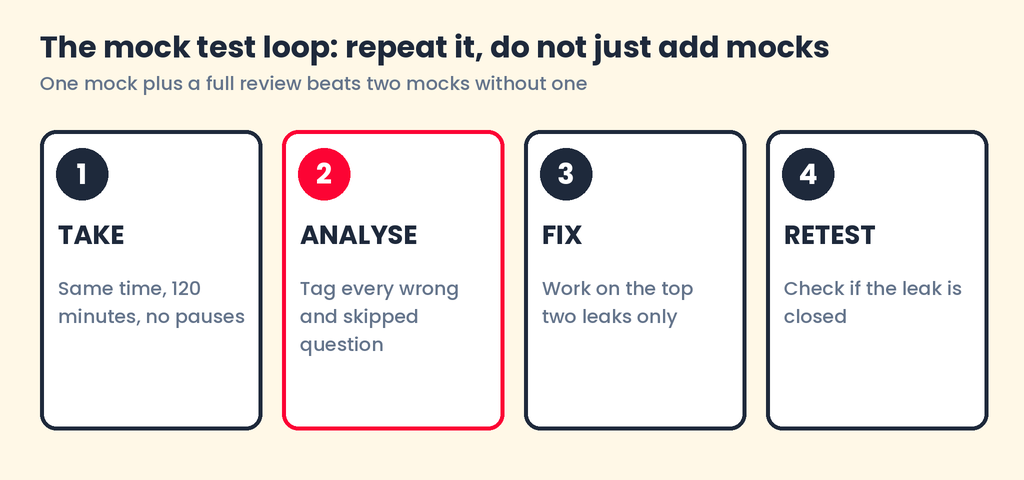
After each mock, work on your top two leaks for the next two days, and then take the next mock. Check one thing only: did those two leaks get smaller? If yes, the loop works. If not, change the fix, not the mock.
Should You Attempt Every Question? Guessing and Negative Marking
CLAT costs you 0.25 for a wrong answer. Here is the simple maths. If you are right on a question one time in five (20 percent), you break even. If you are right more often than that, attempting the question gains marks on average. So when you can remove even one or two options, attempting usually makes sense, and a blind guess is close to neutral.
But please do not build your whole strategy on guessing. It is much better to raise your accuracy by reading carefully. Our guide on negative marking and passages shows how to decide when to attempt.
Sectional Tests or Full Mocks: Which Do You Need?
- Sectional tests are best early on. They help you fix a weak section, such as Legal Reasoning or QT, without spending two hours.
- Full mocks are essential as the exam comes closer. They train stamina, time management and the order in which you attempt sections.
If you want focused practice, the English passages workbook and the QT workbook from MEGA LAW Books can fit into your sectional work.
Which CLAT Mocks Should You Attempt?
Do not collect mock series. Choose a few good ones and finish each properly. A good mix is:
- The Consortium’s own official mock tests, since they come from the exam body. Check its website for them.
- Previous year papers, to feel the real style.
- A good full-length series with detailed solutions, such as our full CLAT mock.
Do not judge a mock by how hard or easy it felt. Judge it by what it taught you.
What Mistakes Should You Avoid With Mock Tests?
- Comparing your score with others. Compare only with your own last mock.
- Taking a mock every day. You will not have time to analyse it.
- Changing your whole plan after one bad mock. Trends matter, not one day.
- Ignoring the answer explanations. They teach you the method.
- Treating mock scores as a rank guarantee. Use them as a rough guide only.
Can You Use Mock Scores to Plan Your NLU Options?
You can use them as a rough guide, not a promise. Mocks differ in difficulty, so a score in one mock may not match the real paper. Look at your trend over several mocks. Then use our college predictor, the rank to NLU guide and the marks vs rank guide to see a planning range.
If you are in the last weeks, read how to revise for CLAT 2027 and the last 25 days plan to use mocks well in that time.
Our Mock Test Guides in One Place
| Read this | When you need it |
|---|---|
| How to Analyse a CLAT Mock Test | You take mocks but do not know what to do with them. |
| Why Your CLAT Mock Score Is Not Improving | Your score has been stuck for weeks. |
| CLAT Mock Analyser | You want your section-wise gaps quickly. |
| Full CLAT Mock Test | You want to practise under exam conditions. |
| CLAT Time Management | You run out of time in the paper. |
| Negative Marking and Passages | You are unsure when to attempt or skip. |
MOCKS THAT TEACH
STOP TAKING MOCKS WITHOUT A PLAN
The problem: many students take mock after mock and still do not know why the score is stuck.
The solution: a full mock under exam conditions, a clear way to analyse it and a mentor to guide the fixes. Start with a full mock.
How Does Mentorship Help You Improve Mock Scores?
At MEGA LAW & G.K., every batch has mentorship from current NLU students, with one mentor for every 10 students. We also provide one-on-one mentorship to all students, taken by me for strategy and decision guidance. Query? WhatsApp us at +91 7983667303.
“A mock is not a judge. It is a teacher. Sit with it, listen to what it says and then fix one thing at a time.”
Manav Lawania, Founder, MEGA LAW & G.K.
Read next on MEGA LAW
Frequently asked questions
How many mock tests should I take before CLAT?
There is no magic number. In the last month, one mock every two or three days, with a full review of each, is enough for most students. Quality matters more than count, because a mock you do not analyse teaches you very little.
What is a good score in a CLAT mock test?
It depends on the difficulty of the mock and on your target NLU, so do not chase one number. Watch your trend over several mocks, your accuracy and your negative marks. Then use our rank and NLU guides for a rough idea of where a score may lead.
Why is my CLAT mock score not improving?
Usually because mocks are being taken but not analysed, or because the same mistakes repeat. Slow reading, wrong guesses and one weak section are the common causes. Find your top two leaks and fix those before you take the next mock.
Should I take mocks at 2 PM?
Yes, at least in the last month. CLAT 2027 is scheduled from 2 to 4 PM, so practising in the same slot trains your mind and your energy for that time of day.
Should I attempt every question in a CLAT mock?
No. You lose 0.25 for every wrong answer, so attempt what you can solve well. If you are right on a question more than one time in five, attempting it gains marks on average, but never build your whole strategy on guessing.
Are sectional tests better than full mocks?
Both help. Sectional tests are good for fixing a weak section early on. Full mocks are needed to practise stamina, time management and your attempt order, so they matter more as the exam gets closer.
Can I rely on my mock score to predict my NLU?
Treat it as a rough guide only. Mocks differ in difficulty and the real paper can feel different, so use mock scores for trends and not as a promise. Our predictor gives a planning range, not a guarantee.
What should I do after a bad mock?
Take a short break first, then review it calmly the same day. Tag the mistakes, pick the biggest leak and work on it for two days. One bad mock is one day's result, and it does not decide the paper.

About the Founder
Manav Lawania, India's Teens & Twenties Mentor. Founder of MEGA LAW & G.K. and UsefullBooks, Agra, Uttar Pradesh. Former Intelligence Officer, Cabinet Secretariat, Government of India. 15+ years of teaching experience and 4,000 to 5,000 students counselled for CLAT and AILET. Manav scored 13 out of 100 in Class 12 before rebuilding his own path, and that comeback is the lens he brings to every student he now mentors. He writes and teaches under the belief that CLAT preparation is as much about having the right data as it is about having the right mindset.