
How to Analyze Your CLAT Mock Test: A Step-by-Step Guide
The short answer
To analyze a CLAT mock test, look at section-wise numbers first, not the total score. Then redo every wrong or guessed question, tag each mistake with one cause, work out your accuracy and time per section, and set one target for the next mock. Do it within 24 hours, while the paper is fresh.
- Plan 90 minutes to 2 hours for a full 2-hour mock.
- Track 5 things: marks, attempts, accuracy, marks lost to negatives and time.
- Fix only your biggest error bucket before the next mock.
Many students take a mock, check the score, feel good or bad for an hour, and start the next one. After a month they have done ten mocks and learned almost nothing. I have counselled 4,000 to 5,000 students, and the ones who improve fastest are not the ones who take the most mocks. They are the ones who know how to analyze a CLAT mock test properly.
Why Is Analyzing a CLAT Mock Test More Important Than Taking One?
CLAT UG has 120 questions in 2 hours, each worth 1 mark, with 0.25 deducted for every wrong answer. In a paper this tight, a few marks decide a lot. Our marks vs rank guide shows how a few marks can change the NLU you get.
A mock gives you data. Analysis turns that data into marks. Without analysis, you only know that you lost marks. With it, you know where, why and how to stop.
How Do You Analyze a CLAT Mock Test Step by Step?
Follow these six steps in order. Keep your question paper, the answer key and a notebook (or a spreadsheet) ready.
Step 1: Analyze within 24 hours, and do not look at the rank first
Do the analysis on the same day or the next day. After that, you forget why you chose an option. Block 90 minutes to 2 hours. Skip the rank and percentile for now. They can wait until the end.
Step 2: Fill the section-wise table
For each section, write the marks, attempted, right, wrong, skipped and minutes spent. Here is a sample mock (numbers made up for illustration, not a real student). The question counts follow the official ranges: English 22 to 26, Current Affairs including GK 28 to 32, Legal Reasoning 28 to 32, Logical Reasoning 22 to 26 and Quantitative Techniques 10 to 14.
| Section | Questions | Attempted | Right | Wrong | Skipped | Marks | Minutes |
|---|---|---|---|---|---|---|---|
| English | 24 | 22 | 17 | 5 | 2 | 15.75 | 28 |
| Current Affairs & GK | 30 | 28 | 18 | 10 | 2 | 15.5 | 22 |
| Legal Reasoning | 30 | 28 | 20 | 8 | 2 | 18 | 36 |
| Logical Reasoning | 24 | 22 | 12 | 10 | 2 | 9.5 | 26 |
| Quantitative Techniques | 12 | 8 | 5 | 3 | 4 | 4.25 | 8 |
| Total | 120 | 108 | 72 | 36 | 12 | 63 | 120 |
Marks are right minus 0.25 for each wrong answer. In Logical Reasoning, 12 right and 10 wrong gives 12 minus 2.5, which is 9.5.
Step 3: Work out four key numbers
These four numbers tell you more than the total score.
- Attempt rate = attempted ÷ total questions. Sample mock: 108 of 120, which is 90%.
- Accuracy = right ÷ attempted. Sample mock: 72 of 108, which is 66.7%.
- Marks lost to negatives = wrong × 0.25. Sample mock: 36 × 0.25, which is 9 marks.
- Time per question = minutes ÷ questions. Legal Reasoning in the sample: 36 ÷ 30, about 1.2 minutes.
Do this for each section too. In the sample, Logical Reasoning has the lowest accuracy (54.5%), and it ties with Current Affairs & GK for the most wrong answers (10 each). There is your first clue.
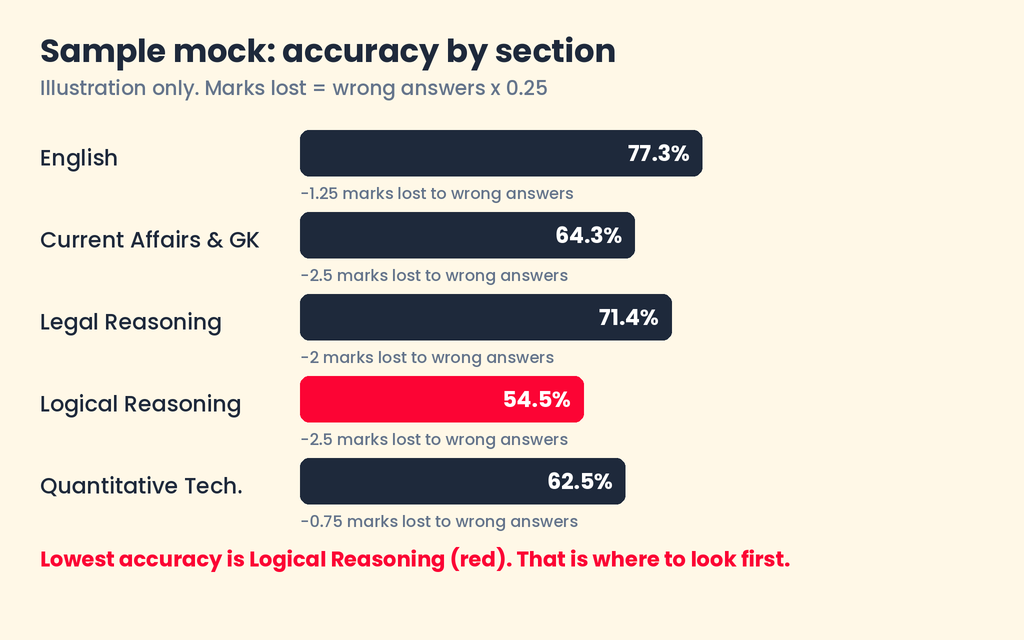
Do not compare these numbers with a fixed target. Compare them with your own last mock. Your aim is that attempts stay steady, accuracy goes up and negatives go down. You can also enter your numbers in our CLAT Mock Analyser to look at your result section by section.
Step 4: Redo every wrong, skipped and lucky-guess question
Without looking at the key, solve each of these again and write what you were thinking the first time. Three groups matter:
- Wrong answers: the obvious ones.
- Skipped questions: find out whether you did not know it or just ran out of time.
- Lucky guesses: questions you got right but were not sure about. They are not safe marks.
Then give each question one tag from this table.
| Tag | How to spot it | Where it usually shows up |
|---|---|---|
| Knowledge gap | You did not know the fact, rule or method | Current Affairs, Legal Reasoning principles, Quantitative Techniques formulas |
| Reading error | You knew it, but misread the passage or missed a word like 'not' | Passages in English, Legal Reasoning and Logical Reasoning |
| Silly mistake | Right method, wrong calculation or wrong bubble | Quantitative Techniques, last-minute marking |
| Time pressure | You rushed it or left it blank because time ran out | Long passages, the last section you attempt |
| Guess | You were unsure and marked anyway | Any section, especially GK |
Step 5: Count the tags and find the pattern
Now count the tags by section. This is where the picture becomes clear. In our sample, the 48 problem questions (36 wrong plus 12 skipped) break up like this:
| Section | Knowledge gap | Reading error | Silly mistake | Time pressure | Guess | Total |
|---|---|---|---|---|---|---|
| English | 1 | 3 | 1 | 2 | 0 | 7 |
| Current Affairs & GK | 8 | 0 | 0 | 1 | 3 | 12 |
| Legal Reasoning | 2 | 4 | 1 | 2 | 1 | 10 |
| Logical Reasoning | 1 | 6 | 2 | 2 | 1 | 12 |
| Quantitative Techniques | 2 | 0 | 2 | 3 | 0 | 7 |
| Total | 14 | 13 | 6 | 10 | 5 | 48 |
Two clear patterns come out. First, 8 of the 14 knowledge gaps are in Current Affairs & GK, so this student has a GK revision problem. Second, 6 of the 13 reading errors are in Logical Reasoning, so the student is reading the arguments too fast. These are two specific problems. Without the tags, they would have looked like one vague problem, which is “my score is low.”
A wrong answer that you turn into a right one is worth 1.25 marks, because you gain 1 mark and stop losing 0.25. Turning 10 of the 19 silly and reading errors in this sample into right answers would add up to 12.5 marks.
Step 6: Set one target and re-test in 48 hours
Pick the biggest bucket and write one target for the next mock. Keep it measurable. For the sample student, it could be:
- Cut Logical Reasoning reading errors from 6 to 3 by underlining the conclusion and the qualifier in every argument.
- Revise the 8 missed GK topics, and re-test them with 10 fresh questions after 48 hours.
If the re-test goes well, your fix is working. If not, change the method, not the number of hours. Our guides on clearing a GK backlog and reading passages faster can help with these two kinds of problems.
What Should a CLAT Mock Tracker Look Like?
A tracker lets you see progress across mocks, not just inside one. Keep it simple. One row per mock is enough.
| Mock | Date | Total marks | Attempted | Accuracy | Marks lost to negatives | Weakest section | Biggest error tag | Target for next mock |
|---|---|---|---|---|---|---|---|---|
| Mock 1 | ||||||||
| Mock 2 | ||||||||
| Mock 3 |
Fill the first seven columns from Steps 2 and 3, the error tag from Step 5 and the target from Step 6. After three mocks, you can read the trend.
How Do You Read Your Mock Trend Across 3 Mocks?
Do not judge by one mock. Look at three together. These are simple rules of thumb, not fixed laws.
| What you see | What it often means | What to do |
|---|---|---|
| Marks flat, accuracy going up | You are improving but attempting fewer questions | Raise attempts slowly, only where you can eliminate options |
| Attempts going up, accuracy going down | You are guessing more | Use the 2-option rule from our negative marking guide |
| Marks flat, same error tag every time | The fix is not working | Change the method, then re-test in 48 hours |
| One section keeps dropping | Time is being taken from it | Fix your section order and time split. See our time management guide |
What Should You Do After Analyzing the Mock?
Analysis is only useful if the next few days change. Spend one day on your target, one day on the weakest section, and then take the next mock. With CLAT 2027 on 6 December, our last 25 days plan and the last 30 days strategy show how to fit this loop into your calendar.
Need a mock to start with? Download our full-length CLAT mock, then use the six steps above on it.
If your weak spot is passages or Quantitative Techniques, these two workbooks are built for targeted practice:
Not sure what your score means for your target NLU? Read the CLAT 2026 closing ranks to set a realistic target.
ANALYZING ALONE?
GET A SECOND PAIR OF EYES
The problem: you analyze your mock alone and cannot tell if your reading of it is right.
The solution: mentorship from current NLU students in every batch, and one-on-one mentorship with me for strategy. Start by analysing your last mock.
How Does Mentorship Help With Mock Analysis?
At MEGA LAW & G.K., every batch has mentorship from current NLU students, with one mentor for every 10 students. We also provide one-on-one mentorship to all students, taken by me for strategy and decision guidance. Query? WhatsApp us at +91 7983667303.
“A mock you do not analyze is just a two-hour sitting. The analysis is what turns it into marks.”
Manav Lawania, Founder, MEGA LAW & G.K.
Frequently asked questions
How do you analyze a CLAT mock test?
Start with section-wise numbers, not the total score. Then redo every wrong, skipped and lucky-guess question without the key, tag each one with a single cause, count the tags, and set one target for the next mock. Do all of this within 24 hours of the mock.
How long should it take to analyze a CLAT mock test?
Plan for 90 minutes to 2 hours for a full 2-hour mock. Most of that time should go on wrong, skipped and guessed questions, not on the ones you got right.
What numbers should I track after every CLAT mock?
Track marks, attempts, accuracy, marks lost to negative marking, and time per section. Also note your biggest error type. Compare each mock with your own previous mock, not with a friend's score.
Should I check my rank and percentile in a mock?
You can, but treat it as a rough guide only. Mocks differ in difficulty and in who attempts them, so your own trend in accuracy and marks tells you more than a rank.
Do I need to analyze the questions I got right?
Only the lucky guesses and the ones that took too long. If you were not sure and got it right, count it as a guess, because that answer may not be right next time.
How many mocks should I analyze before CLAT 2027?
Analyze every mock you take. It is better to take fewer mocks and analyze each one well than to take many and skip the review. CLAT 2027 is on 6 December 2026, from 2 PM to 4 PM.
What if my analysis shows too many problems at once?
Pick the one biggest bucket and fix only that before the next mock. Trying to fix five things together usually fixes none.
Read next on MEGA LAW
- Why Your CLAT Mock Score Is Not Improving, and How to Fix It
- Last 25 Days Before CLAT 2027: What to Revise, What to Stop, and a Day-by-Day Plan
- CLAT 2027 Last 30 Days Strategy: What to Do Week by Week
- CLAT 2027 Time Management: How to Split 120 Minutes Across 5 Sections
- CLAT 2027 Marks vs Rank: How Your Score Translates to an NLU

About the Author
Manav Lawania, India's Teens & Twenties Mentor. Founder of MEGA LAW & G.K. and UsefullBooks, Agra, Uttar Pradesh. Former Intelligence Officer, Cabinet Secretariat, Government of India. 15+ years of teaching experience and 4,000 to 5,000 students counselled for CLAT and AILET. Manav scored 13 out of 100 in Class 12 before rebuilding his own path, and that comeback is the lens he brings to every student he now mentors. He writes and teaches under the belief that CLAT preparation is as much about having the right data as it is about having the right mindset.