
Why October Is the Worst Time to Start GK Preparation for CLAT 2027: Here's How to Fix It in 50 Days

The problem with starting GK in October isn’t the time. It’s the approach. October starters almost always use the wrong one and that’s fixable.
- October starters have 14 months of events to cover with 50 days left. Most try to cover all of it.
- Covering everything shallowly is how you recognise passages on exam day without being able to answer them
- Only 110 to 130 topics from August 2025 to November 2026 will realistically appear in CLAT 2027
- The fix is not working harder. It’s selecting the right 110 topics and studying each one deeply
- Legal Current Affairs is the highest-yield underprepared category for October starters
- 50 days with the right approach gets most students from 10 to 22 or higher on GK
Here is what I hear from students every October. “Sir, I haven’t really started GK yet. I’ve been doing Legal Reasoning and English. I’ll start the newspaper now.” And then they spend 4 weeks reading everything and retaining fragments of nothing.
I’ve been watching this exact pattern for 15+ years. And the students who turn GK around in the final 50 days are not the ones who read the most. They’re the ones who read the right things, in the right depth, with a quiz after each topic.
This piece explains exactly why October is the worst starting point for GK and why it doesn’t have to be.
Why October is genuinely the hardest time to start
There is a reason June starters and October starters get different GK scores, even when they put in similar hours. October starting creates three problems that June starters never face.
Problem 1: The coverage trap. A student starting GK in June has roughly 3 months of current events to cover. A student starting in October has 14 to 16 months of events to catch up on. The psychological response to this gap is almost always the same: read faster, cover more, go broader. This is exactly the wrong response to the problem.
Problem 2: Shallow coverage defeats the passage format. CLAT’s GK section is not a factual recall test. It’s comprehension-based. You read a 400-word passage about an event and answer inferential questions. A student who has seen a headline about a Supreme Court judgment will recognise the passage. But they can’t answer whether the judgment applied the doctrine of proportionality, or whether it overruled a previous bench, or what constitutional right was at stake. That depth comes from studying one topic carefully, not from skimming 30 topics.
Problem 3: Panic produces unfocused studying. October starters study GK from a “catch up” frame. They open a newspaper, read everything, and feel productive. But without a filter separating topics that have a 60 to 70 percent chance of appearing in CLAT from topics that have appeared zero times in 6 years, they spend real hours on content that will never come.
The 3 things October GK starters do wrong
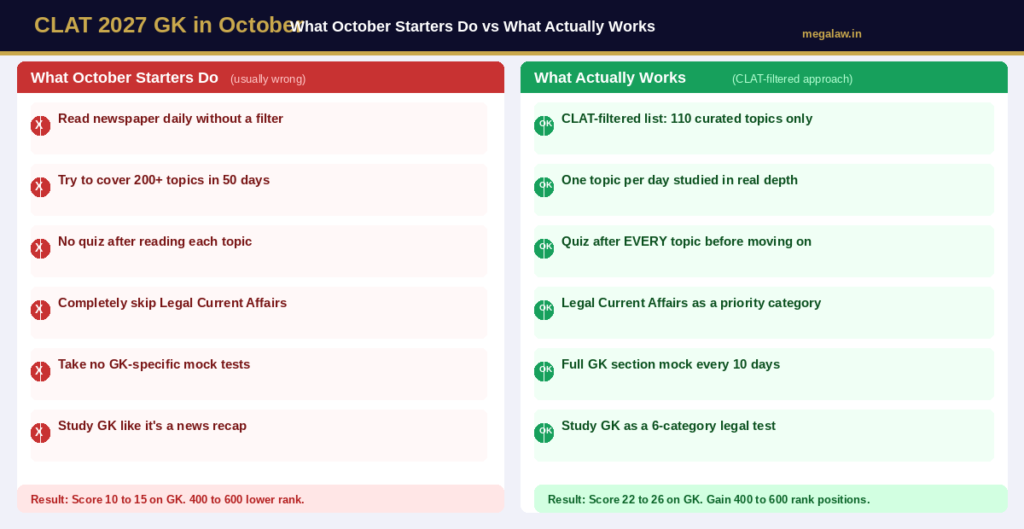
Wrong thing 1: Reading the newspaper instead of a curated list
The newspaper is not a CLAT GK preparation tool. It covers 100 percent of events, including the 80 to 90 percent that will never appear in CLAT. A student who reads The Hindu daily for 50 days covers entertainment news, state political events, company earnings, match scores, and day-to-day political speeches alongside the 10 to 20 percent that actually has CLAT relevance. Without a filter, you can't tell which is which — and you end up studying all of it.
Wrong thing 2: Covering topics without quizzing on them
Reading a topic is not the same as knowing a topic. A student who reads about India's commitments at COP28 and then moves to the next topic without answering any questions has not prepared that topic. They've seen it. Seeing is not CLAT preparation. The quiz after each topic is what converts reading into something you can actually use on a passage.
Wrong thing 3: Treating Legal Current Affairs as optional
Most GK resources and most students skip Legal Current Affairs entirely. They cover polity, international affairs, and science. They don't cover recent Supreme Court judgments, new legislation, and legal doctrines in news. This is the category CLAT tests most specifically — because it's a law entrance test — and it's the category that general GK preparation almost never touches. October starters who skip it are leaving the highest-yield category on the table.
What CLAT actually tests in the GK section
Before you can study GK correctly in 50 days, you need to understand what CLAT is actually testing. It is not testing whether you read the newspaper. It is testing whether you understand the legal and policy significance of specific events.
Six categories appear with near-total consistency across 6 years of CLAT GK sections. These six account for roughly 90 percent of every GK section. The remaining 10 percent comes from Awards and Appointments (4 of 6 years) and Sports at the level of Olympics and Asian Games (4 of 6 years).
Everything outside these six has a near-zero CLAT history. Entertainment, state politics, individual sports statistics, company earnings, and daily news events that produced no law or judgment have collectively appeared zero times in 6 years of CLAT papers.
“The October starter who picks up a newspaper is studying for the wrong test. CLAT GK is not about current events. It’s about current events filtered for legal and policy significance, India connection, and category track record. Once you understand that, 50 days is more than enough.”
Manav Lawania, Founder, MEGA LAW & G.K.
Legal Current Affairs: the category October starters miss most
If I had to pick one thing that separates students who score 22 or higher on GK from students who score 14 or lower, it’s this: the higher scorers studied Legal Current Affairs. The lower scorers didn’t know it existed as a separate category.
Legal Current Affairs for CLAT GK is not just “new laws.” It includes three specific things:
Landmark Supreme Court judgments not the case name, but what the court decided, on what constitutional grounds, and what right or principle it affected. When the Supreme Court ruled on bail norms, on the Right to Privacy, on free speech, on environmental law these are CLAT topics. Not because they’re important generally, but because they test the legal reasoning skills CLAT exists to measure.
New legislation the Bharatiya Nyaya Sanhita (BNS), Bharatiya Nagarik Suraksha Sanhita (BNSS), Bharatiya Sakshya Adhiniyam (BSA), the Digital Personal Data Protection (DPDP) Act, the Competition (Amendment) Act. These are laws. CLAT tests law. A student who understands what the DPDP Act changed about data rights is far better placed on a GK passage about it than a student who has just seen the acronym.
Legal doctrines in news when courts apply the doctrine of proportionality, clarify the basic structure doctrine, or use the doctrine of legitimate expectation in a landmark ruling. These appear as GK passages that test legal reasoning, not factual recall.
The 50-day fix: what actually works
Here is the approach that consistently produces GK scores of 22 to 26 out of 28 to 32 for October starters. It requires discipline and a curated topic list. It doesn’t require 8-hour study days.
The fix in one sentence
Stop studying GK like it’s the news. Start studying it like it’s a 6-category test with a known topic list and a passage-based question format. Once you do that, 50 days is not a crisis. It’s enough.
“I have watched students start GK in October and score 24 or 25 out of 28 to 32 in December. Every single one of them had two things in common: they used a curated topic list, and they quizzed themselves after every topic. Not one of them got there by reading a newspaper.”
Manav Lawania, Founder, MEGA LAW & G.K.
MEGA GK MARATHON 2027
50 days. 110+ CLAT-curated GK, Current Affairs, and Legal Affairs topics. Live classes, topic-wise quizzes, live mock tests, and discussion sessions. The structured programme that turns October starters into consistent 22 to 26 scorers on GK.
Read next on MEGA LAW
- → Which GK Topics Actually Come in CLAT 2027 (and Which Are Wasting Your Time)
- → 60 Days Left for CLAT 2027: What to Do If You're Behind
- → CLAT 2027 Registration Last Date: October 31 Is Closer Than You Think
- → CLAT 2027 Marks vs Rank: How Your Score Translates to an NLU
- → TITAN 2028 — 16-Month CLAT 2028 Foundation Batch
Frequently asked questions
Is 50 days enough to prepare GK for CLAT 2027?
Why is October a bad time to start GK preparation for CLAT 2027?
Which GK topics should I study in October for CLAT 2027?
How many GK topics should I cover in 50 days for CLAT 2027?
What is the MEGA GK MARATHON batch for CLAT 2027?
What is the difference between reading a newspaper and CLAT GK preparation?
Can I score 20 or more on GK in CLAT 2027 starting in October?
Should I read Legal Current Affairs separately for CLAT 2027 GK?

About the Author
Manav Lawania, India's Teens & Twenties Mentor. Founder of MEGA LAW & G.K. and UsefullBooks, Agra, Uttar Pradesh. Former Intelligence Officer, Cabinet Secretariat, Government of India. 15+ years of teaching experience and 4,000 to 5,000 students counselled for CLAT and AILET. Manav scored 13 out of 100 in Class 12 before rebuilding his own path, and that comeback is the lens he brings to every student he now mentors. He writes and teaches under the belief that CLAT preparation is as much about having the right data as it is about having the right mindset.