
Which GK Topics Actually Come in CLAT and Which Ones Are Wasting Your Time
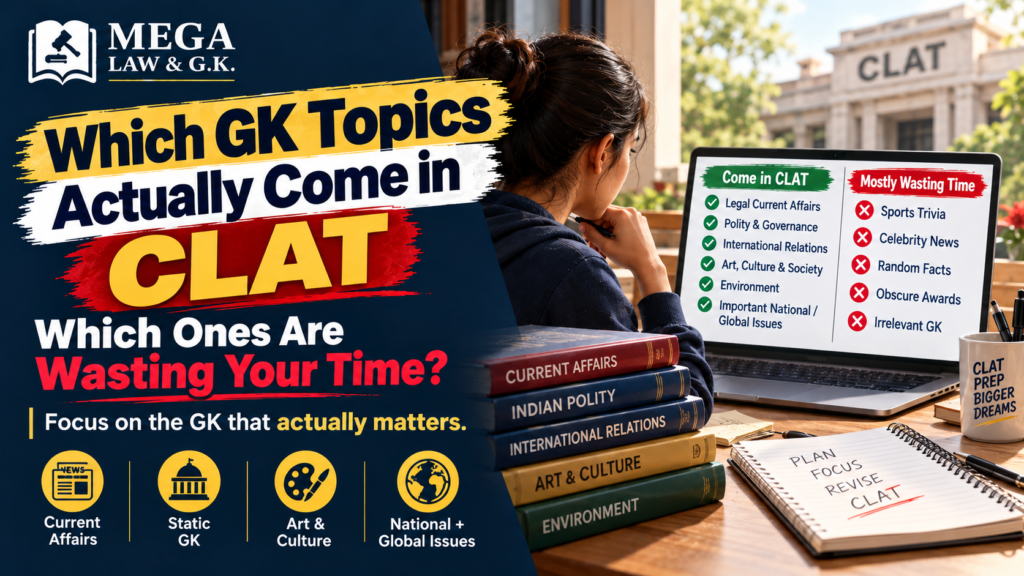
Of the hundreds of events that happen between August 2025 and November 2026, roughly 110 to 130 topics have a realistic chance of appearing in CLAT 2027 the rest will never come.
- 6 categories appear consistently across every CLAT paper going back 6 years
- Legal current affairs is the most underestimated category and the most CLAT-specific
- Newspaper reading without filtering wastes 70 to 80 percent of your GK study time
- One wrong topic you spent 3 days on is one right topic you could have scored from
- The CLAT filter is simple: legal or policy angle, India connection, lasting significance
- MEGA GK MARATHON covers exactly 110 plus curated topics in 50 days no filler
Of the hundreds of events that happen between August 2025 and November 2026, roughly 110 to 130 topics have a realistic chance of appearing in CLAT 2027 the rest will never come.
That sentence should change how you spend the next 50 days on GK.
I’ve been watching CLAT papers for 15+ years. And the single biggest GK mistake I see every year, across every student is coverage without selectivity. Students read everything, retain fragments of everything, and score on almost nothing. They know that a summit happened but not what it decided. They know a law was passed but not what it changed. They’ve covered every topic but mastered none of the ones that actually came.
This piece is about fixing that. Here’s exactly what appears in CLAT’s GK section, what never does, and how to use what’s left of the time before December to make every study hour count.
How CLAT's GK section actually works
First, a quick reality check on the format. CLAT’s GK and Current Affairs section is comprehension-based. You don’t get “Who is the current Chief Justice of India?” as a standalone question. You get a 400-word passage about a landmark Supreme Court judgment, followed by 5 questions that test whether you understood what the judgment was about, what it changed, and what it means for Indian law.
This matters because knowing a fact isn’t enough. You need to understand the context behind it. A student who knows the name of a judgment but not what it held will still get the passage wrong. A student who understood why it mattered the legal principle, the background dispute, the significance will get most questions right even without remembering the exact case name.
The implication: a student who has studied 40 topics in real depth will almost always outscore a student who has touched 200 topics lightly. Depth beats breadth in CLAT GK more than in any other section.
The 6 categories that appear in every CLAT paper
After going through CLAT GK sections year by year for 6 years, one thing is unmistakable. There are six categories that appear with near-total consistency. Not always the same number of questions, not always the same sub-topics, but the categories themselves are stable.

“When I sit down with a student’s GK prep in October, I can almost predict their score before they take a mock. If they’ve spent 3 days on Bollywood controversies and 0 days on the last 4 Supreme Court judgments on fundamental rights, I know exactly what’s coming. The topics they studied won’t appear. The ones they skipped will.”
Manav Lawania, Founder, MEGA LAW & G.K.
6 years of CLAT GK what the pattern shows
Here’s a category-wise breakdown of what appeared in CLAT’s GK section from 2020 through 2025. I’ve tracked this year by year, paper by paper. The distribution shifted slightly each year but the core six never missed.
| Category | Appeared in X of 6 papers | Typical question count | Key sub-topic examples |
|---|---|---|---|
| Polity and Constitution | 6 of 6 | 6 to 9 questions | CJI appointments, Constitutional bench judgments, CAA, UAPA, amendment bills |
| Legal Current Affairs | 6 of 6 | 5 to 8 questions | New criminal law codes, Right to Privacy SC ruling, sedition law, bail reform judgments |
| International Affairs | 6 of 6 | 5 to 7 questions | G20 presidency, India-US 2+2 dialogue, SCO membership, QUAD meetings |
| Science and Technology | 6 of 6 | 4 to 6 questions | Chandrayaan, Gaganyaan, ISRO milestones, tech regulation laws |
| Economy and Finance | 5 of 6 | 3 to 5 questions | RBI rate decisions, Union Budget flagship schemes, India's sovereign ratings |
| Environment and Reports | 5 of 6 | 3 to 5 questions | COP28 outcomes, India's NDC updates, HDI ranking, green hydrogen policy |
| Awards and Appointments | 4 of 6 | 2 to 3 questions | Bharat Ratna, Nobel laureates with India connection, key governor/CEC appointments |
| Sports (Olympics/Asian Games) | 4 of 6 | 1 to 3 questions | India's medal count at Olympics, cricket world cup (if in the period), major championships |
| Bollywood and entertainment | 0 of 6 | 0 | Never appeared in any CLAT paper in 6 years |
| State political events | 0 of 6 | 0 | State assembly results, state CM changes with no national angle — never appeared |
The topics that are quietly eating your study time
Here’s where most students lose the GK battle not by missing what to study, but by spending real hours on topics that have zero CLAT history and zero CLAT probability.
I’m not guessing here. I’ve tracked what students walk into mock tests having studied, and I’ve tracked what actually came in those mocks. The mismatch is consistent.
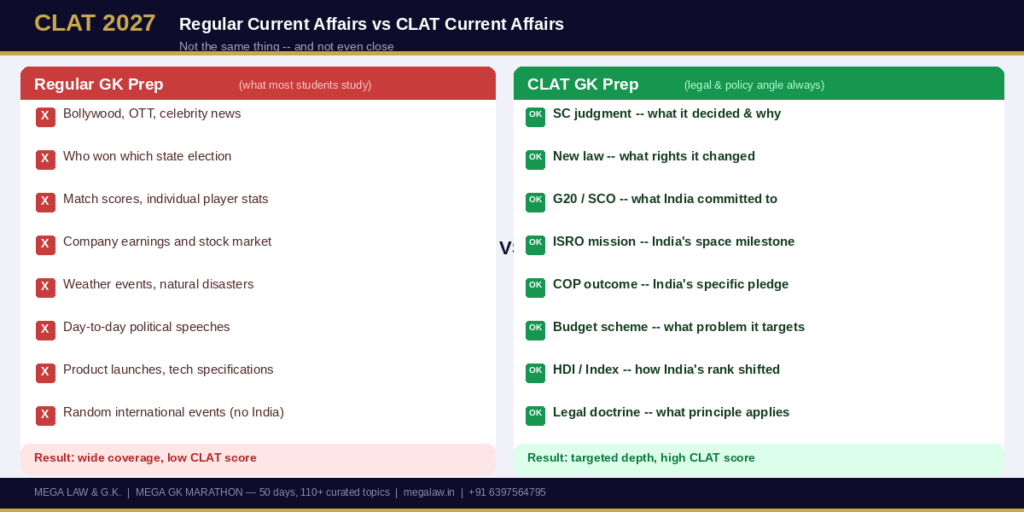
- ✗Entertainment, Bollywood and OTT news. Zero appearances in 6 years of CLAT. Not a single question. Students spend hours on this because it’s easy to remember. It never comes.
- ✗State-level political events with no national angle. Which party won which state assembly, which CM was replaced and why. Unless there’s a Supreme Court order or constitutional angle, this doesn’t appear.
- ✗Detailed sports statistics. Individual batting averages, exact scores, player records. CLAT tests whether India won a major championship not how many runs someone scored in the third over of a match.
- ✗Technical product specifications. The exact payload capacity of a rocket, the specific chip in a new phone, the exact efficiency rating of a solar panel. Context matters, specs don’t.
- ✗Daily news events with no lasting policy significance. A political speech that changed nothing, a stock market movement, a one-day protest. If the event didn’t result in a law, a judgment, a policy, or a treaty it almost certainly won’t appear.
- ✗Company earnings, mergers and acquisitions. Business news that doesn’t connect to policy (competition law, SEBI regulation, antitrust) has no CLAT history.
- ✗Natural disasters with no legal or policy aftermath. A flood or earthquake is relevant only if it triggered a court order, a new disaster management policy, or an international humanitarian response that India led.
The CLAT filter 4 questions every GK topic must answer
Here’s the filter I use every time I’m deciding whether a topic makes the cut for CLAT preparation. I’ve been using a version of this for 6 years. It takes 30 seconds per topic.
- Does it have a legal or policy angle?Did it produce a law, a judgment, a policy change, a constitutional question, or a treaty obligation? If not, its CLAT probability drops significantly.
- Does it have an India connection?CLAT is an Indian law entrance test. An international event is relevant if India was a party, India’s ranking changed, or India’s position was significant. Global events with zero India angle rarely appear.
- Is the significance lasting?Is this something that will still matter in December? A summit with real outcomes, a law that changed rights yes. A one-week news cycle that resolved itself almost certainly no.
- Has this category appeared in 4 of the last 6 CLAT papers?If the category has a track record, a specific new development in that category has a high chance. If it’s a new category that’s never appeared, the bar is much higher.
A topic that clears all four is almost certainly study-worthy. A topic that clears two or three should go in your “monitor but don’t deep-dive” list. A topic that clears one or zero skip it.
Legal current affairs: the category most students underestimate
Of the six core categories, Legal Current Affairs is the one I see students consistently underpreparing. And it’s arguably the most important one for CLAT specifically because it’s the one category where a law entrance test is more likely than any other to go deep.
Here’s what Legal Current Affairs means for CLAT GK it’s not just “what new laws were passed.” It includes:
Landmark Supreme Court judgments not just the names, but what they decided, on what constitutional grounds, and what they changed. Cases on right to privacy, bail, free speech, environmental law, women’s rights.
New legislation the Bharatiya Nyaya Sanhita (BNS), Bharatiya Nagarik Suraksha Sanhita (BNSS), Bharatiya Sakshya Adhiniyam (BSA) that replaced the old criminal law codes. POCSO amendments. DPDP Act. Competition Amendment Act. These aren’t just news. They’re law, and CLAT tests law.
Legal doctrines in news when a High Court applied the doctrine of proportionality to a case, or when the Supreme Court clarified the basic structure doctrine, these are CLAT-relevant because they test legal reasoning, not just current affairs memory.
What to do with the 50 days left before CLAT 2027
If the exam is in December 2026, you have roughly 50 days of meaningful GK study time left accounting for mock tests, revision, and the natural intensity drop in the last 2 weeks when anxiety takes over. Fifty days is enough. But only if you’re working through a curated, filtered list, not a newspaper archive.
Here’s how to use those 50 days:
Week 1 to 3: Go through the core categories in sequence Polity, Legal Affairs, International Affairs. One topic per day at real depth. For each topic: what happened, why it matters, what it changed legally or politically, what CLAT might ask about it. Write one paragraph in your own words. That paragraph is your revision note.
Week 4 to 6: Science and Technology, Economy, Environment. Same approach. Add a mock after each week specifically testing GK from the topics you’ve covered. This tells you what’s sticking and what needs another pass.
Week 7: Awards, appointments, sports. One revision pass on the first six categories. One full GK mock. Error analysis. Another targeted revision pass.
That’s the plan in outline. The hard part isn’t the structure it’s having a curated list of exactly the right 110 topics to go through. Without that, you’re back to filtering a newspaper, which is the problem we started with.
The 50-day reality check
I’ll be direct. If you spend the next 50 days reading a newspaper cover to cover and making notes on everything, you’ll arrive at CLAT with broad, shallow GK knowledge and a score that reflects it. You’ll recognise most of the passages. You won’t be able to answer the questions well because you know the headlines, not the substance.
If you spend the next 50 days going through 110 well-selected topics in real depth understanding each one’s legal and policy significance, testing yourself immediately after each one, and analysing your errors in mock GK sections you’ll score significantly better in a section that most students leave largely to chance.
GK in CLAT isn’t luck. It’s pattern recognition that you can learn in 50 days if you’re studying the right 110 topics instead of the wrong 500.
“I built MEGA GK MARATHON because I was tired of watching students spend October and November on everything except what comes. Every year the same categories appear. Every year students study outside them. The 110 topic list in this batch isn’t a guess it’s what six years of CLAT papers tell us will come.”
Manav Lawania, Founder, MEGA LAW & G.K.
MEGA GK MARATHON 2027
50 days. 110+ CLAT-curated GK, Current Affairs, and Legal Affairs topics. Live classes, topic-wise quizzes, live mock tests, and discussion sessions. The structured programme that turns October starters into consistent 22 to 26 scorers on GK.
Read Next
Frequently Asked Questions
Which GK topics are most important for CLAT 2027?
Five categories appear in every CLAT GK paper based on 6 years of analysis: Polity and Constitutional Affairs (22% of questions), International Affairs with India angle (20%), Legal Current Affairs (18%), Science and Technology (14%), and Economy and Financial Policy (13%). Environment and Reports is a strong sixth at 13%. Together these six account for 90 percent of every GK section. If your 50 days are spent here, you've covered the right ground.
How many GK questions come in CLAT 2027?
The GK and Current Affairs section in CLAT 2027 is expected to carry 28 to 35 questions. Each passage carries 4 to 5 questions, so the section typically has 6 to 8 passages. Topics are drawn from approximately August 2025 to November 2026, with occasional older landmark events if they're constitutionally or legally significant. Negative marking of 0.25 applies. Because it's passage-based, you need to understand the context of a topic, not just remember a fact about it.
What is "legal current affairs" in CLAT GK — how is it different from regular news?
Legal current affairs is the category that most general GK preparation completely misses. It includes three things CLAT tests specifically: landmark Supreme Court judgments (not just the name but what the court decided, on what constitutional ground, and what right or principle it affected), new legislation (the Bharatiya Nyaya Sanhita, DPDP Act, Competition Amendment Act — these are laws, and CLAT tests legal understanding of them), and legal doctrines that appeared in court rulings (proportionality, basic structure, reasonable classification). A newspaper gives you the headline. CLAT GK needs you to understand the legal substance behind it.
Should I read a newspaper daily for CLAT 2027 GK?
Newspaper reading without filtering wastes 70 to 80 percent of your GK study time — because the newspaper covers everything, including the 90 percent that will never appear in CLAT. A smarter approach is a CLAT-filtered daily source that marks events by category (Polity, Legal, International, Science, Economy, Environment) and skips entertainment, state politics, daily trading volumes, and other content with zero CLAT history. If you do read a newspaper, run every story through the 4-question CLAT filter before spending time on it.
Which GK topics are a complete waste of time for CLAT 2027?
Based on 6 years of CLAT GK sections, the following categories have appeared zero times: Bollywood and entertainment news, state-level political events with no national or constitutional angle, individual sports statistics (batting averages, match scores), company earnings and mergers unconnected to competition law or SEBI, technical product specifications, and daily news that didn't result in a law, judgment, policy, or treaty. If a topic doesn't have a legal or policy angle and doesn't have an India connection, skip it.
How far back does CLAT GK go — only the last 12 months or older events too?
The primary window is August 2025 to November 2026 for CLAT 2027. But older events appear when they have continuing legal or constitutional relevance — for example, a Supreme Court judgment from 2 years ago that is still being cited in new cases, or an international treaty signed earlier that India formally ratified during the window. The rule: if something from outside the window produced a development within the window (a new order, an amendment, a ratification), it's fair game. Don't spend time on old events that had no new development during the prep window.
What is MEGA GK MARATHON and who is it for?
MEGA GK MARATHON is a 50-day intensive batch by MEGA LAW & G.K. covering 110+ curated GK, Current Affairs, and Legal Affairs topics for CLAT 2027. It is built for Class 12 students who want to stop reading everything and start studying the right things. The batch includes live classes where Manav sir covers each topic with its legal and policy context, topic-wise quizzes in CLAT passage format, live mock tests with batch ranking, and discussion sessions after each mock. The 110+ topics are selected from a 6-year pattern analysis of CLAT GK sections.

About the Author
Manav Lawania, India's Teens & Twenties Mentor. Founder of MEGA LAW & G.K. and UsefullBooks, Agra, Uttar Pradesh. Former Intelligence Officer, Cabinet Secretariat, Government of India. 17 years of teaching experience and 4,000 to 5,000 students counselled for CLAT and AILET. Manav scored 13 out of 100 in Class 12 before rebuilding his own path, and that comeback is the lens he brings to every student he now mentors. He writes and teaches under the belief that CLAT preparation is as much about having the right data as it is about having the right mindset.