
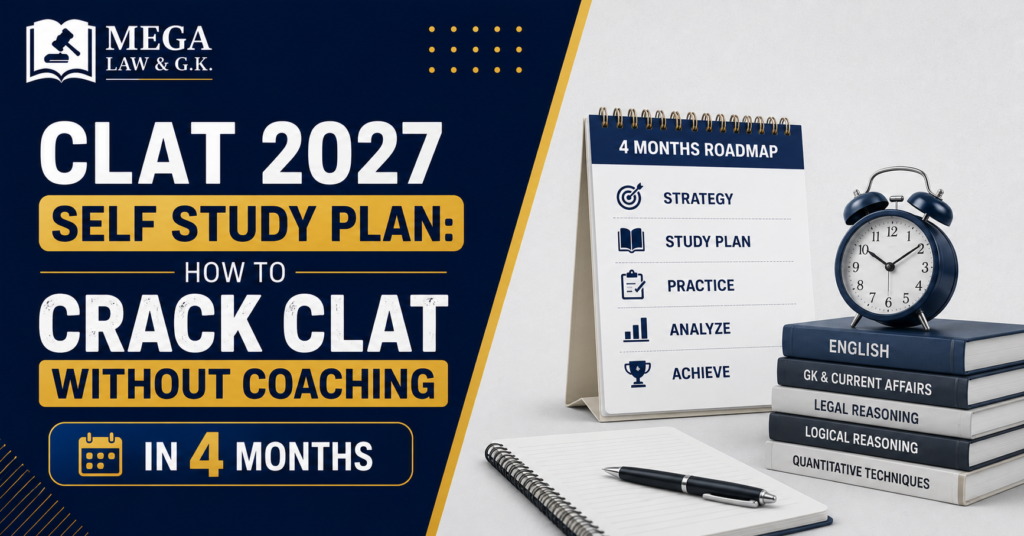
CLAT 2027 Self Study Plan: How to Crack CLAT Without Coaching in 4 Months
QUICK ANSWER
Yes, you can crack CLAT 2027 without classroom coaching — but only if you replicate the four things coaching actually provides: a structured daily schedule, regular timed mocks with full analysis, consistent current affairs input, and feedback on where your reasoning is going wrong. If you can build all four of these yourself over 4 months, a coaching institute is not a requirement. This post gives you the exact plan, section by section, week by week, with the free and paid resources that make it work.
I will be honest with you upfront: I run an online law entrance coaching institute. Saying “you do not need coaching” is not typical from someone in my position. But I have watched enough students waste money on coaching they did not need — and enough self-studiers fail because they underestimated specific requirements — to know the honest answer serves you better than the commercial one.
The students who crack CLAT without coaching are not the smartest students. They are the most disciplined ones. They protect their daily newspaper reading habit like a non-negotiable appointment. They run full mock analysis every single time. They update their error log after every mock without exception. That level of self-regulation is genuinely rare — and if you have it, this plan will work.
I have counselled over 4,000 to 5,000 students for CLAT and AILET across 17 years. The self-studiers who succeed share one pattern: they treat this plan like a job with daily deliverables, not like a self-improvement project with flexible timelines.
“The question is never whether CLAT can be cracked without coaching. It is whether you will do, every single day, the four things that coaching does for you — without anyone holding you to it.”
— Manav Lawania, Founder, MEGA LAW & G.K.
Can You Really Crack CLAT 2027 Without Coaching? The Honest Answer
CLAT is a passage-based aptitude test. It does not test information available only from coaching institutes. The Consortium of NLUs (consortiumofnlus.ac.in) publishes the official syllabus, sample papers, and previous years’ question papers — all free. What coaching provides is not exclusive content. It is structure, accountability, curated current affairs, and expert feedback.
Structure means a written daily schedule you follow regardless of how motivated you feel. Without external accountability, most self-studiers follow their schedule 4 to 5 days a week, not 7. That gap compounds into a significant preparation deficit over 4 months.
Current Affairs is where self-studiers most commonly underperform. Coached students receive consolidated, CLAT-filtered monthly summaries. Self-studiers who do not build an equivalent consolidation process end up with 4 months of reading they cannot retrieve under exam pressure.
Mock analysis feedback is the hardest thing to replicate alone. A mentor watching your legal reasoning errors can identify whether you are misreading the fact pattern or misapplying the principle — a distinction that changes the fix entirely. Without that external eye, many self-studiers misdiagnose their own errors.
The honest verdict: self-study works if you are genuinely disciplined about all four elements. For most aspirants, supplementing self-study with one targeted resource — a GK compilation service, an online mock series with mentor analysis, or a focused section course — produces better outcomes than pure self-study or full coaching.
What 4 Months to CLAT 2027 Actually Looks Like
CLAT 2027 is expected in December 2026. Starting now in late August or September 2026, you have approximately 14 to 16 weeks. Every week matters — there is no week you can treat as a buffer.
Month 1 (Weeks 1–4) — Foundation: You are building habits, not chasing scores. Newspaper reading habit, daily RC passage practice, legal reasoning conceptual base, and QT revision all start simultaneously. No full mocks. The goal is to establish the daily routine the remaining 3 months will run on.
Month 2 (Weeks 5–8) — Section-wise Deep Work: Each section gets focused timed attention. RC gets timing. Legal Reasoning moves from concept to application. GK consolidation sheets get built. LR question volume increases. First full CLAT mock at the end of this month — to identify error patterns, not to assess readiness.
Month 3 (Weeks 9–12) — Mock Sprint: Two to three full mocks per week. Full 5-step analysis after every mock. Error log updated every time. Fix-forward drills on top 3 recurring errors. The error log now drives everything.
Month 4 (Weeks 13–16) — Final Sprint: One full mock per day. No new content. Consolidation sheets only for GK and Legal Reasoning. Final 72-hour protocol from exam day minus 3.
The 4-Month Self-Study Plan — Month by Month
| Month | Primary Focus | Daily Routine (4–5 hrs) | End-of-Month Milestone |
|---|---|---|---|
| Month 1 — Foundation | Habit building, syllabus mapping, concept base | 30 min newspaper. 1 untimed RC passage. 45 min Legal Reasoning concepts. 10 LR questions. 30 min QT revision. | 30-day unbroken newspaper streak. Constitution basics covered. QT formula sheet built. First GK topic page drafted. |
| Month 2 — Deep Work | Timed section practice, principle application, mock baseline | 30 min newspaper. 2 timed RC passages (7–8 min each). 60 min LR application drills. 20 LR questions timed. 30 min QT timed drills. | GK consolidation sheets complete. First full mock taken. Error log started. Top 3 error types identified per section. |
| Month 3 — Mock Sprint | 2–3 mocks/week, error log, targeted drilling | Morning: fix-forward drill on top error type. Afternoon: full mock OR section mock. Evening: full 5-step analysis + error log update. | 15 to 20 mocks completed with full analysis. Error log shows conceptual errors reducing. GK sheets revised twice. |
| Month 4 — Final Sprint | 1 mock/day, consolidation, pre-exam protocol | Morning: GK + LR principle sheets. Afternoon: 1 full mock. Evening: analysis + top 2 error fix-forward only. | 5 to 6 final sprint mocks done. Last 3 days: sheets only. Day before exam: sleep by 10pm. |
Section-wise Daily Schedule and Best Resources for Self-Studiers
| Month | Primary Focus | Daily Routine (4–5 hrs) | End-of-Month Milestone |
|---|---|---|---|
| Month 1 — Foundation | Habit building, syllabus mapping, concept base | 30 min newspaper. 1 untimed RC passage. 45 min Legal Reasoning concepts. 10 LR questions. 30 min QT revision. | 30-day unbroken newspaper streak. Constitution basics covered. QT formula sheet built. First GK topic page drafted. |
| Month 2 — Deep Work | Timed section practice, principle application, mock baseline | 30 min newspaper. 2 timed RC passages (7–8 min each). 60 min LR application drills. 20 LR questions timed. 30 min QT timed drills. | GK consolidation sheets complete. First full mock taken. Error log started. Top 3 error types identified per section. |
| Month 3 — Mock Sprint | 2–3 mocks/week, error log, targeted drilling | Morning: fix-forward drill on top error type. Afternoon: full mock OR section mock. Evening: full 5-step analysis + error log update. | 15 to 20 mocks completed with full analysis. Error log shows conceptual errors reducing. GK sheets revised twice. |
| Month 4 — Final Sprint | 1 mock/day, consolidation, pre-exam protocol | Morning: GK + LR principle sheets. Afternoon: 1 full mock. Evening: analysis + top 2 error fix-forward only. | 5 to 6 final sprint mocks done. Last 3 days: sheets only. Day before exam: sleep by 10pm. |
On previous year papers: The single most valuable free resource for CLAT self-study is the collection of previous year question papers with official answer keys. The Consortium of NLUs at consortiumofnlus.ac.in publishes these. Work through every paper from the last 5 years before attempting any other practice material.
The Mock Test Strategy for CLAT Self-Studiers
How many mocks to take: Zero in month 1. One at the end of month 2. Two to three per week in month 3. One per day in month 4. This ramp-up is intentional — mocks before you have built foundational habits produce discouraging scores and no useful error data.
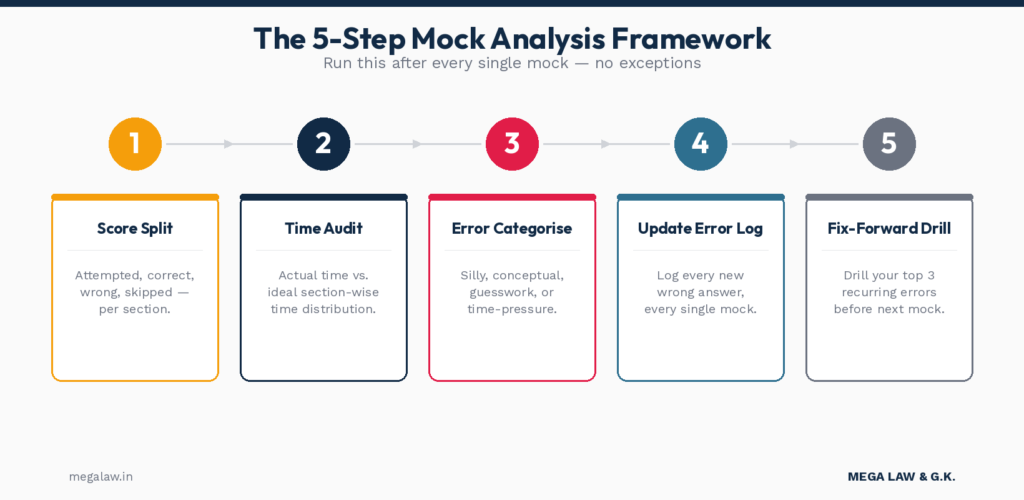
The only mock analysis protocol that improves scores: After every mock, run five steps without exception: split score into attempted, correct, wrong, skipped per section; check time per section; categorise every wrong answer as silly, conceptual, guesswork, or time-pressure; update running error log; pick top 3 recurring errors and drill them before the next mock.
Where to find quality CLAT mocks without coaching: When selecting a platform, look for two things: section-wise time tracking (not just total time), and detailed answer explanations that tell you why the other options are wrong — not just why the correct option is right. See megalaw.in/how-to-analyse-clat-mocks-like-a-topper-the-complete/ for the complete 5-step framework.
The biggest self-study mock mistake: Comparing your raw score to friends or to target scores before month 3. In months 1 and 2, the only number that matters is whether your error log shows specific error types improving.
How to Build Your GK Without a Coaching Institute
The daily newspaper routine. Read The Hindu or Indian Express every morning — editorial page first, then national news, then legal and governance sections. 25 to 30 minutes consistently. The first 2 weeks feel slow because you do not yet have the context to assess what is CLAT-relevant. By week 4, you will be filtering in real time.
The weekly consolidation habit. At the end of every week, spend 20 to 25 minutes writing the most CLAT-relevant events onto your topic-wise consolidation sheet — one sheet per major category. This is the equivalent of what coaching institutes do in their weekly GK sessions. Without this step, your daily reading does not convert into retrievable knowledge.
The CLAT GK lens. CLAT GK passages consistently draw from: Supreme Court and High Court judgments with constitutional or social implications, central government legislation and policy changes, India’s diplomatic engagements, science and technology milestones connected to governance or law, and major national awards. When you read the newspaper, ask: could this event appear in a CLAT passage?
Supplementing with a structured GK resource. For most self-studiers, this is the one area where a low-cost external resource produces the best return on investment. Our GK Booster batch (megalaw.in/gk-booster/) exists specifically for aspirants who are self-studying and want consolidated, CLAT-filtered weekly GK without full coaching.
Legal Reasoning Without a Teacher — What Actually Works
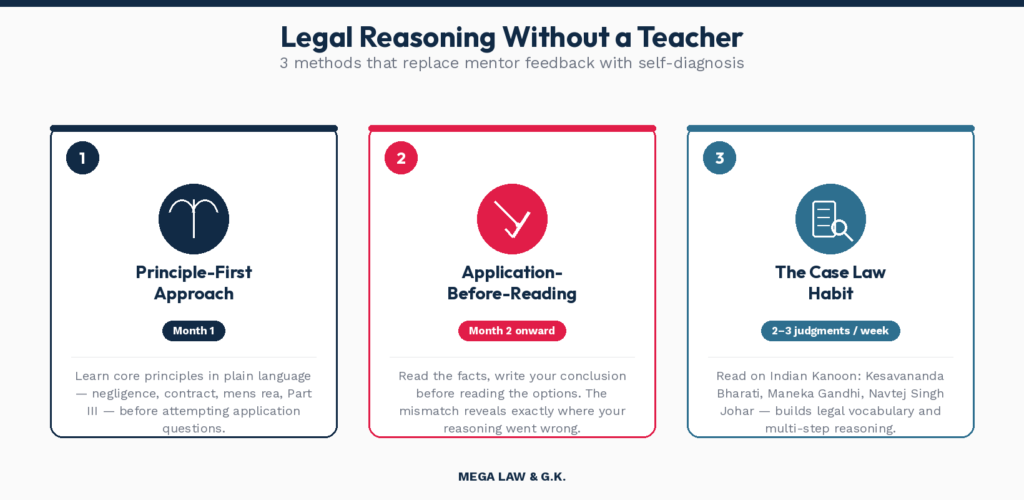
The principle-first approach. Before attempting any legal reasoning application questions in month 1, read through the core principles of each legal domain in plain language: what negligence means and requires, what constitutes a valid contract, what mens rea means in criminal law, what Part III of the Constitution protects. Do not attempt application questions until you can explain each principle in one clear sentence without notes.
The application-before-reading approach for month 2 onward. Read the fact situation first. Write down your conclusion (liable or not liable, valid or invalid) before reading the options. Then read the options. When your pre-formed conclusion matches the correct answer, your reasoning was sound. When it does not, the mismatch reveals exactly where your reasoning went wrong.
The case law habit. Reading 2 to 3 major judgments per week on Indian Kanoon (indiankanoon.org — free, full judgment database) builds both your legal vocabulary and your ability to follow multi-step legal arguments. Start with landmark constitutional cases: Kesavananda Bharati (basic structure), Maneka Gandhi (Article 21 expansion), Navtej Singh Johar (Article 377).
5 Mistakes CLAT Self-Studiers Make That Kill Their Score
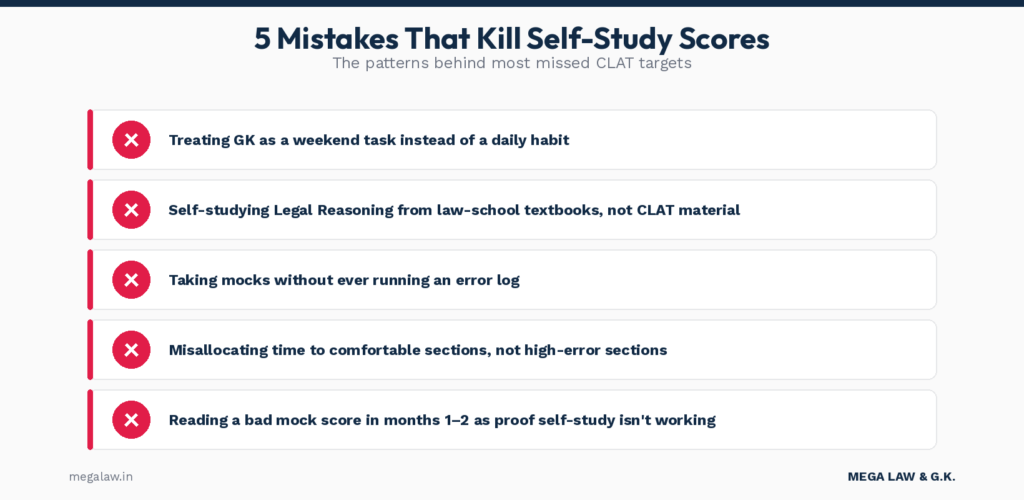
- Treating GK as a weekend task instead of a daily habit. Current Affairs compounds. A student who reads daily for 4 months has a fundamentally different GK foundation from one who reads intensively 2 days every week. The daily habit is not replaceable by the intensive session — the contextual understanding simply does not develop in bursts.
- Self-studying Legal Reasoning from the wrong resources. Legal Reasoning for CLAT tests principle-application on simplified fact situations, not doctrinal legal analysis for law degree students. Use CLAT-specific practice material, previous year papers, and simplified principle summaries — not Pollock and Mulla.
- Taking mocks without the error log. A self-studier who takes 30 mocks and checks the score each time but never runs a proper error analysis has generated data they never use. The error log is what converts mock-taking into preparation.
- Misallocating time across sections. Without a teacher telling you where your marks are leaking, self-studiers tend to spend the most time on the sections they find most interesting — not the sections with the most error density. Let your error log tell you where to spend time, not your comfort level.
- Treating a bad mock score as evidence that self-study is not working. A bad mock score in months 1 to 2 is normal and expected. If your conceptual error rate is decreasing across mocks, your preparation is working even if the score has not moved yet. The error log is what tells you whether preparation is actually working — not the score.
When Self-Study Works and When You Need Support
Self-study works best when: You have a strong base in English reading. You are genuinely self-disciplined — not aspirationally self-disciplined. You have access to a good daily newspaper and read it consistently. You are 6 or more months out from the exam. You can take and fully analyse 2 to 3 mocks per week consistently.
You likely need external support when: You have attempted CLAT before and your GK score has not improved despite independent effort. Your Legal Reasoning error rate has not decreased across 10 or more mocks. You have taken more than 5 mocks and still cannot identify your top 3 recurring error types per section. You are 4 months or fewer from the exam and have not yet built the daily newspaper reading habit.
The middle path most self-studiers underuse: Supplementing self-study with one targeted resource — a weekly GK compilation, an online mock series with mentor-led analysis, or a single section course for your weakest area — addresses the most common self-study gaps without the cost or time commitment of full coaching.
For complete CLAT exam pattern, syllabus, and marking scheme: megalaw.in/clat-exam/. For the honest NLU cutoff data to set a meaningful score target: megalaw.in/your-clat-rank-vs-your-nlu/. For the comparison of batch options and who they are designed for: megalaw.in/clat-dropper-batch-vs-fresher-batch/.
Frequently Asked Questions
Can I crack CLAT 2027 without coaching?
Yes. CLAT is crackable without classroom coaching if you have a structured daily schedule, a running mock error log, daily newspaper reading for Current Affairs, and access to quality practice material for each section. What coaching provides — structure, accountability, curated current affairs, and expert analysis — must be replicated through self-discipline and the right resources. Many CLAT toppers have prepared without coaching. The success rate is lower for self-studiers primarily because most underestimate the GK and mock analysis requirements.
Is 4 months enough to crack CLAT 2027?
4 months is a realistic timeline if you are consistent, structured, and begin immediately. The caveat is Current Affairs — 4 months gives you enough time to cover the news cycle for the exam period, but students who start earlier have a larger GK base. A 4-month self-studier must protect the daily newspaper habit from day one. All other sections — English RC, Legal Reasoning, Logical Reasoning, and Quantitative Techniques — can be covered in depth within 4 months with the right schedule.
How many hours per day should I study for CLAT without coaching?
Aim for 4 to 5 hours of focused preparation per day: 30 minutes newspaper (GK/CA), 60 minutes English RC, 60 to 75 minutes Legal Reasoning, 30 to 40 minutes Logical Reasoning, 20 to 30 minutes QT. Mock analysis adds 45 to 60 minutes on mock days. School or college attendance is additional — CLAT prep slots must be protected around it, not squeezed in between other things.
What are the best free resources for CLAT 2027 self-study?
For Current Affairs: The Hindu or Indian Express daily. For English RC: previous year CLAT papers from consortiumofnlus.ac.in. For Legal Reasoning: Indian Kanoon (free case law database) and CLAT sample papers. For Logical Reasoning: previous year CLAT papers. For Quantitative Techniques: NCERT Class 10 Mathematics (free PDF on ncert.nic.in). For mock tests: platforms that provide section-wise time analysis and detailed answer explanations.
Which section of CLAT is hardest to self-study?
Current Affairs and GK is the hardest to self-study effectively because it requires consistent daily input over a long period — not concentrated study. Legal Reasoning is the second hardest because the principle-application skill is difficult to develop without feedback on where your reasoning is going wrong. A mentor's feedback on Legal Reasoning errors is one of the most significant advantages coaching provides and the hardest gap for self-studiers to close alone.
How should I take mock tests without coaching guidance?
Take at minimum 2 full mocks per week from month 2 onward. After every mock, run the 5-step analysis: score split by section, time audit, error categorisation (silly, conceptual, guesswork, time-pressure), error log update, and fix-forward drill on top 3 recurring errors. The analysis — not the mock itself — is what improves scores.

About the Author
Manav Lawania, India's Teens & Twenties Mentor. Founder of MEGA LAW & G.K. and UsefullBooks, Agra, Uttar Pradesh. Former Intelligence Officer, Cabinet Secretariat, Government of India. 17 years of teaching experience and 4,000 to 5,000 students counselled for CLAT and AILET. Manav scored 13 out of 100 in Class 12 before rebuilding his own path, and that comeback is the lens he brings to every student he now mentors. He writes and teaches under the belief that CLAT preparation is as much about having the right data as it is about having the right mindset.