
Why 40 Questions Is Riskier Than 120: The New Arithmetic of CLAT
The intuition everyone has is wrong. When students hear that CLAT might move to fewer, harder questions, the first reaction is relief — less to cover, less to attempt, less pressure. The mathematics says something completely different. A 40-question CLAT is not a gentler CLAT. It is a higher-stakes, lower-margin, harder-to-recover CLAT. And the aspirants who understand this arithmetic before the exam will prepare fundamentally differently from those who do not.
This is not a theoretical concern. The CLAT Expert Committee has been actively deliberating on reducing question count and increasing per-question complexity for CLAT 2028. Whether the format shifts partially or fully, the direction is clear: fewer questions, more weight per question, higher stakes per passage.
I have taught CLAT and AILET for 17 years and worked with over 4,000 to 5,000 students. Every single one has made decisions about which questions to attempt and which to skip. The students who understand the underlying arithmetic of those decisions are the ones who do not panic in the exam hall. This post gives you that arithmetic in full.
“Most students approach CLAT like a test of what they know. The students who crack it treat it like a test of decision-making under uncertainty — and they know the mathematics of every decision they make.”
— Manav Lawania, Founder, MEGA LAW & G.K.
The Intuition Everyone Gets Wrong
Ask any aspirant whether they would prefer a 40-question CLAT or a 120-question CLAT. Most will say 40. Fewer questions feels like less work, less exposure, less that can go wrong. This intuition is understandable and almost completely backwards.
In any exam with negative marking, fewer questions does not mean lower risk. It means each individual question carries more of your total score, each wrong answer creates a larger proportional setback, and each bad passage you encounter affects a larger percentage of your paper. The risk does not decrease with fewer questions — it concentrates.
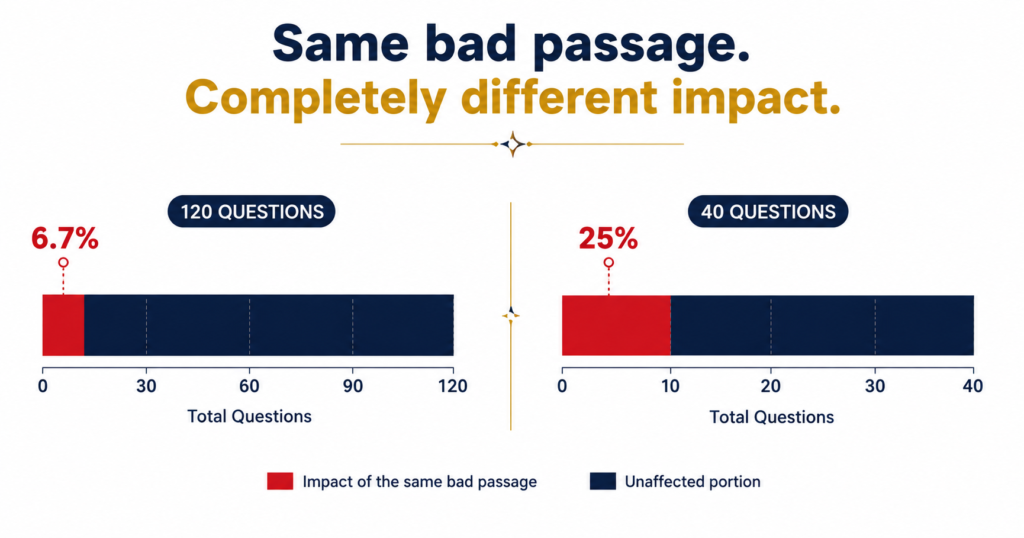
In a 120-question paper, if you get 10 questions wrong in the GK section because the Current Affairs passages covered a topic you missed, you have lost roughly 8 percent of the paper. In a 40-question paper, 10 wrong answers is 25 percent of the total. Same preparation gap. Completely different impact.
The Mathematics: What Each Format Actually Does to Your Score
Numbers make this argument impossible to ignore. Here is the arithmetic of both formats side by side, using the same student performance in each.
| Scenario | 120-Question Format | 40-Question Format |
|---|---|---|
| Marks per correct answer | 1 mark | 3 marks (to total 120) |
| Negative marking per wrong | 0.25 marks | 0.75 marks (proportional) |
| Student gets 80% right, 20% wrong | 96 correct, 24 wrong: 96 − 6 = 90 marks | 32 correct, 8 wrong: 96 − 6 = 90 marks |
| Student gets 70% right, 30% wrong | 84 correct, 36 wrong: 84 − 9 = 75 marks | 28 correct, 12 wrong: 84 − 9 = 75 marks |
| One bad passage (8 questions, all wrong) | Affects 6.7% of paper: costs 2 marks net | Affects 20% of paper: costs 6 marks net |
| Recovery margin after 1 bad passage | 112 questions remaining — high recovery | 32 questions remaining — critical pressure |
| Break-even accuracy for attempting | >20% accuracy on attempted question | >20% accuracy on attempted question |
| Score variance (luck impact) | Low — law of large numbers smooths it | High — each question is a high-stakes event |
The raw scoring mathematics are identical at the same accuracy rate. But the variance, recovery margin, and psychological pressure are completely different. This is the part the intuition misses.
Important: The exact marks per question in CLAT 2028 will depend on the Consortium of NLUs official notification at consortiumofnlus.ac.in. The analysis above uses proportional values for comparison. The risk mechanics — variance, recovery margin, passage impact — hold regardless of the exact mark scheme.
The Law of Large Numbers — Why 120 Questions Is Actually Fairer
This is a concept from statistics that most CLAT students have never applied to their exam strategy, but should.
When you flip a coin 10 times, you might get 8 heads and 2 tails — far from the 50-50 average. When you flip it 1,000 times, you get very close to 500-500. This is the law of large numbers: with more trials, random variation averages out.
In a 120-question paper, your preparation has 120 opportunities to express itself. A few unlucky question phrasings, one passage on an obscure topic, one difficult inference chain — these bad moments average out across the rest of the paper. In a 40-question paper, the same unlucky moments represent triple the impact. A student who genuinely knows the material and has a slightly bad day can be punished far more severely in a 40-question format — not because of preparation, but because there are not enough questions for performance to smooth out.
For strong, well-prepared students, this is a serious risk. It means genuine preparation is harder to demonstrate. This is not a more meritocratic exam — it is a higher-variance one.
The Passage Risk Problem — Why Fewer Questions Amplifies Each Bad Passage
CLAT is a completely passage-based exam. Every question is attached to a passage. This creates a specific kind of risk: passage-level variance. Some passages are well-written and clear. Others are dense, ambiguous, or cover a sub-topic you have not seen. In any exam, you will encounter both types.
In a 120-question format: One difficult passage contains 6 to 8 questions — roughly 5 to 7 percent of your paper. The remaining 18 to 22 passages give ample opportunity to recover. Students can skip a difficult passage mid-way and return to it, minimising damage.
In a 40-question format: One difficult passage still contains 6 to 8 questions — but now that is 15 to 20 percent of your entire paper. You have 5 to 7 remaining passages. A single bad passage is not an inconvenience. It is a structural threat to your total score.
This changes the skill set required. Speed across passages matters less. Ability to extract maximum value from every passage — including difficult ones — matters far more.
What Happens to Negative Marking Strategy
Negative marking is 0.25 marks per wrong answer in CLAT. The break-even for attempting a question is 20 percent accuracy. Here is why: each correct answer gives +1 (or +3). Each wrong answer gives -0.25 (or -0.75). At 20% probability: (0.2×1) + (0.8×-0.25) = 0.2 – 0.2 = 0. Exactly break-even.
This means: if you can eliminate even one option in a four-choice question, your probability exceeds 33% — and attempting always has positive expected value. In a passage-based exam, you almost always have enough context to eliminate at least one option.
This arithmetic is identical in both formats. The break-even percentage does not change. What changes is the psychological pressure per question. When each question carries 3 marks instead of 1, students second-guess themselves more, take longer, and sometimes over-think straightforward eliminations into wrong answers.
The revised guessing rule for a higher-stakes format: Do not change the mathematics. Change the mental discipline. The break-even is still 20 percent. Attempt if you can eliminate. But be rigorous about your elimination — do not guess based on vague familiarity. Every guess in a 40-question format costs you 3 times the recovery path.
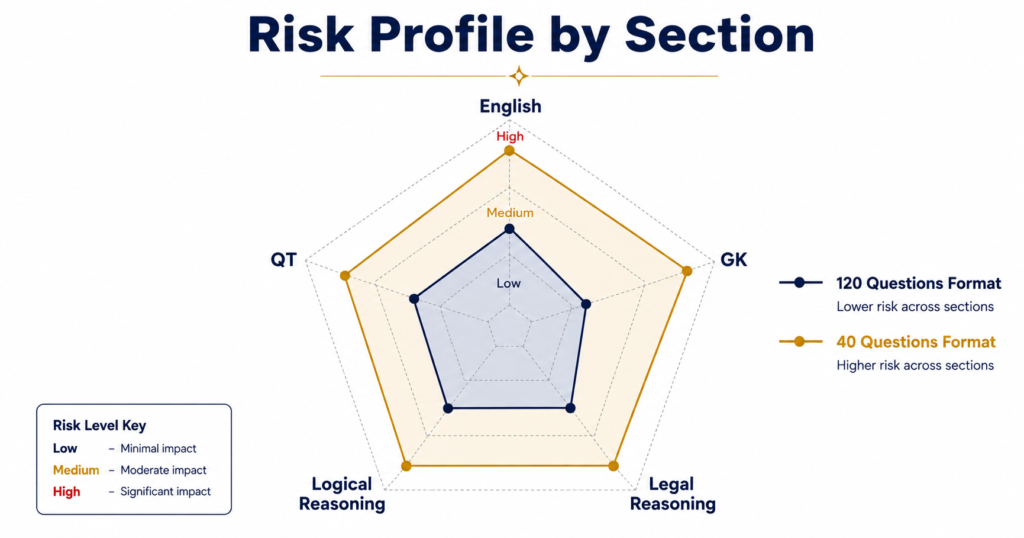
Section-wise: Which Parts of CLAT Become Most Dangerous
| Section | Risk in 120-Question Format | Risk in 40-Question Format | What Changes |
|---|---|---|---|
| Current Affairs & GK | Medium — high volume absorbs gaps | Very High — one unfamiliar topic = 20% loss | Breadth of CA coverage becomes critical |
| Legal Reasoning | High — conceptually demanding | Highest — complex principles on fewer questions | Depth of principle understanding, not speed |
| English Language | Low-Medium — passage volume smooths errors | Medium-High — one difficult passage is catastrophic | Dense passage reading skill becomes essential |
| Logical Reasoning | Medium — high volume allows recovery | High — each wrong assumption-based answer is costly | Per-question accuracy over per-section speed |
| Quantitative Techniques | Low — fewest questions, manageable | Medium — calculation errors have outsized impact | Accuracy on every calculation; no rushing |
The Psychology of High-Stakes Questions
Mathematics aside, there is a psychological dimension to question weight that exam strategy guides rarely address — and that CLAT students almost never account for in their mock practice.
When each question carries 1 mark, a wrong answer is a bump. When each question carries 3 marks, a wrong answer is an event. Students who have only ever practised in the 120-question format will notice something unexpected if they sit a 40-question mock: they read each question more carefully, take longer, and second-guess their first instinct far more often.
Second-guessing is the enemy of CLAT performance. In passage-based questions, your first instinct from the passage is almost always the correct one. The elimination method works best when you trust the process. High question weight disrupts that trust.
The preparation implication is direct: if CLAT 2028 reduces question count, your mock series must include reduced-question-count mocks. Practising decision-making at 120 questions and then sitting an exam at 40 is not adequate preparation. The psychological calibration is different.
5 Things You Must Change About Your CLAT Preparation
If CLAT 2028 moves to fewer, harder questions, the following preparation shifts are non-negotiable.
- Replace speed drills with accuracy drills. The goal in a 40-question format is to get every question you attempt right. Timed speed drills on high volumes should give way to single-question analysis drills where you spend 5 to 7 minutes on one difficult question, understanding exactly why each option is right or wrong.
- Build passage-depth skills, not just passage-speed skills. In a 40-question format, each passage is 15 to 20 percent of your paper. You need to read for structural comprehension — understanding the argument, identifying the author’s position, mapping the logic — not just scanning for keywords.
- Expand your Legal Reasoning concept base significantly. With 4 to 5 Legal Reasoning passages in a 40-question paper, each could test a different legal domain — tort, contract, criminal law, constitutional rights, property. Breadth of conceptual coverage becomes essential.
- Make your current affairs coverage both broader and deeper. GK in a reduced-question format is more punishing when you have gaps because there are fewer questions to absorb those gaps. Monthly consolidation, topic-wise organisation, and weekly revision are the preparation minimum — not optional.
- Add reduced-question-count mocks to your practice regime. Do not wait for official CLAT 2028 mocks. Create your own. Take 40 of the hardest questions from existing mock papers and sit them under exam conditions. Analyse the psychological experience as much as the score.
What This Means for CLAT 2027 Students Too
CLAT 2027 retains the existing pattern. But the core arithmetic — attempt if you can eliminate at least one option, skip only if you have genuinely zero passage context — applies fully to CLAT 2027’s 120-question format.
The students who miss marks in CLAT 2027 are almost never the ones who attempted too many questions. They are the ones who skipped questions they could have gotten right with a careful read, or who rushed sections they should have slowed down on. Understanding the arithmetic of attempt decisions — at any question count — makes you a better exam taker regardless of the format.
Frequently Asked Questions
Why is a 40-question CLAT riskier than a 120-question CLAT?
In a 40-question format, each question carries three times the weight of a 120-question format. One bad passage, one unfamiliar topic, or one section of poor performance has a catastrophic impact on your final score because there is no recovery margin. In a 120-question format, poor performance on 10 questions affects 8 percent of your paper. In a 40-question format, poor performance on 10 questions affects 25 percent. The mathematics of variance and recovery are completely different.
Does CLAT 2028 have 40 questions?
The CLAT Expert Committee has deliberated on reducing the question count and increasing question difficulty for CLAT 2028. The Consortium of NLUs at consortiumofnlus.ac.in will publish the confirmed pattern in the official notification. Students should prepare for both the current 120-question format and the possibility of a reduced-question format by focusing on depth of understanding rather than breadth of coverage.
How does CLAT negative marking work?
CLAT carries a negative marking of 0.25 marks per wrong answer. In the current 120-question format where each question is worth 1 mark, this means each wrong answer costs you 1.25 marks of opportunity (1 mark lost + 0.25 mark deducted). The break-even for attempting a question is 20 percent accuracy — meaning you should attempt a question if you can eliminate even one option with confidence.
What is the safest CLAT attempt strategy?
In the current 120-question format, the safest strategy is to attempt all questions where you can eliminate at least one option. Pure random guessing (no elimination) has a break-even of 20 percent. If you can narrow it to three options, your expected value of guessing is positive. Skipping a question only makes mathematical sense if you have zero information — which is rare in a passage-based format where context is always available.
How should I change my preparation if CLAT 2028 reduces question count?
If CLAT 2028 reduces question count, preparation must shift from breadth to depth. Speed across high volume is no longer the primary skill. Instead, accuracy under pressure on each individual question becomes critical. Timed single-question drills, passage-specific accuracy tracking, and mock analysis focused on per-question performance replace high-volume practice as the core preparation mode.
Which CLAT section becomes most dangerous in a reduced-question format?
Legal Reasoning becomes the highest-risk section in a reduced-question format. It already has the highest number of questions and the most conceptually demanding passages. With fewer total questions, a Legal Reasoning passage that tests an unfamiliar principle or a poorly worded fact situation can account for 20 to 30 percent of your total paper. Depth of legal reasoning preparation becomes more important than ever.

About the Author
Manav Lawania, India's Teens & Twenties Mentor. Founder of MEGA LAW & G.K. and UsefullBooks, Agra, Uttar Pradesh. Former Intelligence Officer, Cabinet Secretariat, Government of India. 17 years of teaching experience and 4,000 to 5,000 students counselled for CLAT and AILET. Manav scored 13 out of 100 in Class 12 before rebuilding his own path, and that comeback is the lens he brings to every student he now mentors. He writes and teaches under the belief that CLAT preparation is as much about having the right data as it is about having the right mindset.