
CLAT 2028 Preparation: Why Class 11 Students Should Start Now
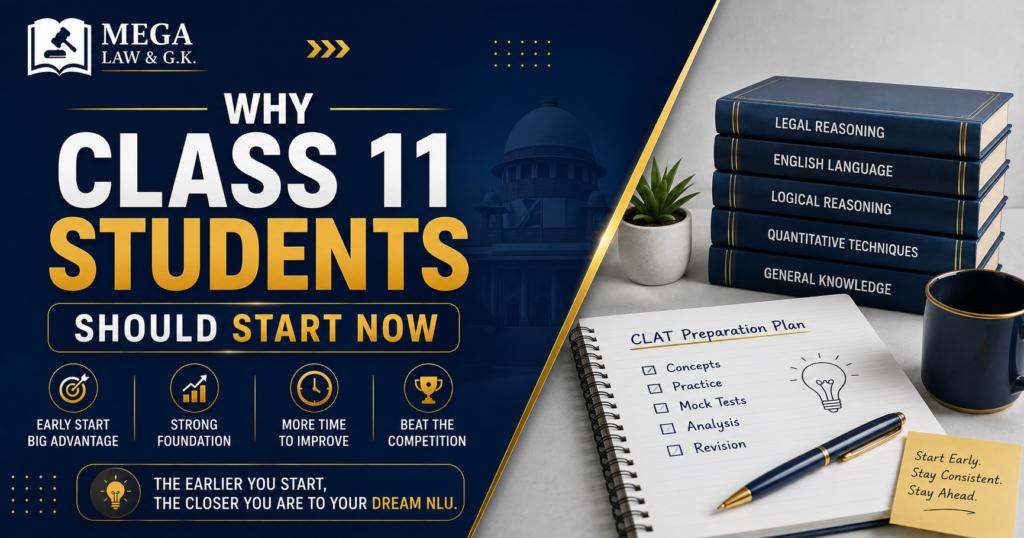
CLAT 2028 Preparation for class 11th students starts with something no coaching brochure will tell is rare time: Roughly 16 months before the December 2027 exam. That is not a comfort zone — it is the only real competitive edge left in a preparation landscape where everyone has access to the same mock papers, the same books, and the same YouTube playlists. The only variable that still separates toppers from average scorers at the starting line is when they started.
Every year I watch the same pattern repeat. A student who spent Class 11 building genuine reading habits, absorbing legal reasoning concepts slowly, and accumulating 12 months of current affairs — sits down for CLAT and finds the paper familiar. The student who started in July of Class 12 finds the same paper exhausting. Same syllabus. Same exam. Completely different experience — because one of them had time to make it second nature.
I have taught CLAT and AILET preparation for 17 years and counselled over 4,000 to 5,000 students. The single clearest finding from those years is this: the students who crack top-5 NLUs are almost never the smartest students in the room in January of Class 12. They are the students who started early enough that nothing on the paper surprises them.
This post tells you exactly what to do, section by section, month by month, so that December 2027 feels like a finish line you have been running toward — not a wall you ran into.
“Every topper I have mentored had one thing in common. Not intelligence, not talent, not coaching. They all started early enough that CLAT stopped feeling like an exam and started feeling like a subject they actually knew.”
— Manav Lawania, Founder, MEGA LAW & G.K.
Why Starting in Class 11 Is the Real Competitive Advantage for CLAT 2028
CLAT 2028 will be taken by roughly 75,000 to 90,000 students. The top-5 NLUs — NLSIU, NALSAR, WBNUJS, NLU Jodhpur, and GNLU — will collectively fill fewer than 1,000 General category seats. That is an acceptance rate of roughly 1 to 1.3 percent for the most competitive bracket.
In a field that large and that competitive, preparation duration is not a minor variable. It is decisive.
Current Affairs cannot be crammed. The GK and Current Affairs section carries the highest weightage and is built from 12 months of news, legal developments, and international events. A student starting in July of Class 12 has 5 months of current affairs. A student starting now has 16. That gap does not close with harder work.
Reading comprehension is a habit, not a skill. The English section tests reading speed and inference ability on dense passages — legal texts, social science extracts, literary pieces. This kind of fluency takes months of daily practice to build. It cannot be acquired in a week.
Legal reasoning requires conceptual depth. The Legal Reasoning section tests your ability to apply principles to unfamiliar fact situations. That application fluency comes from repeated exposure to legal concepts over time — not from reading a summary sheet the week before the exam.
Class 12 boards are non-negotiable. When Class 12 begins, board exams consume significant preparation bandwidth from February to April. A student who has not built their CLAT foundation by then is trying to build it while simultaneously preparing for boards. That is not a preparation strategy — it is crisis management.
The CLAT 2028 Exam Pattern — What You Are Actually Preparing For
Before you plan your preparation, you need to understand what the exam actually tests. The Consortium of NLUs (consortiumofnlus.ac.in) has maintained a consistent passage-based format since 2020. CLAT 2028 will follow the same structure unless the Expert Committee announces a revision.
| Section | Approx. Questions | What It Tests | Time to Build This Skill |
|---|---|---|---|
| English Language | 28–32 | Reading speed, inference, vocabulary in context | 6–8 months minimum |
| Current Affairs & GK | 35–39 | News events, legal developments, static GK | 12 months minimum |
| Legal Reasoning | 35–39 | Principle application, constitutional basics, judgment reading | 8–10 months minimum |
| Logical Reasoning | 28–32 | Argument analysis, critical reasoning, inference chains | 4–6 months minimum |
| Quantitative Techniques | 13–17 | Class 10-level maths — percentage, ratio, speed, profit | 4–6 weeks of revision |
Note on AILET 2028: NLU Delhi conducts AILET separately. CLAT preparation builds a strong base for AILET, but dedicated AILET-specific work is also required. See megalaw.in/ailet-exam/ for the full breakdown.
Section-wise: What to Build in Class 11 vs What to Refine in Class 12
Not all CLAT sections need the same lead time. Here is an honest, section-by-section guide to where your Class 11 time should actually go.
| Section | Approx. Questions | What It Tests | Time to Build This Skill |
|---|---|---|---|
| English Language | 28–32 | Reading speed, inference, vocabulary in context | 6–8 months minimum |
| Current Affairs & GK | 35–39 | News events, legal developments, static GK | 12 months minimum |
| Legal Reasoning | 35–39 | Principle application, constitutional basics, judgment reading | 8–10 months minimum |
| Logical Reasoning | 28–32 | Argument analysis, critical reasoning, inference chains | 4–6 months minimum |
| Quantitative Techniques | 13–17 | Class 10-level maths — percentage, ratio, speed, profit | 4–6 weeks of revision |
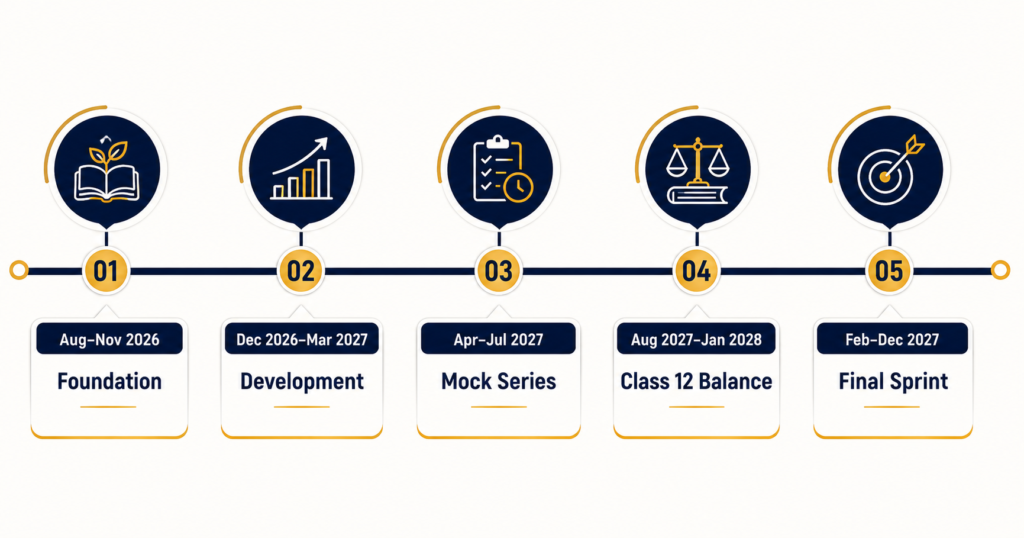
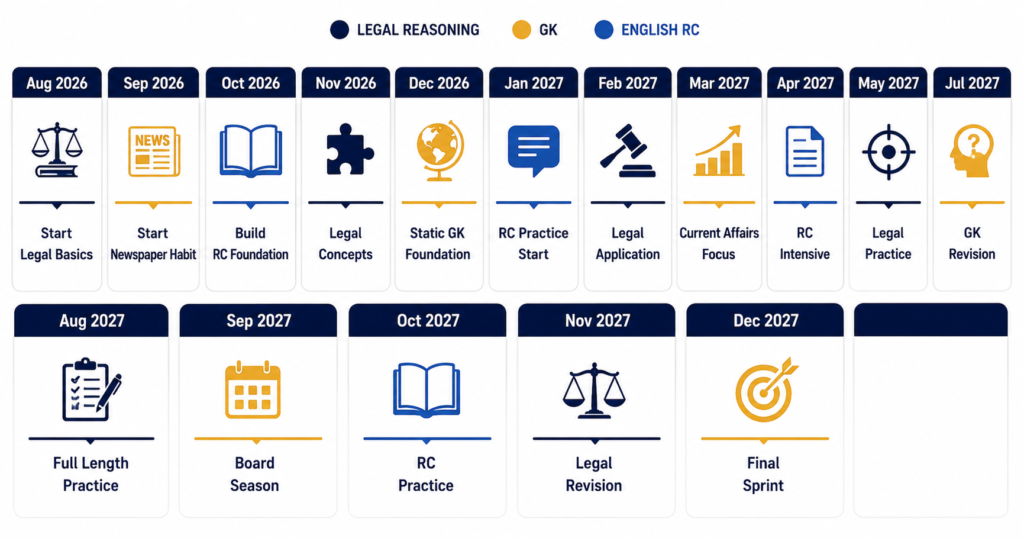
Month-wise Preparation Strategy for CLAT 2028 — Starting Class 11 (August 2026)
Here is a practical, phase-wise framework for a Class 11 student beginning their CLAT 2028 preparation now. This is the same framework used with every TITAN 2028 batch student.
Phase 1: Foundation (August to November 2026)
Habit-building time. Start reading one national newspaper every morning — The Hindu or Indian Express. Read the editorial page first. Solve one RC passage from a CLAT practice book daily without timing yourself. Begin the Indian Constitution: Preamble, Fundamental Rights, Directive Principles. Spend 3 to 4 weeks revising Class 10 maths. Do 10 logical reasoning questions daily. The goal of this phase is not scores — it is routines.
Phase 2: Section-wise Development (December 2026 to March 2027)
By now your newspaper habit is established. Move from just reading to active noting — keep a monthly current affairs log, topic-wise. Start timed RC practice: one passage in 8 minutes. Add basic tort and contract principles to your legal reasoning study. Attempt your first full-length CLAT mock at the end of this phase. Do not analyse the score — analyse the error types only.
Phase 3: Mock Series and Error Log (April to July 2027 — Summer Break)
Your most productive window before Class 12 begins. Take 2 to 3 full mocks per week. After every mock, run the error log — categorise every wrong answer as silly, conceptual, guesswork, or time-pressure. By the end of this phase your error log should show that conceptual errors are decreasing. See megalaw.in/how-to-analyse-clat-mocks-like-a-topper-the-complete/ for the full 5-step analysis framework.
Phase 4: Class 12 + Board Balance (August 2027 to January 2028)
Class 12 begins. Do not abandon CLAT preparation — reduce volume, not quality. One full mock per week. Daily newspaper reading continues. Board subjects that overlap with CLAT — History, Political Science, Economics, English — become dual preparation. Use this phase for refinement, not new concept building.
Phase 5: Final Sprint (February to December 2027)
After boards are done, return to full-intensity CLAT preparation. Three to four mocks per week. Targeted drilling of your top recurring error types from the log. Full paper analysis after every mock. This phase converts your preparation into performance — it only works smoothly if the previous four phases were done properly.
What Class 11 Students Can Build That Class 12 Students Simply Cannot
There are specific advantages that only exist if you start in Class 11. None of them can be replicated by working harder in Class 12.
A 16-month current affairs database. Every month of news you read becomes part of your GK foundation. CLAT rewards students who have been paying attention consistently. Starting now means you cover every major development between August 2026 and December 2027. Starting in Class 12 gives you 6 months of coverage at best.
Genuine reading fluency. CLAT passages are dense — legal extracts, philosophical arguments, social science commentary. A student who has read newspaper editorials and CLAT passages every day for 16 months processes those passages differently from a student who has been practicing for 3 months. This fluency is not acceleratable.
A tested error log. A student who started in Class 11 has run 30 to 50 mocks and knows their patterns. A student who started in Class 12 has run 10 to 15 mocks and is still figuring them out. On exam day, that difference shows in every section.
Lower anxiety under pressure. Students who have taken 40 mocks under timed conditions do not panic in the exam hall. Exam composure is manufactured through repeated, disciplined practice over time — not acquired in the last week.
5 Mistakes Class 11 Students Make When Starting CLAT 2028 Preparation
Starting early is an advantage only if you start correctly. These are the five mistakes that waste the head start.
- Treating Class 11 as a casual warm-up year. There is no warm-up year in CLAT preparation. Students who use Class 11 to “get familiar” arrive at Class 12 with nothing built and everything to do.
- Starting with mock tests before building concepts. Taking mocks before you have built any conceptual foundation just produces discouraging scores and no useful data. The first 3 to 4 months should be almost entirely concept and habit-building.
- Ignoring current affairs because it feels vague. GK feels unmanageable until you have a system. The system is simple: one newspaper per day, weekly notes, monthly compilation. Students who avoid GK in Class 11 find it genuinely unmanageable in Class 12.
- Studying from too many sources. Three RC books, four current affairs apps, two YouTube channels simultaneously — this is information anxiety, not preparation. Pick one primary source per section and go deep.
- Skipping the error log. Without an error log, you will make the same mistakes in mock 20 that you made in mock 5. The log is the difference between students who analyse their preparation and students who just do it.
How Class 11 Subjects Support CLAT 2028 Preparation
Class 11 subjects and CLAT preparation are not competing for your time. For several subjects, they are the same preparation.
Political Science (Class 11) covers the Indian Constitution, fundamental rights, and separation of powers — foundational Legal Reasoning content for CLAT. Every hour you spend on Political Science in school is an hour of CLAT preparation.
History (Class 11) builds the contextual understanding that makes Current Affairs comprehensible. Students who understand the historical arc read current affairs news with depth, not just surface recall.
English (Class 11) — particularly prose and poetry — builds vocabulary and the ability to read dense, formal text. Students who read their Class 11 English curriculum attentively find CLAT passages less intimidating.
Economics (Class 11) introduces GDP, inflation, monetary policy, and trade. These appear regularly in CLAT Current Affairs as policy questions. A student who studied economics in Class 11 already has the framework the CLAT question is testing.
Why MEGA LAW & G.K.'s TITAN 2028 Batch Is Built for This
TITAN 2028 is a 16-month flagship program designed specifically for Class 11 students targeting CLAT 2028 and AILET 2028. It is built around the honest reality of what needs to happen at each stage.
Phase-matched structure. Every TITAN 2028 student follows the 5-phase arc described above — not a generic one-size-fits-all schedule. Foundation first. Mocks after foundation. Final sprint after boards.
Weekly GK sessions ensure that current affairs are consolidated, not just accumulated. The difference is significant: a student who reads but never consolidates cannot retrieve what they read under exam pressure.
Mentor-led mock analysis every week, not just answer keys. Every mock is followed by a structured error-log review — section by section, error type by error type. This is the single habit that separates consistent improvers from students who plateau after 10 mocks.
For complete TITAN 2028 batch details: megalaw.in/titan-batch/
Frequently Asked Questions
Should Class 11 students start CLAT 2028 preparation?
Yes, absolutely. Class 11 students who start now have 16 months before the December 2027 exam. This time advantage is most valuable in Current Affairs, English Reading Comprehension, and Legal Reasoning — all of which require sustained daily habits, not last-minute cramming. The students who crack top-5 NLUs are almost never the ones who started in Class 12.
How many hours per day should a Class 11 student study for CLAT?
Aim for 1.5 to 2 hours of dedicated CLAT preparation per day alongside school. In Class 11, the priority is building habits — daily newspaper reading (30 minutes), one RC passage per day, and 15 to 20 minutes of logical reasoning. Volume increases in Class 12 when the foundation is already in place.
What is the CLAT 2028 exam date?
CLAT 2028 is expected in December 2027. The Consortium of National Law Universities typically announces the confirmed date 6 to 8 months in advance. Check consortiumofnlus.ac.in, or see megalaw.in/clat-exam/ for the latest confirmed pattern details.
Which sections of CLAT should Class 11 students focus on first?
Start with Current Affairs and GK — build the daily newspaper reading habit immediately. Add one RC passage per day for English. Begin Legal Reasoning with Indian Constitutional basics. Leave Logical Reasoning and Quantitative Techniques at a lower volume in Class 11 — they need less lead time and can be intensified in Class 12.
Is CLAT preparation possible alongside Class 11 board studies?
Yes, and Class 11 is actually the better time for it compared to Class 12. Board exam pressure is lower, and several Class 11 subjects — Political Science, History, English, Economics — directly overlap with CLAT content. A student who integrates CLAT awareness into their Class 11 school study is doing dual preparation simultaneously, not competing priorities.
What is the TITAN 2028 batch at MEGA LAW & G.K.?
TITAN 2028 is a 16-month flagship program for Class 11 students targeting CLAT 2028 and AILET 2028. It covers all five sections systematically, includes weekly GK consolidation sessions, mentor-led mock analysis, and a structured phase-wise schedule that

About the Author
Manav Lawania, India's Teens & Twenties Mentor. Founder of MEGA LAW & G.K. and UsefullBooks, Agra, Uttar Pradesh. Former Intelligence Officer, Cabinet Secretariat, Government of India. 17 years of teaching experience and 4,000 to 5,000 students counselled for CLAT and AILET. Manav scored 13 out of 100 in Class 12 before rebuilding his own path, and that comeback is the lens he brings to every student he now mentors. He writes and teaches under the belief that CLAT preparation is as much about having the right data as it is about having the right mindset.