
Is CLAT Getting Harder or More Predictable? The Real Answer for CLAT 2027 and 2028

QUICK ANSWER
CLAT is not simply getting harder, and it is not simply getting more predictable either. It is doing both at once. The overall frame, five sections and 120 questions, is more locked in for CLAT 2027 than it has been in years, since the Consortium has officially confirmed no change to the syllabus or pattern. But inside that frame, individual sections keep shifting style every year, exactly as CLAT 2026 proved when Logical Reasoning suddenly swung from Critical Reasoning to Analytical Reasoning. From CLAT 2028 onward, the frame itself may finally change. Here is what the data actually shows, section by section.
Every serious CLAT aspirant asks some version of this question by October: is CLAT getting harder, or is the exam actually becoming more predictable now that three straight years of pattern data exist to study from?
Both camps are half right. This guide walks through CLAT 2025, CLAT 2026, the confirmed CLAT 2027 pattern, and the proposed CLAT 2028 reform, so you can answer the question with data instead of a gut feeling.
CLAT does not reward students who memorise last year’s paper. It rewards students who can tell which parts of the exam are genuinely stable and which parts are quietly moving underneath them every single year.
Manav Lawania, Founder, MEGA LAW & G.K.
The Real Trend: A Stable Frame With Shifting Content
Since 2020, CLAT has stayed almost entirely passage based across every section, and that comprehension first design has not moved since. That part of the exam is genuinely predictable, and it is why coaching built around reading speed and structured elimination keeps working year after year.
What is not predictable is which section decides to test something new inside that comprehension frame. CLAT getting harder is really a story about individual sections shifting emphasis, not the whole exam being redesigned every year.
What Actually Changed From CLAT 2025 to CLAT 2026
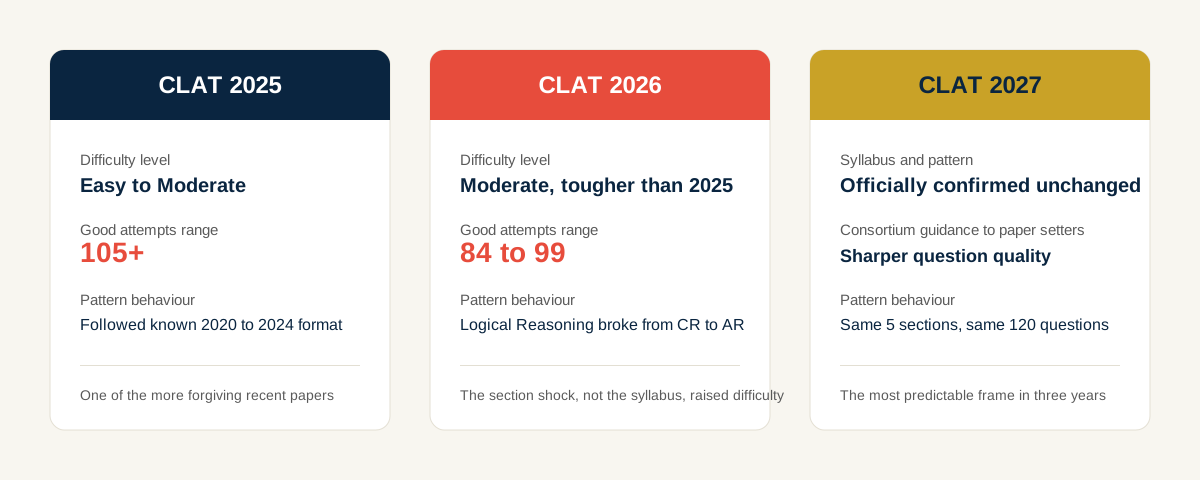
CLAT 2025, held on December 1, 2024, was widely reported as easy to moderate, with a good attempts range above 105 questions. It followed the format aspirants had already trained on for four straight years.
CLAT 2026, held on December 7, 2025, told a different story. The overall difficulty was still called moderate, but the good attempts range narrowed sharply to roughly 84 to 99. The reason was not a harder syllabus. It was Logical Reasoning almost entirely abandoning Critical Reasoning style argument questions for Analytical Reasoning sets like blood relations, sequencing, coding decoding, and tabular arrangements, a genuine break from the 2020 to 2025 trend.
English, GK and Current Affairs, Legal Reasoning, and Quantitative Techniques all stayed close to their known format. That is the part of CLAT getting harder that most students miss: the surprise is usually concentrated in one section, not spread evenly.
CLAT 2027: Same Skeleton, Sharper Execution
The CLAT 2027 Expert Committee Report, submitted to the Consortium’s Advisory Board and finally released in July 2026, settled the biggest open question for this cycle: there will be no change to the syllabus, pattern, or sections for CLAT 2027, UG or PG. Our full breakdown of the CLAT 2027 Expert Committee report covers this in detail.
That confirmation makes CLAT 2027 the most predictable exam frame in three years on paper. Five sections, 120 questions, two hours, no structural surprises. But the Consortium has also asked paper setters to consider the committee’s suggestions on question quality wherever feasible, which points toward more reasoning heavy, less rote memory based questions inside the same five sections.
In practice, this means CLAT 2027 aspirants should stop asking whether the pattern will change and start asking whether their prep can survive a sharper version of a section like Logical Reasoning without warning, the way CLAT 2026 students had to.
This is exactly why SPARTA and Shaurya Elite+ build in a weekly pattern shift review instead of a one time syllabus class, so a repeat of the CLAT 2026 Logical Reasoning shock does not catch our students off guard.
CLAT 2028: The Reform That Could Actually Change the Frame
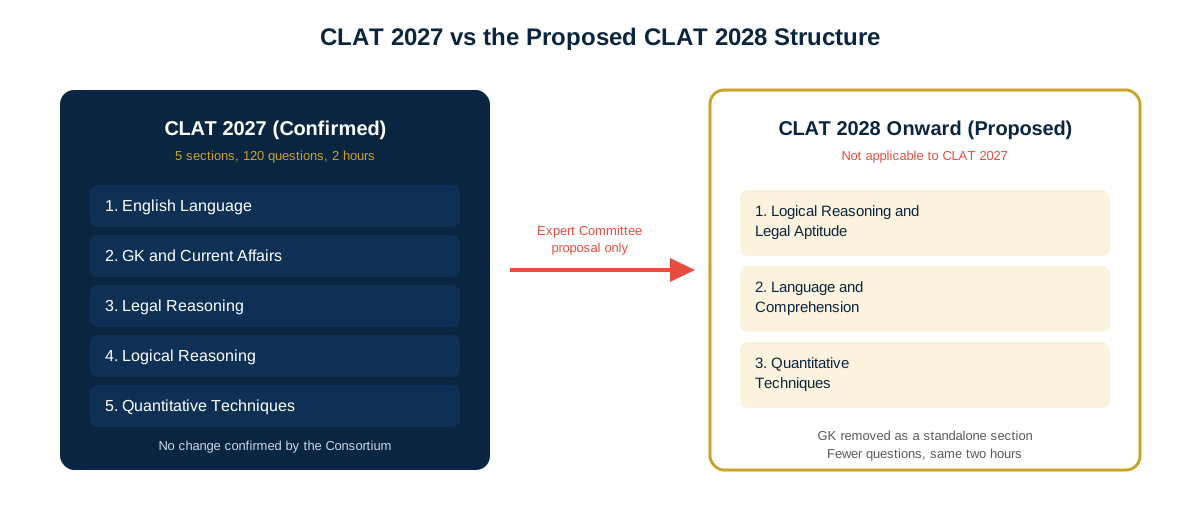
While CLAT 2027 stays untouched, the Expert Committee’s longer term recommendations are aimed squarely at CLAT 2028 and beyond. The committee, chaired by Justice Indu Malhotra with co-chairs from Oxford and LSE, proposed moving from the current five section paper to a three section model: Logical Reasoning and Legal Aptitude, Language and Comprehension, and Quantitative Techniques.
The most talked about change is the proposed removal of GK and Current Affairs as a standalone section. The committee’s own view is that the section currently rewards memory and news cycle trivia more than genuine legal aptitude, and often behaves like another comprehension section instead of testing real awareness.
None of this applies to CLAT 2027. It is a proposal benchmarked against exams like the LSAT in the United States and the LNAT in the United Kingdom, intended for future cycles. But if you are a Class 10 or early Class 11 student, CLAT 2028 is very likely your exam, and that is the one this reform could actually reshape.
Since nobody can confirm the exact shape of CLAT 2028 yet, the safest strategy for a student starting today is building the three skills every version of the reform agrees on: comprehension speed, structured reasoning, and calculation accuracy, rather than betting an entire preparation plan on GK memorisation alone.
Titan Batch is our 16 month CLAT, AILET, and SLAT 2028 program, built around exactly this uncertainty. Instead of one fixed pattern, students build the underlying comprehension, reasoning, and quantitative skills that hold up whichever way the CLAT 2028 reform lands, alongside personal mentorship from Manav Sir through the entire journey.
Section by Section: What Is Getting Harder and What Stays Predictable
CLAT 2027: What Stays vs What Changes
| Area | CLAT 2027 (Confirmed) | CLAT 2028 (Proposed) |
|---|---|---|
| Number of Sections | Stays at 5 sections | Proposed reduction to 3 sections |
| Total Questions | Stays at 120 questions | Not yet specified |
| General Knowledge (GK) Section | Stays as a standalone, full scoring section | Proposed to be removed as a standalone section |
| Logical Reasoning | Stays as-is (already shifted toward Analytical Reasoning in 2026) | Proposed to merge into "Logical Reasoning and Legal Aptitude" |
| English & Comprehension | Stays as a separate section | Proposed to merge into "Language and Comprehension" |
| Quantitative Techniques | Stays as a separate section | Proposed to remain a standalone section |
| Question Quality | Paper setters directed to improve drafting and accuracy | Professionalised paper-setting process proposed (tender/in-house) |
| CLAT PG Pattern | Stays unchanged | Proposed addition of Legal Knowledge section + constructed-response Problem Question |
Source: Consortium of NLUs Expert Committee Report, published July 21, 2026. Reforms are open for public feedback until August 31, 2026, and apply from CLAT 2028 onward — not CLAT 2027.
What This Means for Your Preparation
If you are preparing for CLAT 2027, lean into the predictability. The frame is confirmed, so spend your remaining months on execution speed rather than worrying about a syllabus change that will not happen.
Put extra weight on Logical Reasoning specifically, since that is where the last genuine surprise landed. Building flexibility into that one section, rather than betting only on Critical Reasoning drills, is the single highest leverage move left before December.
Run a proper error log after every mock instead of just checking your score. Our guide on how to analyse CLAT mocks like a topper walks through the exact five step framework we use with our batches, and it is built specifically to catch a pattern shift early instead of after the real exam.
If you are preparing for CLAT 2028, resist the urge to over prepare for a pattern that is not confirmed yet. Build comprehension speed and reasoning depth now. Whatever the final CLAT 2028 structure looks like, those two skills carry over.
Frequently Asked Questions
Is CLAT 2027 going to have a different pattern than CLAT 2026?
No. The Consortium of NLUs has confirmed there will be no change to the syllabus, pattern, or sections for CLAT 2027. The exam stays at five sections and 120 questions. Paper setters have only been asked to consider better question quality wherever feasible.
Why did CLAT 2026 feel harder than CLAT 2025?
The syllabus did not change, but Logical Reasoning shifted almost entirely from Critical Reasoning based questions to Analytical Reasoning sets like blood relations, sequencing, and coding decoding. That single shift narrowed the good attempts range from 105 plus in CLAT 2025 to roughly 84 to 99 in CLAT 2026.
Will CLAT 2028 really remove the GK section?
It is a proposal, not a confirmed change yet. The Expert Committee report recommends a three section model for future CLAT papers, with GK folded out as a standalone section. This is explicitly aimed at CLAT 2028 onward, not CLAT 2027.
Is Logical Reasoning the most unpredictable CLAT section right now?
Based on the CLAT 2025 and CLAT 2026 papers, yes. English, Legal Reasoning, GK, and Quantitative Techniques largely kept their known format, while Logical Reasoning broke a five year pattern in 2026 by turning almost entirely Analytical Reasoning based.
How should I prepare if I do not know what CLAT 2028 will look like yet?
Build the underlying skills every reform proposal agrees on: comprehension speed, structured reasoning, and calculation accuracy. These stay valuable whether the exam keeps five sections or moves to three, which is exactly why Titan Batch is designed around skill building rather than one fixed pattern.
What is a good CLAT 2027 score given the current difficulty trend?
Since CLAT 2027 keeps the CLAT 2026 style skeleton, treat 95 to 100 plus as a strong target for top NLUs, with your actual safe number depending on your accuracy across sections. Mock performance trends matter more than any single predicted cutoff this early. For the official exam pattern and section weightage each year, the Consortium of NLUs remains the authoritative source, and independent legal reporting on the reform process is available through Bar and Bench's coverage of the Expert Committee report.

About the Author
Manav Lawania, India's Teens & Twenties Mentor. Founder of MEGA LAW & G.K. and UsefullBooks, Agra, Uttar Pradesh. Former Intelligence Officer, Cabinet Secretariat, Government of India. 17 years of teaching experience and 4,000 to 5,000 students counselled for CLAT and AILET. Manav scored 13 out of 100 in Class 12 before rebuilding his own path, and that comeback is the lens he brings to every student he now mentors. He writes and teaches under the belief that CLAT preparation is as much about having the right data as it is about having the right mindset.