
How to Fill NLU Preference Order in CLAT 2027: Smart Strategy

Quick answer: Your NLU preference order is the ranked list of National Law Universities you submit inside the CLAT application form. During counselling, the Consortium allots you the highest-ranked university on your list where your rank clears the cutoff. Fill all participating NLUs, never a partial list.
Most aspirants spend six months preparing for the exam and six minutes filling their NLU preference order. That imbalance costs seats every single year. A candidate with AIR 900 who orders the list intelligently can land a better outcome than someone at AIR 700 who ordered it carelessly.
This guide explains exactly how the preference list works, what factors should decide your ranking, and a rank-wise strategy you can apply directly.
What Is the NLU Preference Order in CLAT 2027?
When you fill the CLAT form, you are asked to arrange every participating National Law University from your most preferred to your least preferred. This ranked list is your NLU preference order.
During counselling, the system reads your rank first, then your list. It scans your preferences from top to bottom and allots the first university where seats are still available in your category.
Currently 24 NLUs admit students through CLAT. National Law University Delhi is not part of this list, since it admits through AILET separately. If NLU Delhi is your target, read our AILET preparation guide alongside your CLAT plan.
Remember: The preference list is submitted inside the application form itself, not later. Complete details of the form are covered in our CLAT Application Form 2027 guide.
Why Your NLU Preference Order Decides Your Final Seat
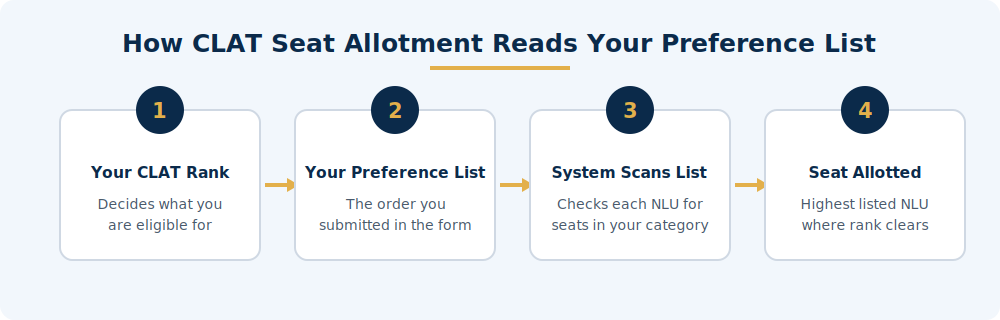
Your rank decides what you are eligible for. Your preference list decides what you actually receive.
Two candidates with nearly identical ranks can end up at very different universities purely because one built a considered list and the other copied a random ranking from a forum. The allotment engine has no way to know your real intent beyond the order you typed.
There is one more reason this matters. If you leave a university out of your NLU preference order, you are permanently excluded from it, even if seats remain vacant in the final round. Omission is treated as rejection.
How to Fill NLU Preference Order in CLAT 2027: Step-by-Step
The interface is simple. The thinking behind it is what takes time.
- Log in to your applicant dashboard on the official Consortium portal.
- Open the section titled preference of NLUs inside the application form.
- Drag each university into the position you want, or enter a number against each name.
- Place every participating NLU somewhere on the list. Do not leave any blank.
- Review the full sequence on the preview page before payment.
- Save and submit. Download the confirmation page as proof of your submitted order.
Official portal: consortiumofnlus.ac.in
5 Factors That Should Decide Your NLU Preference Order
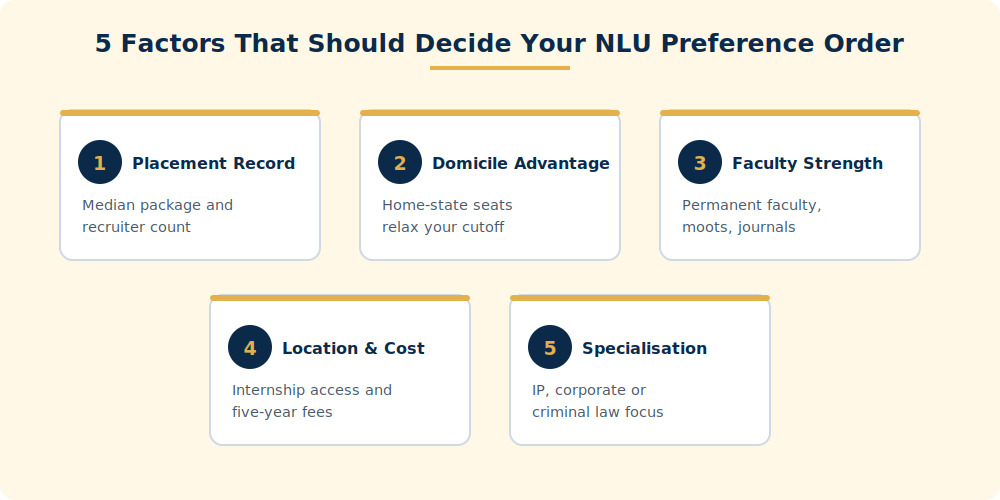
Ignore rankings copied from social media. Build your NLU preference order on these five inputs instead.
1. Placement record and recruiter access
Look at median packages and the number of recruiters visiting campus, not the single highest offer. Older NLUs generally have deeper recruiter relationships and stronger alumni pull.
2. Home-state domicile advantage
Several NLUs reserve a significant share of seats for candidates domiciled in their state. If you hold domicile in that state, your effective cutoff there is far more relaxed, so that university deserves a higher slot in your list.
3. Faculty strength and academic culture
Check permanent faculty count, moot court performance and journal publications. A university with a thin permanent faculty roster affects your five years far more than campus photographs suggest.
4. Location, cost and internship access
Being in or near a metro means easier access to law firm internships, courts and litigation exposure during term. Also compare total five-year fees against your family budget honestly.
5. Specialisation and infrastructure
Some NLUs have distinct strengths in intellectual property, corporate law or criminal law. Compare these carefully in our detailed breakdown of the top law colleges in India.
For an objective third check, the NIRF law rankings published by the Ministry of Education are a useful reference point.
Rank-Wise NLU Preference Order Strategy
Your approach should shift depending on where your mock scores are landing. Use this as a planning frame, not a rigid rule.
| Expected Rank Band | How to Structure Your List |
|---|---|
| Under 100 | Order the top NLUs purely on personal fit, since most will be within reach. Weigh placements against location. |
| 100 to 500 | Keep the top universities at the top anyway, then front-load your home-state NLU where domicile helps you. |
| 500 to 1500 | Balance older established NLUs against your domicile advantage. This is the band where preference order changes outcomes the most. |
| 1500 to 3000 | Prioritise your home-state NLU highly, then arrange remaining universities by placement record and city. |
| Above 3000 | Still list every NLU. Vacancies open up in later rounds as candidates withdraw, and only a complete list captures them. |
Sample NLU Preference Order Logic
Here is how a considered list is usually built, layer by layer.
| Positions | What Goes Here | Reasoning |
|---|---|---|
| 1 to 5 | Your genuine dream universities | Cost nothing to place high; you are only allotted if your rank clears |
| 6 to 10 | Strong established NLUs realistically within your band | This is where most allotments actually happen |
| 11 to 16 | Home-state NLU and solid mid-tier options | Domicile advantage makes these your safety net |
| 17 to 24 | Remaining newer NLUs | Later-round vacancies frequently land here |
Notice that placing an ambitious university at position one carries zero penalty. You are never punished for aiming high, only for leaving options out.
Common Mistakes in the NLU Preference Order
These errors repeat every admission cycle and are entirely avoidable.
- Listing only eight or ten universities because the rest feel unreachable.
- Copying a seniors’ list without adjusting for your own domicile state.
- Ranking universities purely on brand name while ignoring total fees.
- Placing your home-state NLU too low and losing a comfortable domicile seat.
- Filling the order in a rush on the last day of the application window.
- Never discussing the list with a mentor or a current NLU student.
Can You Change Your NLU Preference Order Later?
You can edit your NLU preference order while the application window is open, and again during the correction window if the Consortium permits changes to that field.
Once counselling begins, the list is locked. That is why the order deserves a proper evening of research rather than a hurried five minutes before payment.
During counselling itself, you will still make separate decisions about confirming an allotted seat or waiting for an upgrade in later rounds. Those choices are independent of the preference list you submitted earlier.
Do Not Guess Your Preference List
Our mentors are NLU alumni from NLSIU, NLU Delhi, HNLU and GNLU. They help every student build a personalised NLU preference order based on actual mock performance, domicile and career goals, not guesswork. Batches are capped at 50 students, so this guidance is one-to-one.
Book a free counselling session or see our students’ results including AIR 2, AIR 5 and AIR 8.
Frequently Asked Questions
How many NLUs should I include in my preference order?
All of them. Include every participating NLU without exception. Leaving any university out removes you from consideration there, even if seats stay vacant in the final counselling round.
When do I fill the NLU preference order in CLAT 2027?
You fill it inside the CLAT application form itself, before submitting and paying the fee. It is not a separate step after the exam or the result.
Does my preference order affect my CLAT rank?
No. Your rank depends only on your exam score. The preference list decides which university you are allotted at that rank, nothing else.
Should I place my home-state NLU first?
Not automatically. Place it high enough that domicile reservation works as a reliable safety net, but keep genuinely preferred universities above it. There is no cost to aiming higher first.
Can I change my NLU preference order after the exam?
No. Changes are only possible while the application window or the correction window is open. Once counselling starts, the submitted order is final.
What happens if my rank does not clear any university on my list?
You remain in the pool for later counselling rounds as vacancies arise. This is exactly why a complete list matters more than a short, ambitious one.
Is NLU Delhi part of the CLAT preference list?
No. NLU Delhi admits students through AILET, which is a separate entrance examination with its own application process.