
How to Stay Motivated While Preparing for CLAT: 5 Practical Steps for Aspirants

The honest version upfront
I cannot give you a trick that makes CLAT preparation feel exciting every day. Nobody can. What I can give you is a way to keep going on the days when you do not feel like it.
- Losing motivation in a long preparation is normal. It does not mean you are not made for CLAT.
- One survey of 1,549 students found that studying because you want to goes with more enjoyment, and studying because you ought to goes with more pressure. A survey shows a link, not proof.
- Another study followed 238 working people. They felt best on days when they made progress, and bad days hurt them two to three times more than good days helped. They were not students, but the lesson is the same: write down your small wins.
- The five steps below come from the five C’s of my framework, The Unbreakable Mind™: Clarity, Calm, Code, Connection and Comeback.
- If you feel low for weeks, please talk to someone. There is a short section on this near the end.
A line many students say to me: “Sir, I started with so much energy. Now I just do not feel like studying.”
I scored 13 out of 100 in Class 12. So I know how it feels to start far behind, and to wonder if the effort is worth it. Today I mentor teens and twenties on exam mindset, life mindset and emotional intelligence, and I coach students for CLAT and AILET.
Here is what I would tell any student. Motivation comes and goes. What carries you is a system for the days it goes. That is what this post is about.
Why does motivation drop while preparing for CLAT?
You may see yourself in one or more of these.
- The road is long. The result is far away, so daily work feels like it leads nowhere.
- Mock scores go up and down. A good mock lifts you. A bad one breaks you. The truth is somewhere in the middle.
- You compare. Someone always looks ahead, in groups and on social media.
- The backlog grows. Unfinished chapters pile up, and guilt makes it harder to start.
- You are tired. Little sleep and no breaks make everything feel heavier.
There is also a reason why one bad day feels so big. In a study of 238 working people who kept daily diaries, the researchers found that making progress was the biggest thing behind a good day. But a setback hit them two to three times harder than progress lifted them. The study is called The Progress Principle. For you, this means one bad mock can wipe out ten good days in your mind. The fix is simple: keep a written record of your wins.
What are the 5 steps to stay motivated while preparing for CLAT?
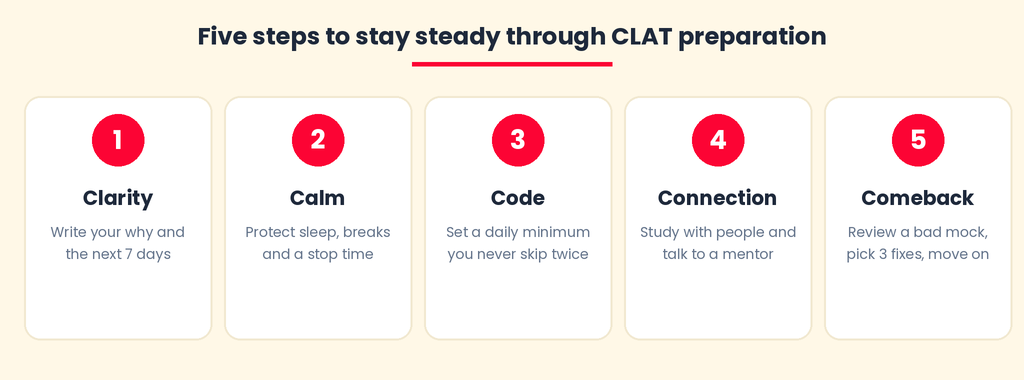
Step 1: Clarity. Know your reason
Take a paper and write one line: why do I want to study law, and why do I want this result? Be honest. Nobody will read it but you.
Why does this matter? A survey of students in Singapore looked at two kinds of motivation. One feels like “I want to.” The other feels like “I have to.” Students with the first kind reported more enjoyment, and students with the second kind reported more pressure. It was a survey, so it shows a link and not proof.
So if your only reason is “everyone expects it from me,” look for something that is truly yours. Maybe a kind of case you want to argue. Maybe a problem you want to fix. Maybe the life you want after college. Then add one more line: the three things you will do in the next seven days.
Step 2: Calm. Protect your sleep and your breaks
A tired mind is slow in every section, and every mock looks worse. Most health guidance for teenagers says about 8 to 10 hours of sleep. So if you cut your sleep to study more, it usually backfires.
- Fix a stop time every evening, and keep to it.
- Take short breaks between study blocks, without your phone.
- Move your body a little every day. Even a walk is enough.
- Mute the comparison. Leave aspirant groups on the day of a mock and the day after.
Step 3: Code. Fix a daily minimum
A code is a set of simple rules, so that a tired brain does not have to decide everything. The best rule is the daily minimum. This is the smallest amount of work you will do even on your worst day. For example: one passage, one GK revision block and one short practice set.
On a good day, do more. On a bad day, do only the minimum. The day still counts.
Add one more rule: never skip twice. Missing one day is human. Missing two becomes a habit. This is a rule I suggest, so change it if you like, but write it down before you need it. If the backlog is what is weighing on you, read How to Clear 10 Months of CLAT GK Backlog in 30 Days.
Step 4: Connection. Do not prepare alone
In the same Singapore survey, feeling connected to other people was the strongest link to “I want to” motivation in class. Again, it is a survey, so take it as a hint and not a rule. But it fits what you can try yourself: students with a study partner, a mentor, or a steady talk at home often find it easier to keep going.
- Find one study partner, and share your weekly plan with them.
- Talk to a mentor when you are stuck, not after a week of being stuck.
- Tell your family what kind of support helps you. Some students need quiet. Some need company.
Step 5: Comeback. Turn a bad mock into a plan
Every aspirant gets a bad mock. What matters is how fast you come back. Try this.
- Wait a few hours before you review. Your first reaction is not fair to you.
- Sort your mistakes into three kinds: did not know, got trapped, ran out of time.
- Pick three fixes, not twenty, and put them in your timetable.
- Take the next mock with that plan.
Remember, a mock score tells you about one paper, not about you. For the full method, read How to Analyse CLAT Mocks Like a Topper. For how to use your 120 minutes, read CLAT 2027 Time Management.
“A bad mock is one bad paper. It is not a bad you.”
Manav Lawania, Founder, MEGA LAW & G.K.
What should you do when you feel stuck?
| When you feel | Try this |
|---|---|
| "I am too far behind." | Write your top three gaps. Work on one at a time, and keep your daily minimum on top. |
| "Everyone is ahead of me." | Mute the groups. Compare yourself only with yourself a month ago. |
| "That mock was a disaster." | Wait a few hours. Then use the Comeback steps above. |
| "I have no energy." | Check your sleep first. Do your minimum block and go for a walk. |
| "I want to quit." | Do not decide on a tired day. Read your reason again, talk to someone, and decide after a week of steady routine. |
How does a weekly win log help?
Because setbacks weigh more than wins in your mind, you need a record that gives wins their proper weight. Spend ten minutes every Sunday on three columns.
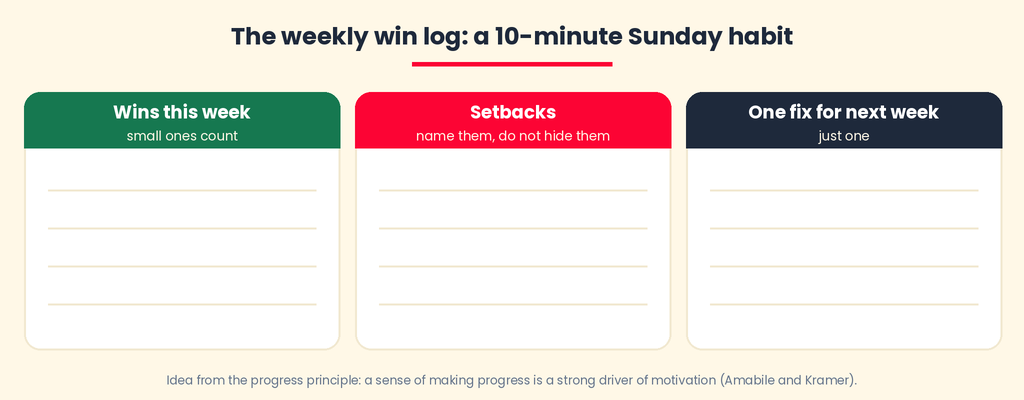
Keep the wins small and specific, such as “finished all passages in the English sectional” or “recalled four months of current affairs without notes.” Choose one fix only, because a long list is another source of guilt. After a month, read your log. You will see progress that your mood had hidden.
A 7-day motivation reset
If you feel flat right now, try this week. It asks for about 20 minutes a day on top of your usual study.
Write your reason
One honest line on why you are preparing, and three things you will do this week.
Set your daily minimum
Decide the smallest day that still counts, and stick it where you can see it.
Fix sleep and a stop time
Choose a bedtime and an evening stop time. Keep both for the rest of the week.
Find your person
Message a study partner or a mentor. Share your plan, and agree on a weekly check-in.
Review your last mock
Sort the mistakes into three kinds, pick three fixes and put them in your timetable.
Start your win log
Fill in your first weekly log on Sunday, and choose one fix for the new week.
How can parents help a child preparing for CLAT?
Many parents search for this, so this part is for you.
- Ask about the plan, not only the marks. “What is your plan for this week?” works better than “How many marks did you get?”
- Do not compare your child with a cousin, a neighbour or a topper.
- Look after the basics: sleep, food and a quiet place to study.
- Listen first. After a bad mock, a calm talk helps more than a lecture.
- Let your child talk about fear. A child who can say “I am scared I will not make it” at home is safer than one who hides it.
If you are a parent and you are not sure how to help, message us on WhatsApp. We will guide you.
When is it more than a low phase?
Let me be honest with you here, because this part matters more than any study tip.
Everyone has low days. That is normal. But some signs tell you it is more than a low day. You feel low or worried for weeks. You cannot sleep. You stop eating properly. Nothing feels enjoyable, not even the things you used to like. If this sounds like you, please do not carry it alone, and please do not wait for the exam to be over.
- Tell one person today. A parent, an elder sibling, a teacher or a friend you trust.
- Speak to a doctor or a counsellor if it has lasted for weeks. You would see a doctor for a bad fever. This is the same thing.
- Talk to us. Message my team on WhatsApp at +91 7983667303 and tell us what you are going through. We will listen, and we will guide you on the right next step.
I am a mentor, not a doctor. So for anything serious, I will also ask you to speak to a professional. And if you ever feel unsafe, or think of hurting yourself, tell a trusted adult right now, or go to the nearest hospital.
Asking for help is not weakness, and it will not take away your chance at CLAT. It protects it.
How does mentorship help when preparation gets heavy?
I did not start MEGA LAW & G.K. only to teach subjects. Many students do not need one more class. They need someone beside them, someone who notices when they are slipping and says, “Hey, let us look at this together.”
This is what mentorship looks like with us.
- Mentors who are NLU students. Every batch includes mentorship from current NLU students, with one mentor for every 10 students. They have cleared this path themselves, so they understand what you are going through.
- Sessions with me. In the MEGA GK Marathon, every week includes a Mindset Strategy Session with me. This is the plan as of October 2026, and the batch page has the latest schedule.
- One-on-one sessions. When you want to talk about your own plan, you can book a one-on-one mentorship session with me.
- Experience. I have 15+ years of teaching experience, and I have counselled 4,000 to 5,000 students for CLAT and AILET.
And what does a mentor actually do? A mentor looks at your timetable and your mock log. They help you choose a daily minimum that is realistic for you. They notice early when you are slipping, and they remind you why you started.
I scored 13 out of 100 in Class 12, so I will never tell you that a bad phase means the end. It does not. It means you need a plan and some people beside you.
The fix in one sentence
Know your reason. Protect your sleep. Keep a small daily minimum. Do not study alone. And after every bad mock, come back with a plan. That is how students stay steady in a long preparation, whether they feel motivated or not.
“You do not have to feel ready every day. You have to show up on most days.”
Manav Lawania, Founder, MEGA LAW & G.K.
Read Next
- How to Analyse CLAT Mocks Like a Topper: The Complete 2027 Framework
- CLAT 2027 Time Management: How to Split 120 Minutes Across 5 Sections
- 60 Days Left for CLAT 2027: What to Do If You're Behind on Your Preparation
- How to Clear 10 Months of CLAT GK Backlog in 30 Days
- The 5 Most Common Traps in CLAT Critical Reasoning (and How to Beat Each One)
Frequently Asked Questions
Why do I lose motivation while preparing for CLAT?
How do I stay motivated for a long CLAT preparation?
What should I do after a bad mock score?
How do I stop comparing myself with other CLAT aspirants?
How much sleep do I need during CLAT preparation?
How can parents help a child preparing for CLAT?
Is it normal to feel like quitting CLAT preparation?
When should I talk to someone about how I feel?

About the Author
Manav Lawania, India's Teens & Twenties Mentor. Founder of MEGA LAW & G.K. and UsefullBooks, Agra, Uttar Pradesh. Former Intelligence Officer, Cabinet Secretariat, Government of India. 15+ years of teaching experience and 4,000 to 5,000 students counselled for CLAT and AILET. Manav scored 13 out of 100 in Class 12 before rebuilding his own path, and that comeback is the lens he brings to every student he now mentors. He writes and teaches under the belief that CLAT preparation is as much about having the right data as it is about having the right mindset.