CLAT Reading Speed: How to Fit 5 Passages in 25 Minutes by Wasting Less, Not Reading Less
The honest version upfront
I cannot teach you to read three times faster and understand everything. Nobody can. What I can show you is how to stop wasting minutes, so that 5 passages fit into about 25 minutes without you guessing.
In CLAT 2026, the English, GK and Legal sections each had 5 passages, and a passage can run up to about 450 words.
The average adult reads English non-fiction at about 238 words per minute. At that pace, 450 words take about 2 minutes.
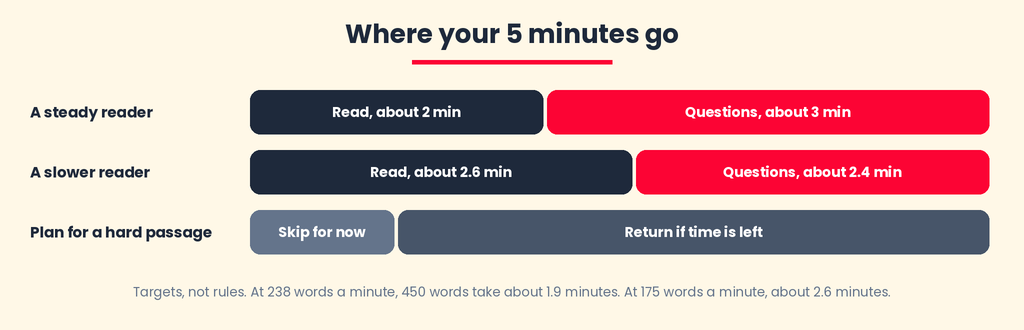
So a fair budget is about 2 minutes to read and about 3 minutes to answer, per passage. It is a target, not a rule.
Research finds a trade-off between speed and understanding. Speed-reading tricks do not remove it. A method and regular reading help more.
Below you will find a 10-minute self-test, the 5-step method and a 7-day practice plan.
A line I hear a lot: “Sir, I understand the passage, but I run out of time before I finish the questions.”
I have taught and counselled thousands of CLAT and AILET aspirants, and I see two kinds of students here. One kind reads too slowly, line by line, and re-reads a lot. The other kind rushes, finishes early and then loses marks on easy questions. Both kinds need the same thing: a steady method for each passage.
Let me give it to you in simple steps, with no tricks.
How fast should you read a CLAT passage?
Let us do the maths, because it removes a lot of fear.
A CLAT passage can run up to about 450 words.
A large review of 190 studies found that the average adult reads English non-fiction silently at 238 words per minute. Most adults fall between 175 and 300.
At 238 words per minute, 450 words take about 1.9 minutes. At 175, about 2.6 minutes. At 300, about 1.5 minutes.
So reading one passage takes about 2 minutes for most of us. If you give one passage 5 minutes in all, about 3 minutes are left for the questions. In CLAT 2026, that works out to about 5 questions a passage in English (24 questions), and about 6 in GK (28) and Legal (30). So you get roughly 30 to 40 seconds a question, and you can go back to the passage for the exact line.
Checkpoints help. Look at the clock only at these points, so that you are not checking after every question.
After passage
Time used (target)
If you are behind
1
5 minutes
Fine. Note how far off you are.
2
10 minutes
Read the next passage with gist notes only, no extra checking.
3
15 minutes
Skip the hardest question of each remaining passage.
4
20 minutes
Decide now which passage you will leave for later.
5
25 minutes
Use any saved time to return to marked questions.
You may not always manage 5 minutes, and that is fine. Some passages are easy and some are heavy. Use 5 minutes as your guide to know whether you are running ahead or behind, and not as a punishment.
Why do speed-reading tricks not work?
You may have seen apps and courses that promise 1,000 words a minute or more. I would be careful.
The author of that large review also notes that reading rates above 1,000 words per minute are not possible without severe loss of understanding.
Another big review of reading research found a trade-off between speed and accuracy. It said that doubling or tripling your speed while understanding as well as before is unlikely.
The same review says that people who really are fast are usually good skimmers who already know the topic. Skimming helps you get the gist. But CLAT asks detailed questions on the passage, so gist alone is not enough.
The good news in that research is this: modest gains come from practice and a bigger vocabulary. That is boring, but it is true, and it is exactly what a CLAT student can do.
What is your own reading pace? A 10-minute self-test
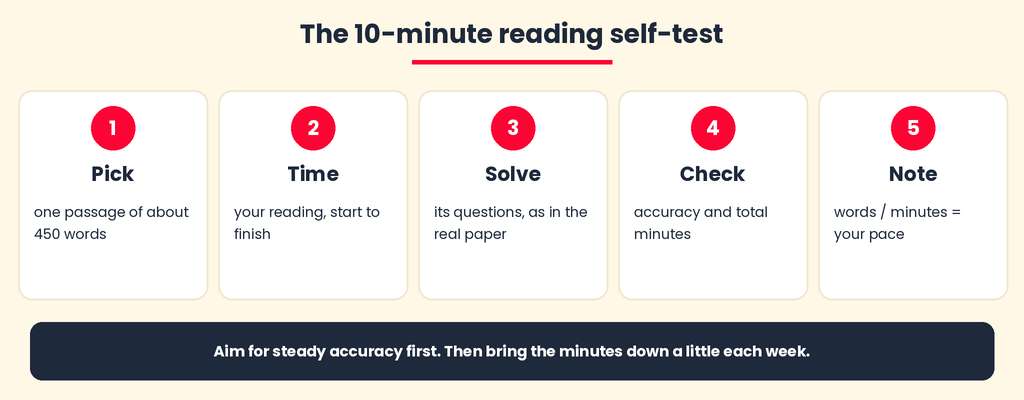
Before you change anything, find out where you stand today.
To find your pace, divide the number of words by the minutes you took to read. For example, 450 words in 2 minutes 30 seconds is 450 divided by 2.5, which is 180 words per minute. Then check how many questions you got right.
What you see
What it likely means
What to do
About 2 to 2.5 minutes, most answers right
Your reading pace is fine.
Work on answering the questions faster.
3 minutes or more, most answers right
Slow but accurate.
Build gist notes and daily reading volume.
Under 2 minutes, many answers wrong
You are rushing.
Slow down a little and read with gist notes.
Slow and many wrong
It may be a vocabulary or comprehension gap, not speed.
Go back to basics: daily reading and word notes.
Keep a small log so that you can see progress. Write one line per passage:
Date
Section
Read (min)
Answer (min)
Right / total
Where I lost time
Example
English
2.5
3.5
3 / 5
Re-read paragraph 1
After two weeks, the last column will show you the same two or three leaks again and again. Those are what you fix.
This table is my own rough guide, so use it as a starting point. If you find it hard to read English at any speed, a mentor can help you build a plan.
What is the 5-minute method for one passage?
Step 1: Fix a budget before you start
Tell yourself: this passage gets about 5 minutes. Look at the clock when you begin, and look again after you finish reading. If you have used more than 3 minutes on reading alone, you are slow on this passage, so speed up on the questions or leave it for later.
Step 2: Read once, and read actively
Read at a normal pace, and write a 2 or 3 word gist next to every paragraph. For example: “cause of delay” or “author disagrees”. This takes a few seconds per paragraph, and it saves you from re-reading, because most re-reading happens when we did not understand a sentence the first time.
Short gist notes and circled turn words let you jump straight to the right line.
See how it works in the example. The question asks why parents stopped coming. Your note for paragraph 2 says “real cause: closing time”, so you go straight to that line, find “closed at five”, and answer. You did not read the passage again.
Step 3: Mark the turns
Circle words that change direction: but, however, although, yet, unless, except. Writers put their real point after these words. In a legal passage, mark conditions and exceptions as well.
Step 4: Answer from the lines, not from memory
For detail questions, go back to the exact line and check. This is faster and safer than relying on what you remember. Your gist notes will tell you where to look, so you do not need to read the whole passage again.
Step 5: Leave on time
If a question holds you for more than a minute, mark it and move on. Come back at the end if time is left. Every wrong answer costs 0.25, so a guess made in a hurry is a bad trade. Our post on negative marking in passages explains why.
A small note: some students like to read the questions first, and some do not. I do not think one way suits everyone. Try both for a week, compare your accuracy and your time, and then stick with the one that works for you.
“Reading fast is not about reading less. It is about wasting less.”
Manav Lawania, Founder, MEGA LAW & G.K.
How should you read English, GK and Legal passages?
Section
How to read
Where speed comes from
English
Read for gist, tone and the writer's view. Do not stop at every hard word.
Reading volume and vocabulary. For story-like passages, see our guide to literary passages.
GK
Read for the facts, names, places and dates. Questions often check whether you know the background.
Knowing the topic already. This comes from regular current affairs and revision, not from reading faster.
Legal
Read the principle slowly and mark its conditions. Read the facts faster.
Notice that GK speed is mostly about preparation. If a GK passage is about a topic you studied, it reads quickly. If it is about something new, no technique will rescue you. That is why steady GK revision also makes you a faster reader.
THE PROBLEM, AND THE FIX
YOU UNDERSTAND THE PASSAGE. THE CLOCK STILL WINS.
The problem: you do not know where your minutes go, so you cannot fix them.
The solution: timed practice with a mentor who reads your error log and your pace, and tells you what to change.
The research is clear on one thing: the more you read, and the more words you know, the faster and easier reading becomes. There is no shortcut around this, but you can make it small and daily.
Read for 20 to 30 minutes every day. Mix editorials, essays and a short story or a book review.
Keep a word notebook. Write the word, the sentence and its meaning in that sentence.
Write one line after each piece. The gist in your own words. It trains the habit you need in the paper.
Solve one timed passage daily. Use the 5-minute budget and review your minutes.
Expect gains that are modest and steady. A student who does this for a few weeks usually feels the difference in calm, even if the stopwatch moves only a little.
Which habits waste your minutes?
The habit
Why it hurts
Do this instead
Reading every line twice
It costs a minute or more per passage.
Write a gist note and move on.
Stopping at every new word
You lose the flow of the argument.
Guess from context. Note the word for later.
Reading aloud in your head, word by word
It slows you to speaking speed.
Read in phrases. Practise with easy material first.
Fighting one hard question
It eats the time of three easy ones.
Mark it, move on, return later.
Skimming to save time, then guessing
You pay in wrong answers.
Read once with care and answer from the lines.
Trying speed-reading apps at the last minute
They promise a lot and the research does not support them.
Use a method and daily reading.
A 7-day practice plan to read faster
About 30 to 40 minutes a day on top of your usual study is enough. Use passages from a mock, a sectional or a good practice book.
Day 1
Find your pace
Do the 10-minute self-test on two passages. Note the words per minute and your accuracy.
Day 2
Gist notes only
Read two passages and write a 2 or 3 word gist per paragraph. Do not look at the questions yet. Check whether your notes tell the story.
Day 3
Mark the turns
Take one passage and circle every "but", "however" and exception. Then see which questions are built on those lines.
Day 4
Look back, do not recall
Solve one passage and, for each detail question, find the exact line before you choose.
Day 5
Questions first, or not
Do one passage each way and compare your time and accuracy. Choose your way.
Day 6
Five passages, 25 minutes
Do five passages of one section with a timer. Do not worry about the score. Note where you went over 5 minutes and why.
Day 7
Fix the leaks
Look at your notes. Pick the two habits that cost you the most time and write one rule for each. Then repeat the week.
It will not make you read three times faster. No method will do that without losing understanding.
It will not fix a weak vocabulary in one week. That needs regular reading over weeks.
It will not make every passage fit in 5 minutes. Some passages are heavy, and skipping them is part of the plan.
What it will do is show you where your minutes go, and give you a calm, repeatable way to read. That is what most students are missing.
How can mentorship help with your reading pace?
Your pace is hard to see from the inside. You may think “I read slowly”, when the real leak is that you re-read the first paragraph of every passage. A mentor can see this by looking at your timed practice with you.
At MEGA LAW & G.K., we provide mentorship to our students. Every batch includes mentorship from current NLU students, with one mentor for every 10 students. We also provide one-on-one mentorship to all students, taken by me for strategy and decision guidance. For any query, message us on WhatsApp at +91 7983667303.
The method in one line
Give each passage a budget, read once with gist notes, mark the turns, answer from the lines and leave on time. Do this daily, and read a little every day, and your pace will settle without any tricks.
WANT HELP WITH YOUR PREPARATION?
MENTORSHIP WITH MANAV SIR AND MEGA LAW & G.K.
Tell us where you are and which section costs you the most time. We will guide you to the right next step: our mentorship in the batches, a one-on-one mentorship session with me, or simply a practice plan for this week.
A passage can run up to about 450 words. The average adult reads English non-fiction silently at about 238 words per minute, so such a passage takes about 2 minutes. That leaves about 3 minutes for its questions if you want to finish 5 passages in about 25 minutes. This is a target, not a rule.
Does speed reading work for CLAT?
Not in the way it is sold. Research reviews find a trade-off between speed and understanding, and reading several times faster usually costs comprehension. What helps is practice, a bigger vocabulary and a calm method.
How can I read 5 passages in 25 minutes?
Give each passage about 5 minutes: roughly 2 minutes to read and 3 to answer. Read once with a short gist note per paragraph, go back to the exact line for detail questions, and leave a stuck question instead of fighting it.
Should I read the questions before the passage?
Practise both ways for a week and compare your accuracy and time. Some students do better with questions first, some without. Choose the one that works for you and keep to it.
Why do I keep re-reading lines in passages?
Mostly because the sentence did not make sense the first time. So the fix is to understand as you go: write a 2 or 3 word gist after each paragraph. More vocabulary and regular reading also reduce re-reading.
How do I improve my reading speed for CLAT?
Read a mix of editorials, essays and short stories for 20 to 30 minutes daily, note new words with their sentence, and solve one timed passage a day. Expect modest, steady gains, not a sudden jump.
Is reading speed the same in English, GK and Legal Reasoning?
No. In English, read for gist and tone. In GK, speed comes mostly from knowing the topic already. In Legal Reasoning, read the principle slowly and the facts quickly.
Can a mentor help me with my reading pace?
A mentor can look at your timed practice, find where the minutes go and fix your plan. At MEGA LAW & G.K., we provide mentorship to our students and also one-on-one mentorship to all students. For any query, message us on WhatsApp at +91 7983667303.
About the Author
Manav Lawania, India's Teens & Twenties Mentor.
Founder of MEGA LAW & G.K. and UsefullBooks, Agra, Uttar Pradesh. Former Intelligence Officer, Cabinet Secretariat, Government of India. 15+ years of teaching experience and 4,000 to 5,000 students counselled for CLAT and AILET. Manav scored 13 out of 100 in Class 12 before rebuilding his own path, and that comeback is the lens he brings to every student he now mentors. He writes and teaches under the belief that CLAT preparation is as much about having the right data as it is about having the right mindset.