
CLAT 2028 Preparation Guide: Complete 15-Month Roadmap for Class 11 Students
DIRECT ANSWER
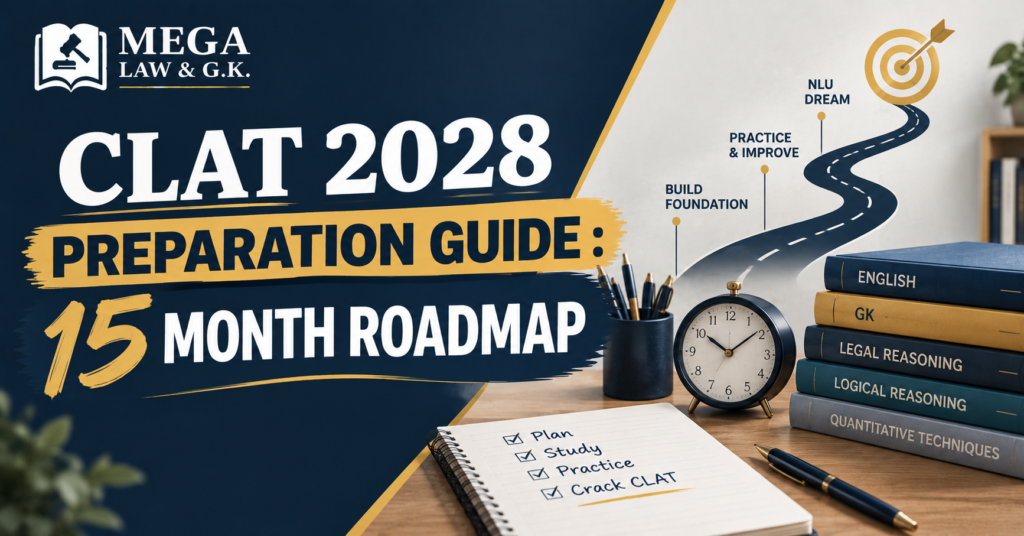
CLAT 2028 preparation for Class 11 students runs across 15 months (October 2026 to December 2027) in 4 phases. The approach must be reasoning-first throughout — whether or not the Expert Committee’s proposed new pattern is confirmed, the direction of CLAT is toward depth of reasoning over breadth of content.
→ Phase 1 (Months 1 to 4): Foundation — reasoning habit, newspaper, basic passage work
→ Phase 2 (Months 5 to 9): Depth building — section-specific drilling, mock introduction, GK consolidation system
→ Phase 3 (Months 10 to 12): Application — full mocks every week, error log driven drilling
→ Phase 4 (Months 13 to 15): Final revision — accuracy maximisation, time management, subject consolidation
→ Daily time: 2 to 3 hours in Class 11, 4 to 5 hours in Class 12
→ GK: maintain the newspaper habit regardless of whether GK is confirmed for CLAT 2028
If you are in Class 11 and targeting CLAT 2028, you have something rare in competitive exam preparation: time. Not the 4 months of frantic coverage that most CLAT aspirants get — but 15 months of structured preparation in which you can actually build the skills that this exam tests, rather than cramming content that approximates them.
This guide gives you the complete preparation roadmap: what to do in each of the 15 months, which sections to prioritise and in what sequence, how the CLAT 2028 proposed new pattern changes your approach, and the specific habits that separate students who reach the top 100 from those who reach rank 800.
I have been teaching CLAT and AILET for 15+ years and have counselled over 4,000 to 5,000 students through this process. The roadmap below is not aspirational — it is what actually works.
“The students who reach the top 100 in CLAT are not the ones who studied the most. They are the ones who built the right habits the earliest and maintained them the longest. 15 months of consistent, structured preparation beats 6 months of intense cramming every single time — because reasoning skills compound, but content coverage does not.”
— Manav Lawania, Founder, MEGA LAW & G.K.
Why CLAT 2028 Demands a Different Preparation Approach
Before building the roadmap, you need to understand what CLAT 2028 is likely to test and why it changes the preparation strategy for Class 11 students significantly.
The Expert Committee Report (published July 2026) recommends replacing the current 5-section CLAT with a 3-section model: Logical Reasoning and Legal Aptitude, Language and Comprehension, and Quantitative Techniques. The GK section is recommended for removal. This change is not yet confirmed — but the direction it signals is unambiguous: CLAT is moving toward testing reasoning depth, not information recall.
This shift matters for Class 11 preparation in three specific ways:
- Reasoning skills take 10 to 12 months to build to a high level.You cannot develop strong legal aptitude in 3 months before the exam. The ability to read a fact pattern, identify the applicable principle, and apply it correctly to a new situation is a trained skill — it requires hundreds of hours of deliberate practice. Class 11 students who start now have time to build this properly. Class 12 students who start in April 2027 do not.
- GK remains worth maintaining even if it may be removed.The newspaper reading habit builds the contextual awareness that makes legal reasoning passages easier to process. A student who reads quality editorial content daily for 15 months will outperform an equally intelligent student who did not — regardless of whether GK carries marks in the final paper.
- The 15-month window allows layered preparation.Foundation, then depth, then application, then consolidation — each layer building on the previous. This structured progression produces significantly better results than starting with mock tests and working backward, which is what students who start in Class 12 are forced to do.
For the full breakdown of what the Expert Committee proposed and what the Consortium has confirmed, see our CLAT 2028 complete guide at megalaw.in/clat-2028/
The 15-Month CLAT 2028 Preparation Timeline
The 15 months from October 2026 to December 2027 divide naturally into 4 preparation phases. Each phase has a different primary focus, a different daily structure, and a different success metric.
Foundation Building
Build the three core daily habits: 20-minute newspaper reading with topic consolidation, 30-minute passage reading with argument identification, and 20-minute basic data practice. No mocks yet. No pressure. Just habit formation.
Depth and Section Drilling
Section-specific drilling begins. Legal aptitude application sets daily. Timed passage reading with error tracking. First mocks introduced at Month 5. GK consolidation sheets built every week. Error log system established.
Mock Integration and Application
Full mocks every week with 5-step analysis protocol after each one. Error log drives daily drilling. GK consolidation accelerates. Section-wise accuracy tracked across each mock. Target rank clarity established.
Revision and Final Push
Full mocks 2 to 3 times per week. Tight revision cycle on error log top items. GK final consolidation and high-frequency topic revision. Time management fine-tuning. No new content — only deepening what is already known.
TITAN 2028 This is exactly what TITAN 2028 is structured around. TITAN 2028 begins with Phase 1 in October 2026 — building the three core habits from Day 1 before introducing any section-specific content. Regular classes start October 2026 for the Class 11 batch. If you are starting now, this is the moment to join — because Phase 1 is where the foundational advantage is built. Details at: megalaw.in/titan-batch/ |
Section-Wise Preparation Strategy for CLAT 2028
Here is what to prepare in each section, how to structure daily practice, and what the proposed new pattern means for your approach.
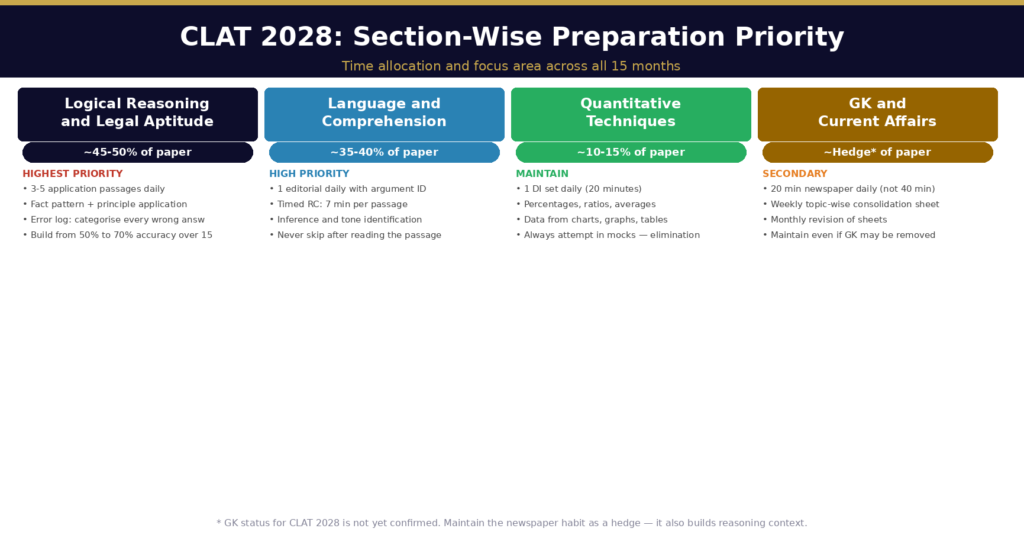
Section 1: Logical Reasoning and Legal Aptitude (Proposed highest weightage: 45 to 50%)
This is the section that CLAT 2028 will be decided on. The Expert Committee’s proposed model merges current Legal Reasoning and Logical Reasoning into one section that tests the application of given rules to novel facts — no prior legal knowledge required. The rules are always supplied in the passage. What is tested is whether you can read the rule accurately, identify its scope, and apply it correctly to a new situation.
How to build this skill over 15 months:
- Months 1 to 4 (Foundation): Read one legal reasoning passage per day. Do not attempt the questions first. Read the passage, identify the principle stated, paraphrase it in your own words, and then identify 2 to 3 real-world situations to which it would and would not apply. This builds principle identification — the base skill that all CLAT legal aptitude questions test.
- Months 5 to 9 (Drilling): Timed application sets — 5 passages per session, 8 minutes per passage, with accuracy tracked every week. Maintain an error log: for every wrong answer, identify whether the error was fact misread, principle misapplied, or option mis-eliminated. Drill the top error type weekly.
- Months 10 to 15 (Mock application): Legal aptitude and logical reasoning are always attempted together in mocks. Never skip these questions after reading the passage. Your accuracy in this section should be 55 to 70% by Month 12. If it is below 50% at Month 10, the drilling approach needs review.
In TITAN 2028, we run dedicated Legal Aptitude application sessions three times per week from Month 1 — not as a class lecture but as a supervised practice session where every error is categorised and fed back into the next session’s drill set. This is the part of preparation that coaching genuinely accelerates, because self-studiers cannot easily diagnose the difference between a fact misread and a principle misapplication without an experienced eye reviewing their work.
Section 2: Language and Comprehension (Proposed weightage: 35 to 40%)
The proposed Language and Comprehension section is not English grammar. It is deep reading for argument structure, tone, inference and implication. The section tests whether you can read a passage and extract what the author is arguing, what they are assuming, and what can and cannot be concluded from what they have said.
- Daily habit (all 15 months): 20 minutes of quality editorial reading — The Hindu, Indian Express, or Indian Express Explained. Not just reading but active processing: after each editorial, identify the main argument in one sentence, identify one assumption the argument depends on, and identify one thing the passage does not establish but might seem to.
- Months 5 to 9: Timed RC practice — 7 minutes per passage, questions answered before re-reading. Track tone identification errors and inference errors separately in your error log.
- Months 10 to 15: RC questions should be attempted at close to 100% rate in mocks. The passage gives you everything you need to eliminate at least 2 options on every question. Never skip a Language question you have read.
Section 3: Quantitative Techniques (Proposed weightage: 10 to 15%)
Quantitative Techniques in CLAT 2028 is expected to remain broadly similar to the current section. The focus is on data interpretation and basic arithmetic — not advanced mathematics.
- Months 1 to 4: 20 minutes of basic arithmetic daily — percentages, ratios, averages, profit and loss. These are the building blocks for all data interpretation questions.
- Months 5 to 9: Data interpretation sets — one DI set per day (5 to 6 questions based on a chart, graph or table). Time target: 6 minutes per set.
- Months 10 to 15: QT should be attempted fully in mocks. Never skip data interpretation questions — the data is given, so elimination is always possible.
GK and Current Affairs: Maintain or Drop?
The honest answer: maintain, at reduced intensity. Even if the GK section is removed from CLAT 2028 — which is a strong probability but not a confirmed fact — the newspaper reading habit builds reasoning context that makes Legal Aptitude passages significantly easier to process. A student who has read quality news for 15 months understands legal and governance contexts at a level that pure reasoning practice cannot replicate.
The adjusted approach: 20 minutes of newspaper reading daily (down from the 40 to 45 minutes recommended for CLAT 2027 students). Weekly consolidation into topic-wise sheets. Monthly revision of sheets. Do not stop GK entirely — but do not let it dominate a preparation schedule that must now be reasoning-first.
Monthly Milestones: What You Should Have Done by Each Month
This table gives you a specific, measurable milestone for each month of the 15-month roadmap. Use it as a monthly check — not aspirationally, but as a hard standard.
| Month | Period | Milestone to Hit |
|---|---|---|
| Month 1 | October 2026 | Daily newspaper reading habit established. One editorial per day, argument identified after each. Basic arithmetic revision complete. |
| Month 2 | November 2026 | 20 legal aptitude passages completed. Principle identification accuracy above 60%. GK consolidation sheet system started. |
| Month 3 | December 2026 | Timed passage reading at 7 minutes per passage consistent. Logical reasoning basic question types covered. First GK monthly revision done. |
| Month 4 | January 2027 | 50 legal aptitude passages completed with error categorisation. Data interpretation — one DI set per day. Strong daily habit across all 3 domains established. |
| Month 5 | February 2027 | First full mock attempted. Section scores recorded. Error log started. Legal aptitude drilling sessions running 5 days a week. |
| Month 6 | March 2027 | 3 mocks completed with full 5-step analysis after each. Top 3 error types per section identified. GK consolidation sheets covering 6 major topic areas. |
| Month 7 | April 2027 | Legal aptitude accuracy above 50% across last 3 mocks. English RC accuracy above 55%. Error log driving daily drilling topics. |
| Month 8 | May 2027 | 6 mocks completed. Section-wise accuracy trend is upward in at least 3 of 4 sections. Target rank confirmed with section improvement identified. |
| Month 9 | June 2027 | Logical reasoning application accuracy above 55%. Data interpretation sets completed in under 6 minutes consistently. Board exams complete — CLAT preparation intensifying. |
| Month 10 | July 2027 | One full mock per week minimum. Full 5-step analysis after every mock without exception. Legal aptitude accuracy above 60%. |
| Month 11 | August 2027 | 12 to 14 mocks completed total. Overall mock accuracy above 55%. GK consolidation sheets fully updated for all major topic areas from October 2026 to date. |
| Month 12 | September 2027 | Legal aptitude accuracy 60 to 70%. RC accuracy 65 to 75%. Time management consistent — 120 questions in 2 hours with at least 110 attempted. |
| Month 13 | October 2027 | 2 to 3 mocks per week. No new content. Error log top 5 items drilled daily. All GK sheets revised twice. |
| Month 14 | November 2027 | Minimum 20 full mocks completed total. Best mock score stable across last 5 mocks. Exam day time strategy finalised and tested in mocks. |
| Month 15 | December 2027 | CLAT 2028 examination. You have done the work. Execute the strategy. Attempt at least 112 of 120 questions. |
What TITAN 2028 Covers — And Where It Fits This Plan
TITAN 2028 is MEGA LAW & G.K.’s flagship 15-month batch for Class 11 students targeting CLAT and AILET 2028. Every element of the roadmap above is built into the TITAN 2028 curriculum. Here is exactly how the batch maps to the 4 phases:
| Phase | What TITAN 2028 Provides | What Self-Study Provides |
|---|---|---|
| Phase 1 (Foundation) | Supervised passage reading sessions. Principle identification worksheets reviewed by mentors. GK consolidation system set up and checked weekly. Daily schedule accountability from Day 1. | Self-directed reading. No external check on whether habit is forming correctly. No feedback on whether principle identification is accurate. |
| Phase 2 (Depth) | Dedicated legal aptitude drilling 3 times per week. Every error categorised by mentor — fact misread vs principle misapplied. Weekly mock series with cohort benchmarking. GK sessions with CLAT-filtered compilation. | Self-directed drilling. Hard to diagnose own error type without experienced feedback. No calibrated mock series. GK requires building own filtration system. |
| Phase 3 (Application) | Weekly full mock with mentor-led analysis session. Error log reviewed and drilling adjusted monthly. Full GK booster integration. Section-wise accuracy targets tracked. | Can run own mocks. Analysis quality depends on self-discipline and accuracy of own error diagnosis. GK requires independent consolidation. |
| Phase 4 (Final) | Intensive mock series. Manav's direct session on exam-day strategy and attempt approach. Final GK revision sessions. Personal counselling on NLU preference order and counselling strategy. | Self-directed revision. No external calibration of whether preparation is on track. |
The honest picture: self-study is viable for students who have demonstrated self-regulation over long periods, can build their own error diagnosis system, and can access a calibrated mock series independently. TITAN 2028 is for students who want the structure, the expert feedback loop, and the accountability that turns a 15-month window into a top-100 result.
TITAN 2028 Regular classes begin October 2026 for Class 11 students. Joining in Month 1 means building the foundation the right way from the start — with supervised sessions, mentor feedback on your first legal aptitude errors, and the GK consolidation system set up before the habit has a chance to slip. Demo classes are running now. See the full curriculum, schedule and fee structure at the link below. Details at: megalaw.in/titan-batch/ |
The 5 Things That Separate CLAT 2028 Toppers From Everyone Else
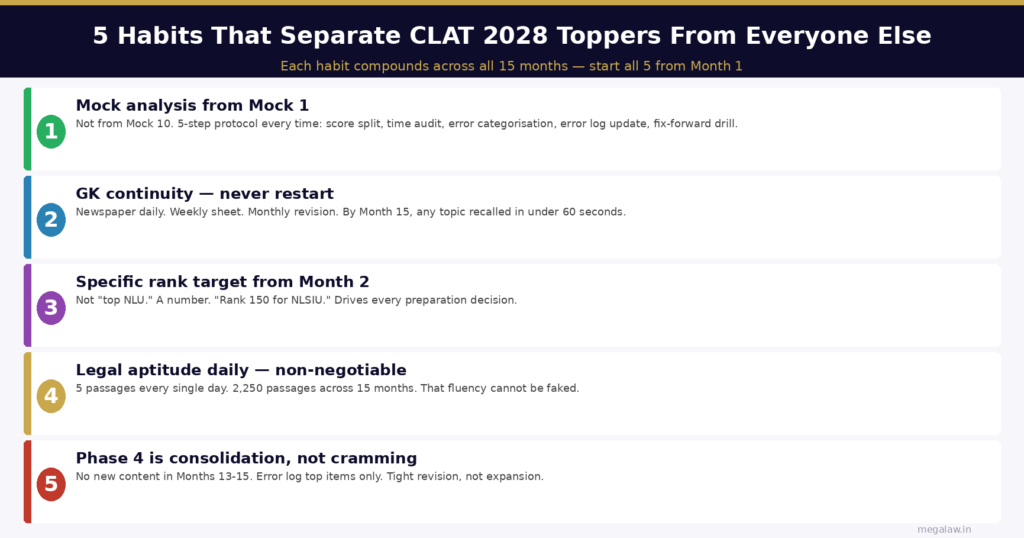
Based on 15+ years of tracking what separates the students who reach the top 100 from those who reach rank 800, these are the 5 differences that compound across a 15-month preparation:
- They start the mock analysis protocol from their first mock — not their tenth.Most students take 5 to 8 mocks before they start analysing them seriously. CLAT toppers run the full 5-step analysis (score split, time audit, error categorisation, error log update, fix-forward drill) after their very first mock. The error log they build from Month 5 onwards is the most valuable preparation document they produce. See the complete mock analysis framework at megalaw.in/how-to-analyse-clat-mocks-like-a-topper-the-complete/
- They maintain GK continuity throughout the 15 months — never restarting.The GK consolidation sheet is built from Month 1 and updated every week without exception. By the time the exam arrives, a student with 15 months of consistent consolidation can recall the 10 most relevant events from any major category with minimal review time. The students who restart GK in October 2027 spend 6 to 8 weeks just recovering ground they had already covered.
- They have a specific rank target from Month 2 onwards.Not “I want to get into a top NLU” — a number. “I need rank 150 or below for NLSIU” or “I need rank 700 or below for GNLU.” The number drives daily preparation decisions about where to spend drilling time and what section improvement is required. Students without a specific target drift toward comfort zones in preparation rather than weakness areas.
- They treat Legal Aptitude application as a daily non-negotiable.Not 3 times a week. Not when they feel like it. Every single day, at least 3 to 5 legal aptitude passages. The students who reach the top 100 treat this the way athletes treat their training: consistency over intensity. 5 passages every day for 15 months is 2,250 passages of deliberate practice. That level of application fluency cannot be faked in an exam hall.
- They finish their preparation in better shape than they started.This sounds obvious but it is not. Most students peak around Month 11 and then plateau or regress in Months 13 to 15 due to revision anxiety, board exam fatigue, or coaching batch disruptions. The toppers design Phase 4 specifically to prevent regression — no new content, tight error log focus, reduced mock volume with higher analysis quality. The goal in the final 3 months is not improvement. It is consolidation of what is already there.
Daily Schedule: What a Good CLAT 2028 Preparation Day Looks Like
The specific allocation below is for a Class 11 student in Phase 2 (Months 5 to 9) — the core depth-building phase. Adjust time blocks for Phase 1 (less mock work) and Phase 3 (more mock work).
| Time Block | Activity | Duration | Notes |
|---|---|---|---|
| Morning (before school) | Newspaper reading — one editorial with argument identification | 20 min | Write main argument in one sentence. Do not just read — process. |
| After school — Block 1 | Legal Aptitude application drilling — 3 to 5 passages with error log | 45 min | Timed: 8 to 10 minutes per passage set. Error categorised immediately. |
| After school — Block 2 | Logical Reasoning — 1 passage set or argument analysis | 25 min | Alternate with English RC passage on alternate days. |
| Evening — Block 3 | Quantitative Techniques — 1 DI set or arithmetic drill | 20 min | Keep this short and focused. QT does not need more than 20 minutes daily at this stage. |
| Evening — Block 4 | GK consolidation — update weekly sheet or revise monthly sheet | 15 min | Update sheet on days when something significant happened. Revise old sheets on other days. |
| Total | 2 hrs 5 min | Add 45 to 60 minutes for mock and analysis on mock days (once per week in Phase 2). |
Common CLAT 2028 Preparation Mistakes to Avoid
- Starting with content coverage instead of habit formation.The most common Class 11 mistake is trying to complete the entire CLAT syllabus in Month 1. Start with 3 daily habits, not 5 subjects. The habits are the foundation — the content builds on them.
- Treating the proposed new pattern as confirmed.CLAT 2027 is unchanged. CLAT 2028 may or may not adopt the 3-section model. Prepare reasoning-first because that is what the direction demands — not because you are certain GK has been removed. Students who drop GK entirely based on the Expert Committee recommendation and then find it retained in CLAT 2028 will regret it significantly.
- Skipping the error log.The error log is not optional. It is the core preparation document that tells you where your marks are leaking and what to drill next. Students who take 20 mocks without an error log improve far less than students who take 10 mocks with one. For the full error log and mock analysis system, see megalaw.in/how-to-analyse-clat-mocks-like-a-topper-the-complete/
- Starting mocks too early or too late.Too early (before Month 4): you have not built enough foundation to learn from the errors the mock exposes. Too late (after Month 8): you have insufficient time to improve based on what the mocks show. Month 5 is the right point to introduce the first full mock for most Class 11 students.
- Letting school board pressure derail Phase 3.Board exams fall squarely in the Phase 3 period (March to May 2027 for most boards). Students who stop CLAT preparation entirely during boards lose 2 to 3 months of the most important preparation window. The right approach: reduce daily CLAT time to 45 to 60 minutes during boards, but never stop. Maintain the legal aptitude habit even if everything else is reduced.
- Having no NLU target.Preparation without a specific target rank is preparation without direction. Identify your target NLU, look up its expected closing rank, and reverse-engineer the score you need. Everything in your preparation should be driven by that number. See megalaw.in/clat-rank-1000-which-nlu-2027/ for the cutoff data.
Self-Study vs Coaching for CLAT 2028: The Honest Comparison
Over a 15-month preparation window, the coaching vs self-study decision matters more than it does for an 8-month Class 12 preparation cycle — because more can go wrong in 15 months, and the compounding effect of early errors is larger.
Self-study works for CLAT 2028 if you meet four conditions: you have a demonstrated track record of maintaining daily habits without external accountability, you can accurately diagnose your own legal aptitude errors (fact misread vs principle misapplied), you have access to a calibrated mock series with cohort benchmarking, and you can build and maintain the GK consolidation system independently. If all four are true, self-study with structured resources is viable and often produces excellent results.
Coaching adds clear value when: the 15-month timeline is difficult to structure independently, legal aptitude error diagnosis requires an external eye, you need the accountability of a regular schedule to maintain habits during school terms, or you want access to a curated GK resource rather than building your own filtration system from scratch.
For the detailed coaching vs self-study analysis, see the honest breakdown at megalaw.in/clat-coaching-vs-self-study/
Read Next
- CLAT 2028 Complete Guide: Exam Date, Pattern, Syllabus and Eligibility
- TITAN 2028 Batch: Full Curriculum, Schedule and Fee Structure
- How to Analyse CLAT Mocks Like a Topper: The Complete Framework
- Is CLAT Coaching Necessary or Can I Self-Study? Honest Answer
- Which NLU Can I Get With CLAT Rank 1000? Complete Guide
- Top Law Colleges in India: Complete NLU Guide with Fees and Placements
- 3 Out of 4 CLAT Droppers at MEGA LAW & G.K. Improved Their Rank: What Changed
- CLAT 2027 Complete Guide: Syllabus, Pattern and Important Dates
Frequently Asked Questions
How should I prepare for CLAT 2028 in Class 11?
Preparation should be reasoning-first from Day 1. Build three core daily habits in the first 4 months: 20 minutes of quality editorial reading with argument identification, 30 to 45 minutes of legal aptitude passage application, and 20 minutes of data practice. Introduce mocks at Month 5. Run the full 5-step analysis after every mock. Maintain GK consolidation weekly. Keep a specific target rank and section improvement target from Month 2 onwards. See the complete month-by-month milestone table above for what you should have completed by each stage of the 15-month roadmap.
When should I start preparing for CLAT 2028?
Now. Class 11 students starting in September or October 2026 have approximately 15 months before the December 2027 examination. This is the most valuable preparation window CLAT offers — 15 months builds genuine reasoning depth through layered practice. Students who start in Class 12 have only 7 to 8 months and must prioritise very differently. Starting in Class 11 with the right structure gives a significant rank advantage because reasoning skills compound over time in a way that content coverage does not.
Is CLAT 2028 harder than CLAT 2027?
The proposed CLAT 2028 pattern is not harder — it is differently demanding. It shifts from testing a combination of aptitude and information recall to testing pure aptitude. Students who build genuine reasoning ability will find the proposed new pattern easier than the current one. Students who have relied heavily on GK and coaching-curated current affairs as their scoring anchor will find it harder. The difficulty shift favours students who have used preparation time to build thinking skills rather than covering content.
What is the most important section for CLAT 2028?
Logical Reasoning and Legal Aptitude — the proposed merged section — is expected to carry 45 to 50% of the paper. This is the section that requires the most time to build to a high level, which is exactly why starting in Class 11 matters. A student who has completed 2,000 to 2,500 legal aptitude application passages over 15 months will consistently outperform a student who completed 800 passages in 6 months — at the same level of underlying intelligence.
How many hours per day should I study for CLAT 2028?
In Class 11 (Months 1 to 9), 2 to 3 hours of dedicated preparation per day is the right target alongside school. In Class 12 (Months 10 to 15), increase to 4 to 5 hours per day as board exam pressures settle. Do not study for more hours than your attention can sustain productively — 2 focused hours beats 4 distracted hours every time. Track output (passages completed, error log entries made) not input (hours spent).
What is the TITAN 2028 batch and who is it for?
TITAN 2028 is MEGA LAW & G.K.'s 15-month CLAT and AILET preparation batch for Class 11 students targeting the December 2027 examination. It is structured around the 4-phase roadmap described in this guide — Foundation, Depth, Application, Final Push — with supervised legal aptitude drilling, calibrated mock series with mentor analysis, weekly GK sessions with topic-wise consolidation, and personal counselling on NLU selection and counselling strategy. Regular classes begin October 2026. Explore the full curriculum at megalaw.in/titan-batch/.

About the Author
Manav Lawania, India's Teens & Twenties Mentor. Founder of MEGA LAW & G.K. and UsefullBooks, Agra, Uttar Pradesh. Former Intelligence Officer, Cabinet Secretariat, Government of India. 15+ years of teaching experience and 4,000 to 5,000 students counselled for CLAT and AILET. Manav scored 13 out of 100 in Class 12 before rebuilding his own path, and that comeback is the lens he brings to every student he now mentors. He writes and teaches under the belief that CLAT preparation is as much about having the right data as it is about having the right mindset.