
CLAT 2027 Time Management: How to Split 120 Minutes Across 5 Sections
The honest version upfront
No official time limit exists for each CLAT section, so any CLAT time management plan is a guess until you test it, and the split I give you is a starting plan and not a rule. What I can give you is the arithmetic, the CLAT 2026 facts, and a way to find your own split with your mocks.
- CLAT 2027 is on 6 December 2026, which is 44 days from today, 23 October. The paper has 120 questions in 120 minutes, so the average is one minute a question.
- In CLAT 2026 the sections had 24, 28, 30, 26 and 12 questions (English, GK, Legal, Logical, QT), according to Hitbullseye.
- The good attempts reported for each section add up to about 96 to 107. So “attempt all 120” is not how strong students usually score.
- A stuck question costs time more than marks. Four minutes on one question is the time of four average ones.
- Our suggested starting split: 22, 22, 30, 28 and 12 minutes, plus 6 minutes of buffer.
A line I hear after almost every mock is: “Sir, I knew the answers, but I ran out of time.”
When I look at those papers, the problem is rarely speed in general. It is usually one or two places where the clock quietly went missing: a puzzle set that took ten minutes, a passage read twice, or a Quantitative Techniques question that would not give way.
That matters more this year, because analysts called the CLAT 2026 paper reading-heavy with intense time pressure, and said even strong students struggled to finish comfortably. So this post on CLAT time management is about how to spend your 120 minutes: what the sections look like, how many questions to attempt, a time budget for each section, a rule for stuck questions and a 44-day routine to train it.
What did CLAT 2026 look like, section by section?
Before you split time, you need the shape of the paper. This is what Hitbullseye reported for CLAT 2026.
| Section | Questions | Passages or sets | Good attempts | Reported difficulty |
|---|---|---|---|---|
| English | 24 | 5 passages | 20 to 22 | Easy to slightly moderate |
| GK | 28 | 5 passages | 22 to 25 | Moderate |
| Legal | 30 | 5 passages | 26 to 28 | Moderate to difficult |
| Logical | 26 | Puzzle and analytical sets | 20 to 22 | Moderate to tough |
| QT | 12 | 2 sets of 6 | 8 to 10 | Medium to difficult |
Baseline
Take one full mock as you normally would. Record the minutes you spent in each section, and mark every question where you were stuck for more than 90 seconds.
Timed sectionals
Practise one section a day with the budget from the table and a passage-level timer. Note which sections go over time, and by how much.
Full mocks and order test
Take a full mock every three days. Try two section orders and compare minutes and accuracy. Then fix your order, and keep a count of "stuck minutes" in each mock. It should fall.
Light revision
Re-read your time rules and your list of stuck questions, and take at most one last mock early in this block. Rest well, and do not change your plan now.
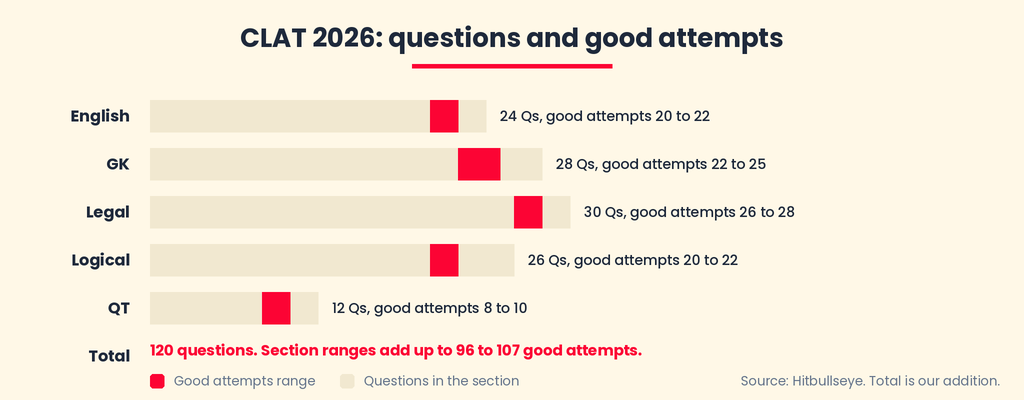
Two cautions. First, analyses differ on difficulty. NLTI rated Legal and QT as easy to moderate, while the other analysis rated them harder, so do not trust a label over your own mock data. Second, the Consortium of NLUs has said the 2027 pattern and syllabus are unchanged, but the number of questions in each section can still shift a little from year to year.
Should you attempt all 120 questions in CLAT?
For most students, no. The sections’ good attempts add up to about 96 to 107, and a second analysis puts good attempts at roughly 100 to 110 overall. It also says students who attempted about 100 with high accuracy did better than students who attempted 110 with low accuracy. Speed without accuracy is useless.
Now the maths. A correct answer gives 1 mark and a wrong one takes away 0.25. With four options, here is what a guess is worth on average.
| Options left after elimination | Chance of being right | Average marks from the guess |
|---|---|---|
| 4 (blind guess) | 25% | +0.06 |
| 3 | 33% | +0.17 |
| 2 | 50% | +0.38 |
So a blind guess is worth almost nothing, and one that has dropped to two options is clearly worth taking. That is why the penalty is not the main reason to skip. The main cost is the minutes.
Here is an illustration with one assumption of mine. Suppose you answer ordinary questions at about 80% accuracy, so each is worth about 0.75 marks on average (0.8 minus 0.2 × 0.25). If you spend 4 minutes on one stuck question, you lose the time for four ordinary ones, which is about 3 marks, to chase at most 1. That is the whole case for a time cap. For the penalty arithmetic in more detail, read CLAT Negative Marking Strategy 2027.
How should you split 120 minutes across the 5 sections?
The sources I checked give a total of 120 minutes for the whole paper and no section-wise time limits, so read the instructions on your own paper to confirm. Here is a starting plan that is proportional to question counts and adjusted for how long each section tends to take. It is a suggestion, not an official rule.
| Section | Questions | Suggested minutes | Per passage or set |
|---|---|---|---|
| English | 24 | 22 | about 4.4 minutes a passage |
| GK | 28 | 22 | about 4.4 minutes a passage |
| Legal | 30 | 30 | 6 minutes a passage |
| Logical | 26 | 28 | cap of about 7 minutes a set |
| QT | 12 | 12 | 6 minutes a set |
| Buffer | none | 6 | for returns and last checks |
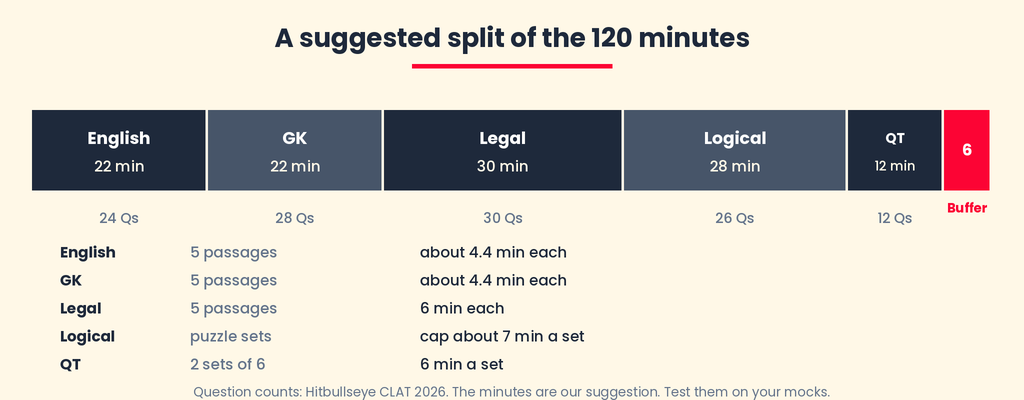
The logic behind the numbers: Legal gets the most time because it has the most questions, and six questions on each passage reward careful reading. GK gets less because it tests recall, and if you know the fact you are quick, while if you do not, more time will not help. Logical gets about 28 minutes because puzzle sets can run long, and I would rather you cap each set than lose ten minutes on one. QT has only 12 questions but is often time-consuming, so it gets a hard limit.
The order of sections is yours to choose, and nobody has proved one order is best. Try two orders in two mocks and compare minutes and accuracy. Then fix one and keep it in the paper.
Section-wise time management strategy for CLAT 2027
English: bank time here, but do not read twice
English had 5 passages and was the easiest section in CLAT 2026 by most ratings, so it is where you can finish fast and bank a few minutes. The trap is reading each passage twice. Read once with purpose, then answer using the passage and not your memory of it. Aim to finish near 22 minutes, and let any saved time flow to Legal or Logical.
GK: if you know it, move; if you do not, do not dig
GK had 28 questions across 5 passages. Facts come fast or not at all. Answer what you know, eliminate what you can, and take the guess only when two options remain. This is the section where your preparation shows, which is why a steady revision plan matters. If you are behind, read How to Clear 10 Months of CLAT GK Backlog in 30 Days.
Legal: the biggest section, so protect its time
Legal had 30 questions in 5 passages of six, the largest block in the paper. Give it a firm 30 minutes and about 6 minutes a passage. Use the same approach every time: find the principle in the passage, then apply it to the facts. Do not bring outside law into the answer. If one passage is clearly harder than the rest, do it last in the section, as you would a Logical set.
Logical Reasoning: triage the sets and cap each one
Logical had 26 questions in puzzle and analytical sets, and many students lost time here in CLAT 2026. Spend the first two minutes scanning the sets and mark each as easy, medium or hard. Do the easy ones first and cap every set at about 7 minutes. The method is in How to Score 20+ in CLAT Logical Reasoning, and the argument-question side is in The 5 Most Common Traps in CLAT Critical Reasoning.
Quantitative Techniques: two sets, two time boxes
QT had only 12 questions, in 2 sets of 6, and good attempts of 8 to 10. Read both sets quickly and start with the one whose numbers look friendlier. Give each set a limit of about 6 minutes. If a calculation is going nowhere, leave it and use the time elsewhere, where a minute earns more. If maths is your weak point, the CLAT QT Mastery Workbook is built for it.
“The clock does not care how clever the question is. Decide your limits on a calm day, and obey them on the hard one.”
Manav Lawania, Founder, MEGA LAW & G.K.
The 90-second rule, a halfway check and the buffer
Two simple rules hold the plan together. Both are my suggestions, so test them on your mocks before you rely on them.
- The 90-second rule. A standalone question that has not moved in about 90 seconds gets an elimination attempt. If two options are left, choose one. If not, mark it and move on. For a passage or set, use the cap from the table above.
- Checkpoints by minutes. Because the average is one minute a question, the number of questions you have touched should roughly match the minutes elapsed. At minute 60, you should be near the halfway mark, about 60 questions. If you are far behind, shorten your next caps and do not rush the questions you are sure of.
- The buffer. Use the last 6 minutes only for the questions you marked, and not to re-check ones you were sure about.
A 44-day routine to train your CLAT time management
Day 1 here is 23 October. Fit this into your usual schedule, and read 60 Days Left for CLAT 2027 if you are behind in other areas. Review each mock using the steps in How to Analyse CLAT Mocks Like a Topper.
The fix in one sentence
Decide your limits before the paper, find your own split with your mocks, and treat a stuck question as a cost in minutes. That is how strong students use all 120 minutes without chasing all 120 questions.
“A good CLAT paper is not the one with the most attempts. It is the one where every minute earned its place.”
Manav Lawania, Founder, MEGA LAW & G.K.
Want a mentor to run this plan with you?
Everything in this post works on your own. If you want a structured batch, mentors who are current NLU students and live practice, these are the options. Pick the one that matches where you are.
FULL CLAT AND AILET 2027 PREP
Shaurya Elite Plus
Our premium batch for CLAT and AILET 2027. Mentorship is part of the batch, in small groups of 10 students per mentor, and your mentors are current NLU students.
View Shaurya Elite PlusFOR THE 50 DAYS AFTER REGISTRATION
MEGA GK Marathon 2027
A 50-day GK and current affairs revision batch for the final stretch, with weekly live classes and live tests.
View Batch Details WhatsApp: +91 6397564795IN CLASS 11?
TITAN 2028
Your attempt is CLAT 2028, not this one. TITAN is our 15-month foundation batch for CLAT, AILET and SLAT.
Learn about TITAN 2028See all courses · See our student results · CLAT QT Mastery Workbook for Quant
Read next on MEGA LAW
- → CLAT Negative Marking Strategy 2027
- → How to Score 20+ in CLAT Logical Reasoning (2027): A Realistic Target and the Habits Behind It
- → How to Analyse CLAT Mocks Like a Topper: The Complete 2027 Framework
- → How to Clear 10 Months of CLAT GK Backlog in 30 Days
- → 60 Days Left for CLAT 2027: What to Do If You're Behind on Your Preparation
Frequently asked questions
How should I divide 120 minutes in CLAT?
Should I attempt all 120 questions in CLAT?
How many questions are in each CLAT section?
How many attempts are a good score in CLAT?
Which section should I attempt first in CLAT?
How do I stop spending too much time on one question?
Is negative marking a reason to skip questions?
How can I improve my speed in the next 44 days?

About the Author
Manav Lawania, India's Teens & Twenties Mentor. Founder of MEGA LAW & G.K. and UsefullBooks, Agra, Uttar Pradesh. Former Intelligence Officer, Cabinet Secretariat, Government of India. 15+ years of teaching experience and 4,000 to 5,000 students counselled for CLAT and AILET. Manav scored 13 out of 100 in Class 12 before rebuilding his own path, and that comeback is the lens he brings to every student he now mentors. He writes and teaches under the belief that CLAT preparation is as much about having the right data as it is about having the right mindset.