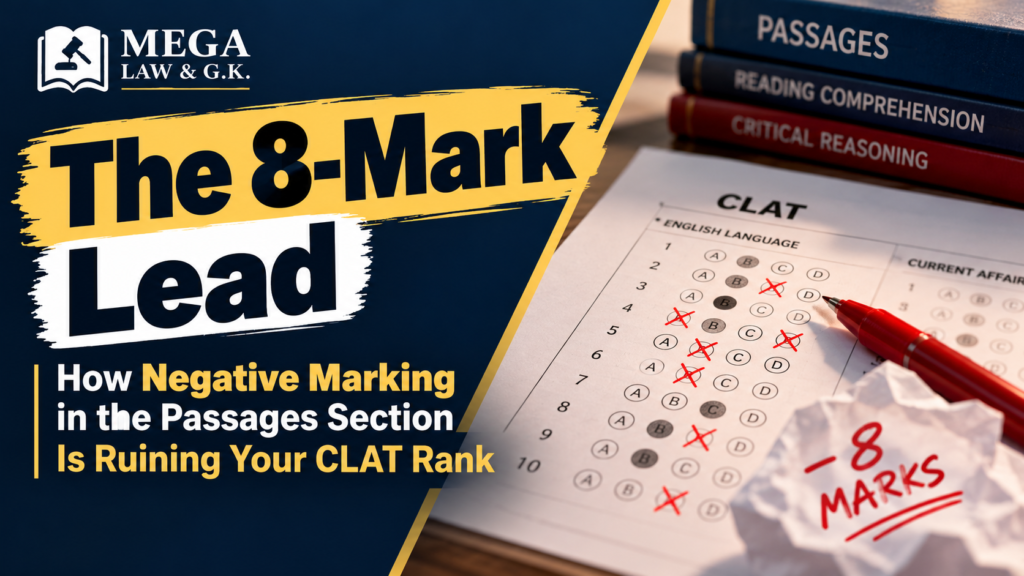
The 8-Mark Lead: How Negative Marking in the Passages Section Is Ruining Your CLAT Rank
The honest version upfront
CLAT negative marking is not the villain. The way we answer passages under negative marking is.
- CLAT 2027 is on 6 December 2026: 120 questions, 120 minutes, +1 for correct, minus 0.25 for wrong. The break-even accuracy is 20%.
- Every section is built on passages, so mistakes do not arrive one by one. They arrive in packs from one misread idea.
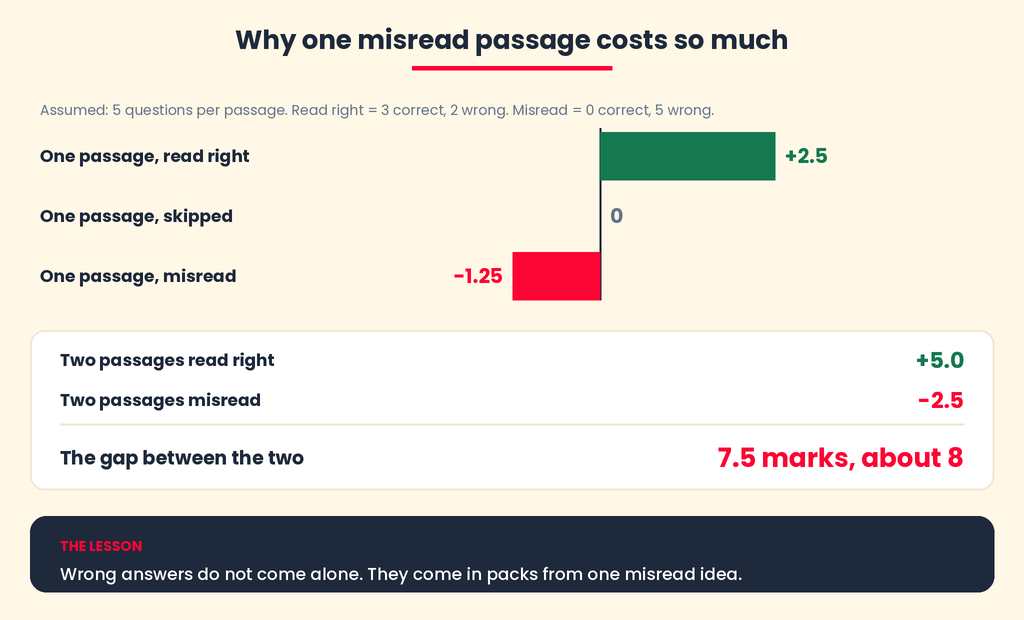
- As an illustration (my own arithmetic, not a topper statistic): two misread passages of five questions each cost about 7.5 marks compared with reading them correctly. That is the 8-mark lead.
- NLTI notes that every four wrong answers cost you one mark, a margin that can move a rank by hundreds.
- Blind guessing is not the main problem. The confident wrong answer is.
- The fix is one routine per passage, the Passage Gate, not attempting less. Over-skipping loses marks too.
Here is a question I ask every student who says, “Sir, my knowledge is fine, but my mock score is stuck.” Open your last mock. Do not count your wrong answers. Ask where they sit. If your wrong answers are scattered one by one across the paper, you have a knowledge problem. If they are bunched inside three or four passages, you have a reading problem, and negative marking is multiplying it.
Those few passages quietly take away your lead over students you know you can beat. This post is about that lead. In simple words, I will show you how CLAT negative marking works inside passage-based sets, why wrong answers cluster, how much one bad passage can cost, and the routine I teach to stop it. You have about 50 days left for CLAT 2027, which is enough time to fix this, but not enough to ignore it.
What is the 8-mark lead in CLAT?
The 8-mark lead is the gap you can open, or lose, by how you handle passages, with the same knowledge. It comes from two simple facts about the CLAT marking scheme.
- A wrong answer costs 1.25 marks against a correct one. You lose the 1 mark you could have got and you pay 0.25 on top.
- Thirty-two wrong answers cost 8 marks in penalty alone, before counting the marks you did not score.
Now see what happens inside a passage with five questions. These numbers are an illustration, so please do not read them as an average.
| What happens in one passage (5 questions) | Correct | Wrong | Marks |
|---|---|---|---|
| You read it right | 3 | 2 | 3 − 0.5 = +2.5 |
| You skip it | 0 | 0 | 0 |
| You misread the main idea | 0 | 5 | 0 − 1.25 = −1.25 |
The swing between reading a passage right and misreading it is 3.75 marks. Two such passages make 7.5 marks, which is the 8-mark lead. In a paper where a few marks can separate ranks, two bad passages are enough to move you from one college bracket to another.
Why does CLAT negative marking hurt more in passage-based questions?
CLAT has been passage-based in every section since 2020, from English and Legal Reasoning to GK and Quantitative Techniques. That one design choice changes how negative marking works.
- The questions are connected. If you misread the main idea, tone or conclusion, the inference questions built on it fail together.
- The wrong options follow the common misreading. Setters write distractors for the exact mistake a hurried reader makes. You are not choosing randomly. You are walking into a prepared trap.
- Wrong answers feel confident. A misread idea feels like understanding, so you attempt every question with full confidence.
- Time pressure makes it worse. With 120 questions in 120 minutes, you average one minute a question. A hard passage tempts you to rush the rest.
This is also why a single-question view of negative marking, the 20% break-even maths, is incomplete for CLAT. It is correct, and I explain it in our CLAT negative marking strategy for 2027. But the maths assumes your attempts are independent. In passages, they are not.
How much can 8 marks change your CLAT rank?
At the top end of CLAT, ranks are packed closely. Here are the general category closing ranks for the top NLUs
| NLU (general category) | Closing rank 2025 | Closing rank 2024 |
|---|---|---|
| NLSIU Bengaluru | 112 | 102 |
| NALSAR Hyderabad | 159 | 167 |
| WBNUJS Kolkata (BA LLB) | 327 | 279 |
| NLU Jodhpur | 367 | 379 |
| NLIU Bhopal (BA LLB) | 480 | 450 |
These are ranks, not marks, and they change every year, so please do not treat them as a target. The point is the spacing. NLSIU and NALSAR closed within about 50 ranks of each other in 2025. When so many students sit within a few marks of each other, even a small swing from wrong answers decides which side of a closing rank you land on. To see how a score maps to colleges, read CLAT 2027 Marks vs Rank and our guide to the top law colleges.
NLTI’s CLAT 2026 analysis also calls 95+ attempts a strong rank zone and 105+ a safe competitive zone. That means you cannot solve negative marking by simply attempting less. You need to attempt a lot, and attempt accurately. Which brings us to the habits that ruin this.
The 4 ways CLAT negative marking ruins your rank in passages
1. The Misread Pack
What it looks like. Three or more wrong answers in one passage. You were sure, so you answered all of them.
Why it hurts. It is the 3.75-mark swing from the table above, repeated passage after passage.
The fix. Write the main idea in eight words before you look at the options. If your answers clash with those eight words, stop and re-read the first and last lines.
2. The Confident Wrong Answer
What it looks like. You feel 80% sure, but the passage does not say it.
Why it hurts. A pure guess on four options is worth about +0.06 marks, so guessing is almost harmless. A confident wrong answer is not a guess. It is a prepared trap that you walked into.
The fix. Before you tick, point your finger at the line in the passage that supports your answer. No line, no tick. I explain five such traps in The 5 Most Common Traps in CLAT Critical Reasoning.
3. The Panic Skip
What it looks like. After two or three wrong answers in a row, you start skipping questions you could have solved.
Why it hurts. Skipping has a price. A question you can solve with 50% accuracy is worth +0.375 marks on average (0.5 × 1 − 0.5 × 0.25). Skipping it gives you 0. Skip twenty such questions and you give away about 7.5 marks in expectation.
The fix. Decide by evidence, not by mood. If you can remove two options, attempt.
4. The Sunk-Cost Passage
What it looks like. You spend eight or nine minutes on one passage because you have already invested so much in it.
Why it hurts. You average one minute per question across the paper. A nine-minute passage takes minutes from sets you would have read well.
The fix. Set a limit of about one minute per question. If a set goes far beyond that, answer the direct questions and move on.
“Negative marking does not punish you for being unsure. It punishes you for being sure and wrong, and passages make that very easy.”
Manav Lawania, Founder, MEGA LAW & G.K.
The Passage Gate: a 4-step routine to stop wrong answers in packs
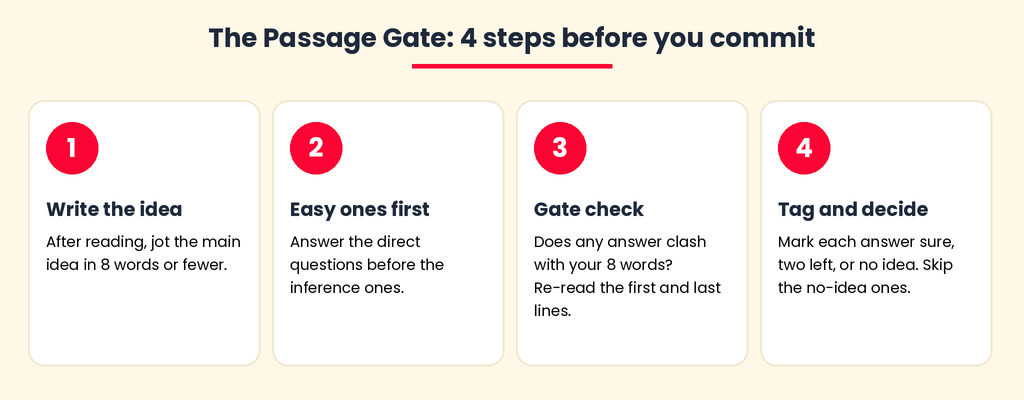
This is the routine I teach. It takes under a minute of extra effort per passage, and it protects the whole set.
- Write the idea. After reading, note the main idea in eight words or fewer. If you cannot, you have not understood the passage yet.
- Answer the easy questions first. Direct questions, such as meaning in context or a stated fact, come before inference and tone questions.
- Run the gate check. Does any answer clash with your eight words? If yes, re-read the first and last lines of the passage for 30 seconds. This one step catches many Misread Packs.
- Tag and decide. Mark each answer as sure, two left or no idea. Attempt the first two. Skip no-idea questions, or guess them at the end only if you have removed two options.
How should I apply this in each section?
| Section | Where wrong answers cluster | Gate check to use |
|---|---|---|
| English | Tone and author's purpose | Does my answer match the author's attitude in the last two lines? |
| Legal Reasoning | Applying the rule to the facts | Did I use only the rule given in the passage, not what I know of the law? |
| Logical Reasoning | Assumption, inference, strengthen and weaken | Did I mark S or W and find the conclusion first? |
| Current Affairs and GK | Options that sound right but are not in the passage | Is my answer in the passage, or only in my memory? |
| Quantitative Techniques | Data set misreads | Did I read the units and the question stem before calculating? |
How to audit your mock tests passage by passage
| Passage | Attempted | Wrong | Pack? (3 or more wrong) | Cause |
|---|---|---|---|---|
| Example: Legal 2 | 5 | 3 | Yes | Used outside law knowledge |
If a passage shows three or more wrong answers, treat it as a reading problem, not a knowledge problem, and write the cause next to it. Your target is not zero wrong answers. Your target is fewer packs from one mock to the next. For a full review framework, read How to Analyse CLAT Mocks Like a Topper.
A 50-day plan to protect your lead
Baseline audit
Take one full mock. Count wrong packs, not just wrong answers, and note the cause of each pack.
Learn the Passage Gate
Practise passages without a timer, using all four steps every time. Speed comes later. Accuracy first.
Add time and confidence tags
Time each passage at about one minute per question and tag every answer sure, two left or no idea. Check at week end: were your sure answers actually right?
Full mocks
Take a full mock every three days. Review packs first, then individual wrong answers. Your goal is fewer packs each time.
Light revision
Re-read your pack log, revise your top two causes and sleep well. Do not start new topics now.
The fix in one sentence
Do not try to fear negative marking less. Try to read the passage more carefully before you answer, because in CLAT a wrong reading does not cost one mark. It costs a pack.
“Your rank is rarely decided by what you did not know. It is decided by the passages you read wrongly and answered confidently.”
Manav Lawania, Founder, MEGA LAW & G.K.
Read next on MEGA LAW
- → CLAT Negative Marking Strategy 2027: The Attempt vs Accuracy Maths
- → The 5 Most Common Traps in CLAT Critical Reasoning (and How to Beat Each One)
- → How to Analyse CLAT Mocks Like a Topper: The Complete 2027 Framework
- → 60 Days Left for CLAT 2027: What to Do If You're Behind on Your Preparation
- → TITAN 2028: 15-Month CLAT 2028 Foundation Batch
Frequently asked questions
What is the negative marking in CLAT 2027?
How many marks will I lose for 10 wrong answers in CLAT?
Should I attempt a question when I am not sure?
How many questions should I attempt in CLAT 2027?
Why do I get so many wrong answers from the same passage?
What is the tie-breaker in CLAT?
Is it better to skip a whole passage?
How can I reduce negative marking in the next 50 days?

About the Author
Manav Lawania, India's Teens & Twenties Mentor. Founder of MEGA LAW & G.K. and UsefullBooks, Agra, Uttar Pradesh. Former Intelligence Officer, Cabinet Secretariat, Government of India. 15+ years of teaching experience and 4,000 to 5,000 students counselled for CLAT and AILET. Manav scored 13 out of 100 in Class 12 before rebuilding his own path, and that comeback is the lens he brings to every student he now mentors. He writes and teaches under the belief that CLAT preparation is as much about having the right data as it is about having the right mindset.