
How to Clear 10 Months of CLAT GK Backlog in 30 Days

The honest version upfront
I cannot promise you a GK score, and no plan can turn 10 months of news into mastery in 30 days. What this plan can do is get you through a first pass, so the last two weeks are for revision and not for panic.
- CLAT 2027 is on 6 December 2026, which is 46 days from today, 21 October. A 30-day catch-up still leaves 16 days to revise.
- Careers360 puts GK at 28 to 32 questions, about a quarter of the paper. NLTI says most questions come from the last 10 to 12 months.
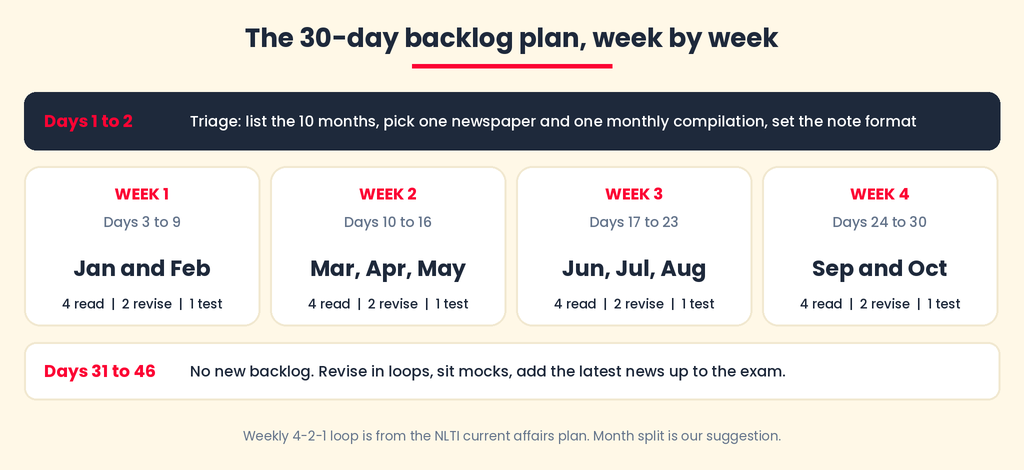
- The plan covers January to October in 16 reading days, using a weekly loop of 4 days reading, 2 days revision and 1 day testing.
- Read one newspaper and one monthly compilation. Skip random PDFs, exact figures and junior officials’ names.
- Judge the plan by recall, not by pages finished. If you cannot write the five biggest events of a month from memory, that month is not done.
A message I get a lot at this time of year goes like this: “Sir, I have not touched current affairs since January. I have 10 months of news behind me and no idea where to start.”
If that is you, the first thing to know is that you are not alone, and the second is that the problem is smaller than it looks. You do not need every news item from 10 months. You need the events that a passage-based exam can build a paragraph around, the people and institutions in them, and the reason each one matters.
Many students lose the whole month in guilt, or in collecting more PDFs. The better move is to decide a scope today, set a daily routine and start. In this post I will show you the maths of a 30-day catch-up, what to read and what to skip, a week-by-week plan and a way to check that it is working.
Can you really clear 10 months of GK backlog in 30 days?
Yes, if “clear” means a first pass over the important events with a note for each. No, if it means knowing everything. Here is the arithmetic.
| What you have | The number |
|---|---|
| Days until CLAT 2027 (6 December 2026) | 46 from 21 October |
| Days for the backlog | 30, then 16 days for revision and mocks |
| Setup days | 2 (days 1 and 2) |
| Days in four weeks of the 4-2-1 loop | 28: 16 reading, 8 revision, 4 testing |
| Months to read, January to October | 10, about 1.6 reading days for each month |
Why does this matter? Because GK is not a small section. It carries 28 to 32 questions out of 120. Hitbullseye reports 28 in CLAT 2026, with good attempts at 22 to 25. With a penalty of 0.25 per wrong answer, a student who knows the facts can gain a lot here, and a student who guesses can lose a lot. If you want the full penalty maths, read CLAT Negative Marking Strategy 2027.
One more point on scope. Most current affairs questions come from the previous 10 to 12 months, so January to October is the right core. If you have already read November and December 2025, good. If not, they come last, only if time remains. The news from November 2026 up to the exam goes in the final 16 days.
What should you read when you are 10 months behind?
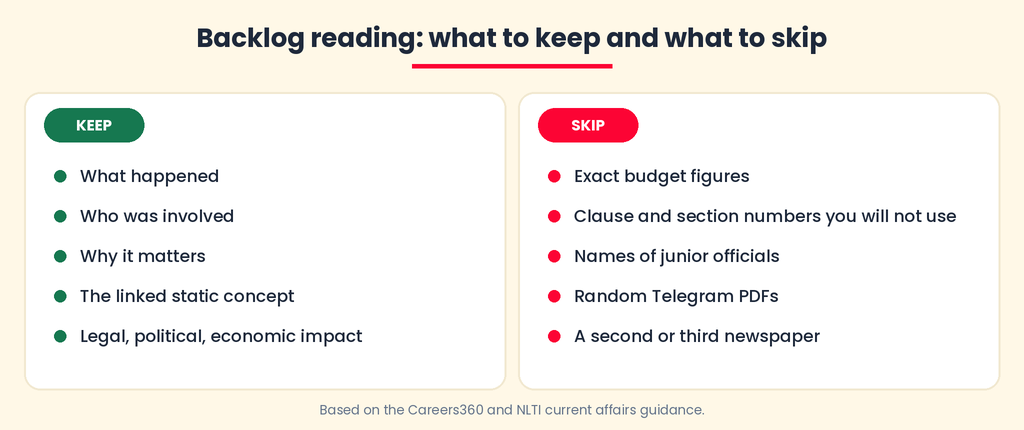
The answer is less than you think. The usual advice is one reliable newspaper and monthly CLAT-focused GK compilations, and to avoid random Telegram PDFs, UPSC-heavy compilations and multiple newspapers.
For a backlog, I would change one thing. Do not use the newspaper for the old months at all. A monthly compilation already filters ten months of news down to what an exam can ask. Use the newspaper only for the days from now onwards, so you keep up while you catch up.
- For the 10 old months: one monthly CLAT-focused compilation, read in the order of the months.
- For the days ahead: one newspaper, 20 to 30 minutes a day.
- For practice: questions based on passages, as in the paper, since GK comes as 4 to 6 passages and not as one-line facts.
If you want to know which topics are worth your limited hours, read CLAT GK Topics That Actually Appear.
The 5 rules for reading a GK backlog
Rule 1: Read by month, and finish a month before you start the next
Think in clusters and not in dates. Treat each month as one cluster. Events in the same month often connect, and connected events are far easier to remember than a long list of separate items.
Rule 2: Write three lines for every event
Focus on what happened, who was involved, why it matters, and the legal, political, economic or social impact. That is your note format. Three lines per event is enough, and it forces you to understand before you move on.
Rule 3: Link each event to one static idea
Static GK provides the base, and current affairs activate it. So when you read an event, attach it to the idea behind it. Try this one. The headline below is only an example, to show the method.
Try it: turn a headline into a note
Illustrative headline: “High Court strikes down a state rule as violating the right to equality.”
Note, in three lines. What: a court set aside a state rule. Static link: Article 14, equality before the law and equal protection of the laws. Why it matters: it shows that state action must meet the equality test, and a passage on this can ask about the principle behind the ruling, not only the case name.
Do this for each event, and your notes become a map of ideas instead of a list of dates.
Rule 4: Skip the fine detail
Skip exact budget figures, clause numbers and the names of junior officials unless they are directly relevant. In a backlog this rule saves you hours. Concept clarity beats rote memory, and your time is short.
Rule 5: Test your recall, do not re-read
Revision should be cyclic, with spaced repetition. For you, that means closing the compilation and writing the five biggest events of the month from memory, with the reason each matters. What you cannot write, you mark and revisit on the next revision day.
“A backlog is cleared by notes you can recall, not by pages you have turned.”
Manav Lawania, Founder, MEGA LAW & G.K.
A 30-day plan to clear your CLAT GK backlog
Day 1 here is 21 October. The weekly loop is four days of reading and notes, two days of revision and one day of testing. The month split and the daily hours are my suggestion, so change them if your schedule needs it. If you are behind in other sections too, read 60 Days Left for CLAT 2027.
Triage and setup
List the ten months. Pick one compilation and one newspaper. Fix your note format from Rule 2, and set a daily slot of about two hours: roughly 75 minutes of reading, 30 minutes of recall, and a few passage questions.
Week 1: January and February
Read four days, with about two days for each month. Revise on two days using your notes and recall. On the seventh day, take a short GK test and mark what you missed.
Week 2: March, April and May
The same loop, with three months in the four reading days, so keep your notes short. Spend the revision days on Week 1 as well as Week 2.
Week 3: June, July and August
The same loop again. By now your three-line habit should be fast. On the test day, include questions from the first two weeks too.
Week 4: September and October
Read the two freshest months and start adding the newspaper for the days since. On the last day, write the five biggest events of every month, January to October, from memory.
Revise, mock and add the latest news
No new backlog now. Revise in short loops, give priority to the months where recall was weakest, and read the newest news up to the exam. Review GK in every full mock. Do not start new sources in the last week.
Want a structured plan for the GK part of these 46 days? The MEGA GK Marathon 2027 is our 50-day GK and current affairs revision batch, with weekly live classes and live tests.
View Batch Details WhatsApp: +91 6397564795How do you know the plan is working?
Do not measure the plan by pages. Use three simple checks at the end of each week.
- Recall check: write the five biggest events of the month from memory, with one line on why each matters.
- Link check: pick three events and name the static idea behind each one.
- Test check: after each weekly test, sort wrong answers into two kinds: “never read it” and “read it but forgot it.” The first means your coverage has a gap. The second means you need more revision days.
If a week runs late, cut detail, not months. It is better to have rough notes on all ten months than perfect notes on six. For a structured way to review your mocks, read How to Analyse CLAT Mocks Like a Topper.
The fix in one sentence
Read one source, write three lines per event, link each event to one static idea, and test your recall every week. That will not make you perfect in 30 days, but it can turn a pile of unread news into a section you can attempt with confidence.
“Ten months of news looks like a mountain. In clusters of three lines, it is a month of steady work.”
Manav Lawania, Founder, MEGA LAW & G.K.
Want a mentor to run this plan with you?
Everything in this post works on your own. If you want a structured batch, mentors who are current NLU students and live practice, these are the options. Pick the one that matches where you are.
Want a mentor to run this plan with you?
Everything in this post works on your own. If you want a structured batch, mentors who are current NLU students and live practice, these are the options. Pick the one that matches where you are.
FULL CLAT AND AILET 2027 PREP
Shaurya Elite Plus
Our premium batch for CLAT and AILET 2027. Mentorship is part of the batch, in small groups of 10 students per mentor, and your mentors are current NLU students.
View Shaurya Elite PlusFOR THE 50 DAYS AFTER REGISTRATION
MEGA GK Marathon 2027
A 50-day GK and current affairs revision batch for the final stretch, with weekly live classes and live tests.
View Batch Details WhatsApp: +91 79836 67303IN CLASS 11?
TITAN 2028
Your attempt is CLAT 2028, not this one. TITAN is our 15-month foundation batch for CLAT, AILET and SLAT.
Learn about TITAN 2028See all courses · See our student results · CLAT QT Mastery Workbook for Quant
MEGA GK MARATHON 2027
50 days. 110+ CLAT-curated GK, Current Affairs, and Legal Affairs topics. Live classes, topic-wise quizzes, live mock tests, and discussion sessions. The structured programme that turns October starters into consistent 22 to 26 scorers on GK.
Read next on MEGA LAW
- → CLAT GK Topics That Actually Appear
- → Why October Is the Worst Time to Start GK Preparation for CLAT 2027
- → MEGA GK Marathon 2027: 50-Day GK and Current Affairs Revision Batch
- → How to Analyse CLAT Mocks Like a Topper: The Complete 2027 Framework
- → 60 Days Left for CLAT 2027: What to Do If You're Behind on Your Preparation
Frequently Asked Questions
How many GK questions come in CLAT 2027?
Can I really clear 10 months of GK backlog in 30 days?
How many months of current affairs should I cover for CLAT 2027?
How many hours a day do I need to clear a GK backlog?
Which sources should I use for the backlog?
How many GK questions should I attempt in CLAT?
Do I need to learn static GK too?
Will GK be removed from CLAT 2028?

About the Author
Manav Lawania, India's Teens & Twenties Mentor. Founder of MEGA LAW & G.K. and UsefullBooks, Agra, Uttar Pradesh. Former Intelligence Officer, Cabinet Secretariat, Government of India. 15+ years of teaching experience and 4,000 to 5,000 students counselled for CLAT and AILET. Manav scored 13 out of 100 in Class 12 before rebuilding his own path, and that comeback is the lens he brings to every student he now mentors. He writes and teaches under the belief that CLAT preparation is as much about having the right data as it is about having the right mindset.