
Is There Negative Marking in AILET 2027?

QUICK ANSWER
AILET deducts 0.25 marks for every wrong answer. There is no penalty for questions left unattempted. The exam has 150 multiple-choice questions across English Language, Current Affairs and General Knowledge, and Logical Reasoning, to be completed in 120 minutes. Unlike CLAT, AILET carries negative marking — accuracy matters as much as speed.
Every AILET aspirant asks some version of the same question by October: should I attempt every question, or play it safe? The honest answer has nothing to do with gut feeling about “risk” and everything to do with a fixed, calculable number. Most students who lose marks to negative marking are not bad guessers — they are good students who never worked out where the actual break-even point sits.
I have taught CLAT and AILET for 17 years and worked with over 4,000 to 5,000 students. Nearly every one of them has, at some point, either guessed too freely or left a gettable question blank purely out of fear of the 0.25 deduction. Both mistakes cost marks. This post gives you the exact numbers so neither mistake has to be yours.
“Negative marking does not punish guessing. It punishes guessing without elimination. Once you understand the difference, AILET’s marking scheme stops being something to fear and becomes something you can calculate around.”
— Manav Lawania, Founder, MEGA LAW & G.K.
AILET 2027 Marking Scheme — The Complete Numbers
| What | Value |
|---|---|
| Marks for a correct answer | +1 |
| Marks deducted for a wrong answer | −0.25 |
| Marks for an unattempted question | 0 (no penalty) |
| Total questions | 150 |
| Total marks | 150 |
| Duration | 120 minutes |
| Sections | English Language, Current Affairs & GK, Logical Reasoning |
There is no sectional cut-off and no sectional time limit in AILET — the 0.25 deduction applies uniformly across all three sections. This is different from some other entrance exams that vary the penalty section by section, so you don’t need to adjust your attempt strategy depending on which section you’re solving.
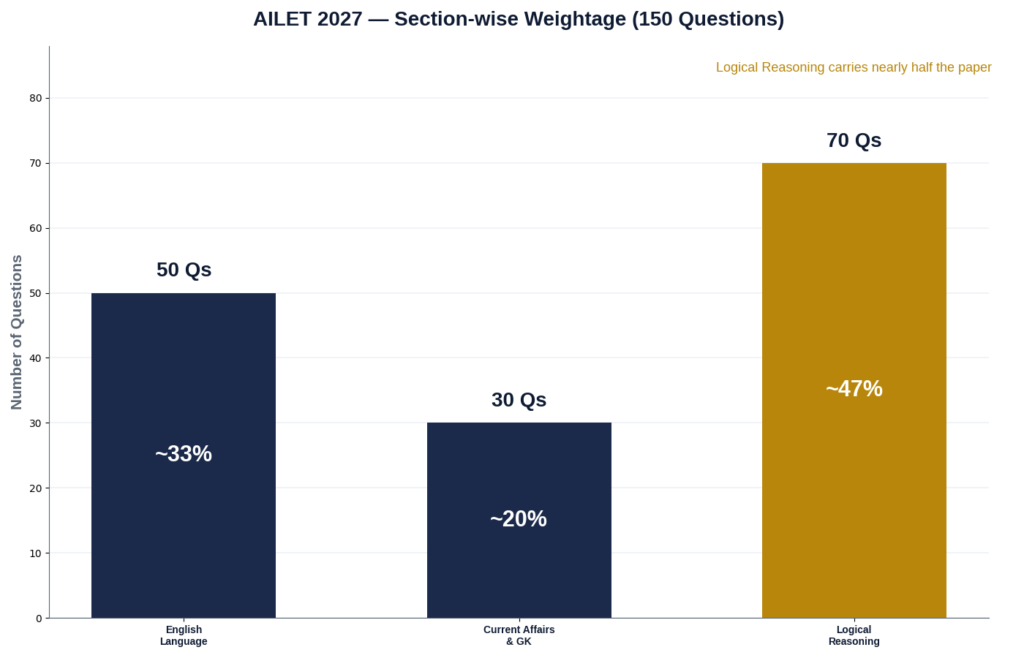
AILET Section-wise Weightage — Where Negative Marking Hits Hardest
| Section | No. of Questions | Approx. Weightage |
|---|---|---|
| English Language | 50 | ~33% |
| Current Affairs & GK | 30 | ~20% |
| Logical Reasoning | 70 | ~47% |
Because Logical Reasoning carries nearly half the paper, careless negative-marking losses here have the largest impact on your final AIR — a string of guessed-and-wrong Logical Reasoning answers costs proportionally more than the same number of wrong answers in Current Affairs & GK, simply because there are more Logical Reasoning questions to lose. Full section-wise syllabus detail is in our AILET Exam 2027 guide.
Is There Negative Marking in AILET — The Short Version
Yes. AILET has carried a uniform 0.25 negative marking per wrong answer since its inception, and NLU Delhi has given no indication this will change for the 2027 cycle. Every correct answer adds 1 mark. Every incorrect answer subtracts 0.25 marks. Leaving a question blank subtracts nothing. This structure is exactly why AILET rewards accuracy over blind attempt volume — a distinction that students moving over from exams without negative marking sometimes miss.
What Happens If You Skip a Question in AILET
Skipping costs you only the 1 mark you could have earned — nothing more. There is no additional penalty for an unattempted question beyond the opportunity cost of not scoring on it. This matters because it changes the actual decision at every question: it is never “attempt vs. play safe.” It is always “is my chance of being right high enough that the expected gain outweighs the expected loss.”
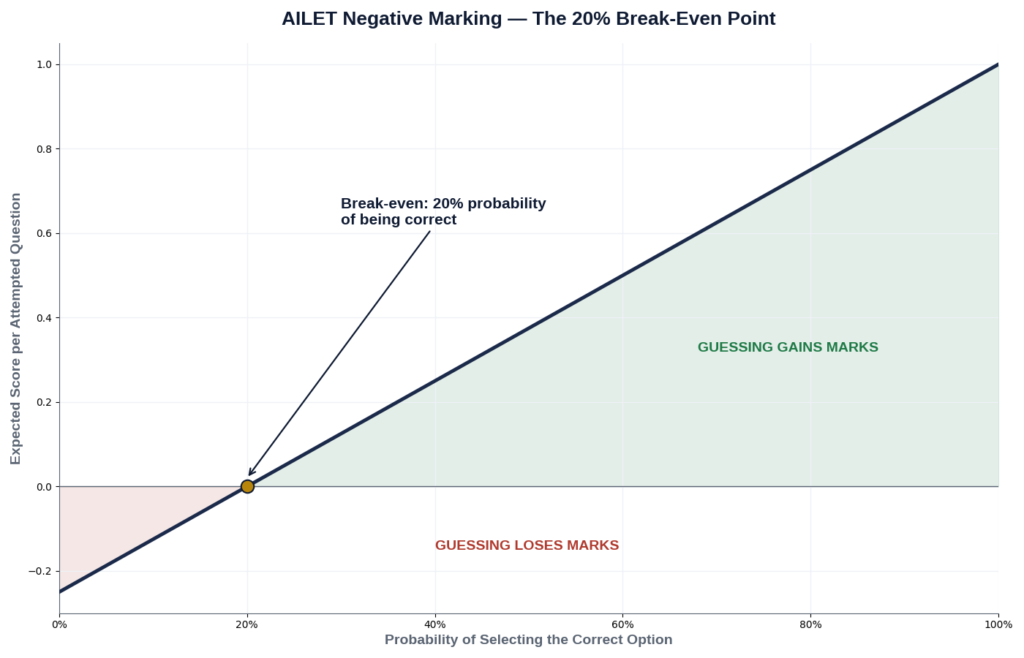
The Break-Even Number Every AILET Aspirant Should Know
Here is the calculation in full. If you attempt a question with probability p of being correct, your expected score is (p × 1) + ((1 − p) × −0.25). At p = 0.20 (20% chance): (0.2 × 1) + (0.8 × −0.25) = 0.2 − 0.2 = 0 — exactly break-even.
Below 20% probability, guessing loses you marks on average. Above it, guessing gains you marks on average — even though you will still get plenty of individual questions wrong. The practical rule this produces: if you can eliminate even one option from AILET’s four choices, your odds rise above 25%, comfortably clearing the 20% break-even. In a passage-based section like English or Current Affairs & GK, you can almost always eliminate at least one option using context. In Logical Reasoning, elimination is usually even easier, because wrong options frequently contain a flaw you can spot directly.
Blind guessing with zero elimination technically still clears break-even at 25% odds — but treat it as a last resort, not a strategy.
Is AILET Harder Than CLAT Because of Negative Marking
No — the negative marking is identical. CLAT also deducts 0.25 marks per wrong answer, so the marking scheme itself doesn’t make one exam harder. What differs is the structure around it: AILET packs 150 questions into 120 minutes against CLAT’s 120 questions in 2 hours, and AILET is nearly half Logical Reasoning while CLAT spreads its 120 questions across five sections. Compare both patterns in our CLAT Exam 2027 guide. The real difficulty difference is time pressure, not marking — AILET gives you under 48 seconds per question on average.
How to Handle Negative Marking in AILET — A Practical Attempt Strategy
- Attempt anything where you can eliminate at least one option.This alone puts you above the 20% break-even in almost every case.
- Don’t confuse “unfamiliar” with “unanswerable.”Read all four options before deciding to skip — one is often clearly wrong.
- Flag genuine zero-context questions and move on.With no basis to eliminate anything, skipping beats a blind guess. This is the one case where skipping is clearly correct.
- Practise on real AILET-pattern mocks, not CLAT mocks.Logical Reasoning at nearly half the paper needs section-specific timed practice.
- Track negative-marking losses separately in every mock.Knowing what you lost to wrong answers versus blanks tells you whether to attempt more or fewer questions next time.
Frequently Asked Questions
Is there negative marking in AILET?
Yes. AILET deducts 0.25 marks for every wrong answer, and this has been the marking scheme since the exam's inception. There is no penalty for questions left unattempted, and no sectional variation — the same 0.25 deduction applies across English Language, Current Affairs & GK, and Logical Reasoning.
What happens if I skip a question in AILET?
Nothing is deducted. Skipping a question only costs you the 1 mark you might have earned by attempting it correctly — there is no additional negative marking for leaving a question blank.
Is AILET harder than CLAT because of negative marking?
No. Both exams deduct exactly 0.25 marks per wrong answer, so the marking scheme itself is identical. Any difference in difficulty comes from AILET's tighter time-per-question ratio (150 questions in 120 minutes) and its heavier weightage toward Logical Reasoning, not from the negative marking rule.
How should I handle negative marking in AILET?
Attempt any question where you can eliminate at least one of the four options — this raises your odds above the 20% mathematical break-even point where guessing stops costing marks on average. Only skip questions where you have zero basis to eliminate any option.
What is the break-even accuracy for guessing in AILET?
20 percent. At exactly 20% probability of being correct, the expected gain from a correct guess (+1 mark) and the expected loss from an incorrect one (−0.25 mark, weighted by the 80% chance of being wrong) cancel out. Any elimination that raises your odds above 20% makes attempting the mathematically better decision.

About the Author
Manav Lawania, India's Teens & Twenties Mentor. Founder of MEGA LAW & G.K. and UsefullBooks, Agra, Uttar Pradesh. Former Intelligence Officer, Cabinet Secretariat, Government of India. 17 years of teaching experience and 4,000 to 5,000 students counselled for CLAT and AILET. Manav scored 13 out of 100 in Class 12 before rebuilding his own path, and that comeback is the lens he brings to every student he now mentors. He writes and teaches under the belief that CLAT preparation is as much about having the right data as it is about having the right mindset.